Pacific Community: Flag, History and Membership
The Pacific community, SPC for short, uses a sign of stars, sails, waves and a palm tree on a blue background. It refers to the connections of the island world and scientific cooperation. The organization counts 27 countries and territories as members. Only 17 of them are in the independent country directory of this quiz; the differing figures describe different categories.
Test your knowledge →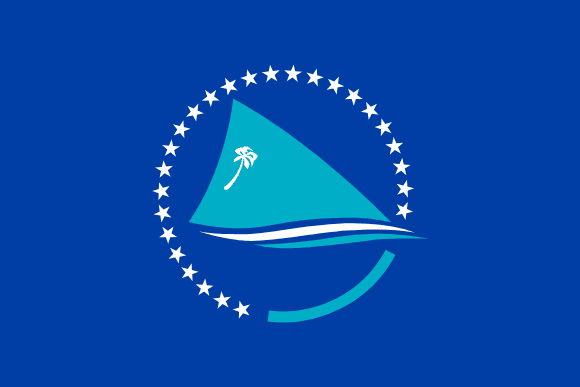
Key facts and distinctions
- Article focus
- International organisation
- Membership record
- 1 November 2026
- Linked country entries
- 17
- List definition
- Country subset of the supplied member record
- Name of name
- Pacific Community/Pacific Community
- Abbreviation
- SPC
- Founded
- 1947
- Establishment basis
- The Canberra Agreement
- Current members
- 27 Countries and territories
- Of which in the country quiz
- 17 countries
- Pacific island countries and territories
- 22
- Renaming
- 1997
- General use of today's name
- Since 2015
Stars, sails and the connection of the ocean
The flag shown bears the bright SPC sign on a dark blue background. A star arc surrounds a stylized sailboat with palm and two wave forms. The official statement assigns the stars to the 27 members. The curved beam that complements the circle of stars symbolizes the community as a connection between its various parts.
The sail and the two waves stand for oceanic connectedness, unity and exchange. Dark blue denotes the ocean, turquoise the promise of the future of youth. The central motif is a racing canoe with a coconut palm, the so-called tree of life in the Pacific. The visual language thus describes living space, mobility and common perspectives, instead of juxtaposing individual national coats of arms.
From the South Pacific Commission to the Pacific Community
In 1947, Australia, France, New Zealand, the Netherlands, the United Kingdom and the United States established the then South Pacific Commission on the basis of the Canberra Agreement. These governments administered territories in the Pacific at that time. The colonial context of its origins is part of the history of the organization and differs significantly from its current self-description as a member-supported development institution.
With the independence and self-management of island companies, membership changed. Samoa became the first independent Pacific island member in 1965.In 1983, all 22 Pacific countries and territories were given equal voting and contribution rights.In 1997, the name was renamed Pacific Community; since 2015, this legal name has been commonly used, while the well-known abbreviation SPC has been preserved.
27 members are not 27 independent states
The current official list includes 27 members: 22 Pacific island countries and territories, as well as Australia, France, New Zealand, the United Kingdom and the United States. Self-governing states in free association, such as the Cook Islands and Niue, as well as various dependent territories, are independent members. So the organization does not count exclusively sovereign states according to the usual UN list of states.
The SPC is a scientific and technical development organization. Her work combines ocean, climate, land, culture and the well-being of the population. It can be distinguished from the Pacific Islands Forum. Membership in a Pacific association does not allow for an automatic conclusion about belonging to the other, even if many countries and issues involved overlap.
Details Worth Remembering
Why 27 and 17 go together
The 27 are all independent members of the organization. The 17 result from the limited independent land stock of this quiz. The remaining ten do not disappear from the SPC: they are registered as additional members with their respective status. Especially in the case of regional organizations, the definition of the numbered unit is crucial.
Same voice despite different status
The 1983 decision recognized the Pacific countries and territories as full voting and contributing members. Their different constitutional relations have not been annulled. Rather, the SPC shows how a technical regional organization can enable equal institutional participation without making independent nation states out of all participants.
An abbreviation survives the renaming
SPC comes from South Pacific Commission. Today’s name Pacific Community reflects the wider Pacific reach and changing role of members. The abbreviation retained is therefore a piece of organizational history. Anyone who only compares today's initial letters could otherwise mistakenly suspect various institutions behind old and new names.
The illustrated signs and variants
Countries in the supplied learning record
These links cover countries represented in this site’s country database. Any territories, regional governments, observer categories or participation qualifications are discussed above. Counts are not interchangeable.
 AustraliaCanberra
 FijiSuva
 FranceParis
 KiribatiSouth Tarawa
 Marshall IslandsMajuro
 Federated States of MicronesiaPalikir
 NauruYaren District
 New ZealandWellington
 PalauNgerulmud
 Papua New GuineaPort Moresby
 SamoaApia
 Solomon IslandsHoniara
 TongaNuku'alofa
 TuvaluFunafuti
 United KingdomLondon
 United StatesWashington, D.C.
 VanuatuPort Vila
Continue exploring
 United Nations
 European Union
 NATO
 Commonwealth of Nations
 African Union
 Arab League
What did you discover?
Take this flag into the quiz
Sources and image credits
This English article draws on the institutional sources listed below. Figures and memberships retain their stated reference dates.
Source record: 2 November 2026. A translation does not change the reference date of a figure or membership list.
- spc.global.ssl.fastly.net/about-us/history
- spc.global.ssl.fastly.net/our-members
- spc.global.ssl.fastly.net/media
- spc.global.ssl.fastly.net/about-us
- spc.int/digitallibrary/get/4pzpp