United Kingdom Flag, Capital and Country Facts
The United Kingdom comprises England, Scotland, Wales and Northern Ireland. Great Britain is the island containing the first three of these constituent parts. That distinction helps when reading maps and understanding the flag: the Union Jack brings historic crosses together in a deliberately asymmetric design.
Test your knowledge →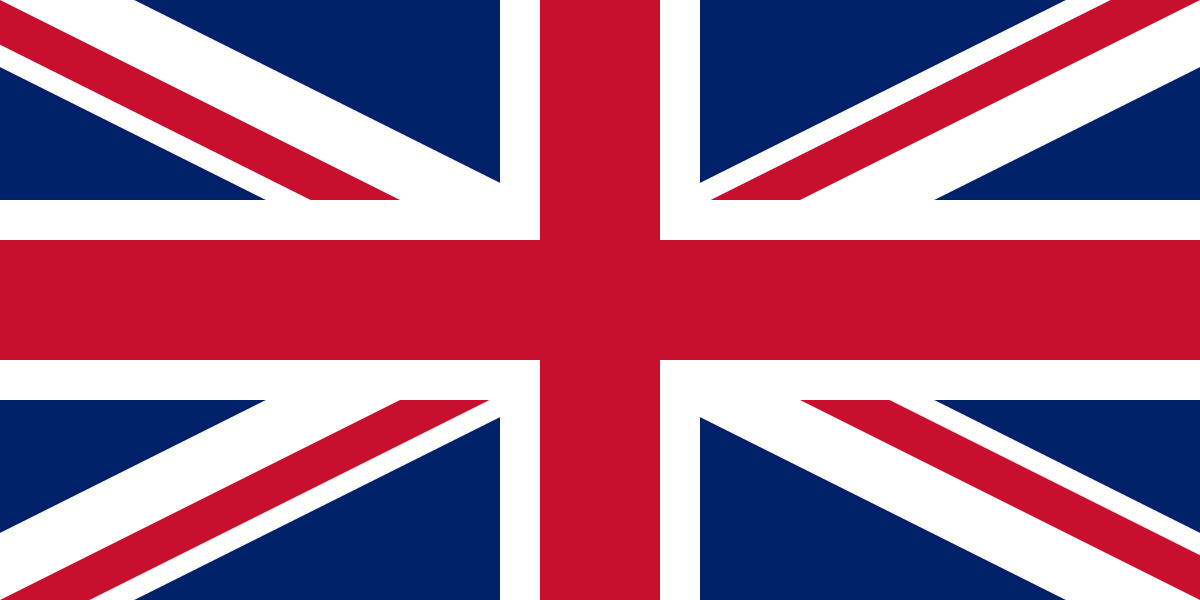
United Kingdom at a glance
- Capital
- London
- Quiz continent
- Europe
- Languages in reference record
- English is predominant; regional among others Welsh, Scottish Gaelic and Irish
- Currency
- Pound Sterling (GBP)
- Population
- 69,487,000 (2025, World Bank)
- Area
- 242,900 km²
- Coastal setting
- Not landlocked
- ISO codes
- GB / GBR
- Internet country suffix
- .uk
- Highest mountain
- Ben Nevis, 1,345 m
- River through London
- Thames
- Four parts of the country
- England, Scotland, Wales and Northern Ireland
- Scottish capital
- Edinburgh,
- Prehistoric site
- Stonehenge
- Connection with the continent
- Eurotunnel under the English Channel
United Kingdom Flag: Design, Meaning and History
The flag shows on a blue background the red, white bordered straight cross of St. George. In addition, there is a white diagonal cross and a narrower red diagonal cross with white borders. The diagonal red stripes are not everywhere exactly central in the white. The pattern should therefore not be considered as a freely interchangeable collection of symmetrical crosses.
The George Cross stands for England, the white St. Andrew’s Cross for Scotland and the red Patrick’s Cross for Ireland. The current combination was created with the Union of 1801. Wales does not have an additional cross of its own. The common names Union Flag and Union Jack mean the same basic national motif, which has also greatly influenced other flags.
Capital: London
London is located in the south-east of England on the Thames. The capital is the seat of government and parliament and at the same time a large economic and cultural metropolis. The river connects the city with the North Sea. This situation explains part of its development as a trading centre, but is not enough on its own to describe its growing political importance.
Westminster with Parliament and Abbey is a UNESCO World Heritage Site. Other London World Heritage sites include the Tower, Maritime Greenwich and Kew Botanical Gardens. The different places stand for domination, religion, shipping and science. It is precisely this diversity that shows that a capital city is not only characterised by a single palace or a single administrative district.
Practise this capital →United Kingdom: Geography, History and Culture
The island of Great Britain ranges from the Scottish Highlands to deeper and more densely populated areas of England. Many coasts are strongly divided; the Atlantic, the North Sea and the Irish Sea form different maritime spaces. Northern Ireland is located on the island of Ireland and has a land border with the Republic of Ireland. It is an independent state and not part of the United Kingdom.
English dominates, but regional languages are important for culture and public identity. Welsh, Scottish Gaelic and Irish each have their own distribution areas and legal connections. Likewise, the parts of the country have their own historical centers. Edinburgh’s Old and New Towns are on the World Heritage List, making it clear that London is not the only major urban reference point in the country.
History includes prehistoric monuments as well as the Industrial Revolution. Stonehenge and Avebury point to very early cultural landscapes; Ironbridge Gorge stands for a much later economic upheaval. The comparison extends the country’s image beyond the royal house and the capital. At the same time, it shows how archaeological, technical and urban evidence can make different epochs vivid.
Great Britain and the Kingdom
Great Britain is an island, the United Kingdom a state with four parts. Northern Ireland belongs to the state, but is on another island.
Industry as World Heritage
Ironbridge Gorge and several other British sites document industrial history. World Heritage also includes technical facilities and the landscapes they characterize.
A Flag of Crosses
The three signs of the cross explain the Union Jack. Especially the offset diagonal stripes are a detail that stands out when viewed closely.
Explore neighbouring and related places
 Ireland
What did you discover?
Sources and image credits
This English article draws on the institutional sources listed below. Figures and memberships retain their stated reference dates.
Source record: 2 November 2026. A translation does not change the reference date of a figure or membership list.
- github.com/factbook/factbook.json/blob/144d6977b2b01ac1cbd220de754c0a005616760b/europe/uk.json
- data.worldbank.org/indicator/SP.POP.TOTL
- whc.unesco.org/en/statesparties/gb
- github.com/mledoze/countries