Fiji Flag, Capital and Country Facts
Fiji is an island nation in the South Pacific, whose habitats range from mountainous main islands to small coral islands. Viti Levu and Vanua Levu are important geographical reference points. The capital Suva is located on Viti Levu; the former capital Levuka on Ovalau, on the other hand, reminds of a different phase of port and colonial history.
Test your knowledge →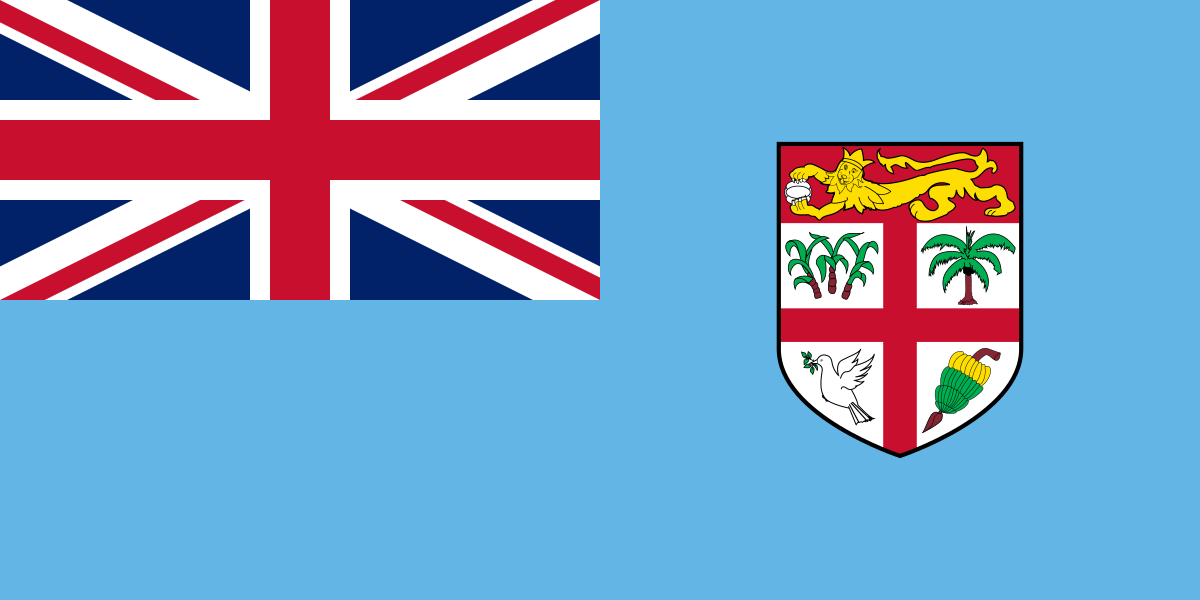
Fiji at a glance
- Capital
- Suva
- Quiz continent
- Oceania
- Languages in reference record
- English, iTaukei and Fiji Hindi
- Currency
- Fiji dollar (FJD)
- Population
- 933,154 (2025, World Bank)
- Area
- 18,272 km²
- Coastal setting
- Not landlocked
- ISO codes
- FJ / FJI
- Internet country suffix
- .fj
- Main island of the capital
- Viti Levu
- Other main island
- Vanua Levu
- Highest mountain
- Tomanivi, 1,324 m
- Former capital
- Levuka
- Island of Levuka
- Ovalau
- Independence
- 10 October 1970
Fiji Flag: Design, Meaning and History
The flag has a light blue background. On the top left is the British Union Jack, on the right half of Fiji's coat of arms. A red cross divides the shield; above it appears a lion with a coconut. The lower fields show, among others, sugar cane, a palm tree, bananas and a white pigeon.
The light blue is associated with the Pacific Ocean. The Union Jack refers to British colonial history, while the plants in the coat of arms allude to important agricultural products. The flag thus combines an adopted historical sign language with concrete references to the islands and their economy; it is not a pure sea flag.
Capital: Suva
Suva is located in the southeast of Viti Levus and is the political center of the country. The location on the largest main island must not be confused with its own island name: Suva is the city, Viti Levu its island. The port location combines capital functions with transport and trade relations within the widely scattered archipelago.
Before Suva, Levuka was the capital. The historic port is located on Ovalau and belongs to the UNESCO World Heritage. The comparison of both cities makes the capital change spatially comprehensible: State functions shifted between different islands. Levuka preserves an urban testimony of the early colonial port development, instead of exercising the role of capital today.
Practise this capital →Fiji: Geography, History and Culture
Many islands are of volcanic origin and have mountainous interiors. The Tomanivi on Viti Levu reaches 1,324 meters. The coasts and offshore reefs form different habitats than the forested heights. Therefore, Fiji cannot be adequately described either as a flat sand island or as a single contiguous mountain country.
Distances between islands make maritime and air transport particularly important. An archipelago has different spatial connections than an equally large contiguous state: water separates settlements, but at the same time provides transport routes. The tropical-maritime climate is influenced by the ocean, with local differences between wind-facing and protected areas.
iTaukei, English and Fiji Hindi reflect different historical contexts. One of the formative developments is the immigration of contract workers of Indian origin during the colonial period. Language and family history are therefore important parts of today’s cultural spectrum. Fiji became independent from Britain on October 10, 1970; the National Day commemorates this date.
Levuka as a World Heritage Site
The historic port town preserves a special connection between local settlement and colonial urban development. Its World Heritage status makes it clear that Fiji’s history can not only be told about beaches and reefs; port facilities and older urban structures are also part of it.
The largest island as an orientation
Viti Levu carries both the capital Suva and the highest mountain Tomanivi. Whoever assigns these two points to the same island gains a useful starting point before the other island groups and smaller islands of the state are added.
Coats of arms with crops
Sugar cane and bananas in the sign are concrete references to agriculture. Together with the palm tree and the lion, they show how a small flag coat of arms can connect several economic and historical themes in a confined space.
Explore neighbouring and related places
 Australia
 Federated States of Micronesia
 Kiribati
 Marshall Islands
 Nauru
 New Zealand
What did you discover?
Sources and image credits
This English article draws on the institutional sources listed below. Figures and memberships retain their stated reference dates.
Source record: 2 November 2026. A translation does not change the reference date of a figure or membership list.
- github.com/factbook/factbook.json/blob/144d6977b2b01ac1cbd220de754c0a005616760b/australia-oceania/fj.json
- data.worldbank.org/indicator/SP.POP.TOTL
- whc.unesco.org/en/statesparties/fj/
- github.com/mledoze/countries