South Africa's former flag
The former South African flag combined orange, white and blue stripes with three small historical flags. The basic pattern was introduced in 1928 and replaced in 1994. Here appears the brighter blue variant from 1982 to 1994. Their history leads to colonial rule, political compromises within the white minority and the exclusion of the black majority during apartheid.
Test your knowledge →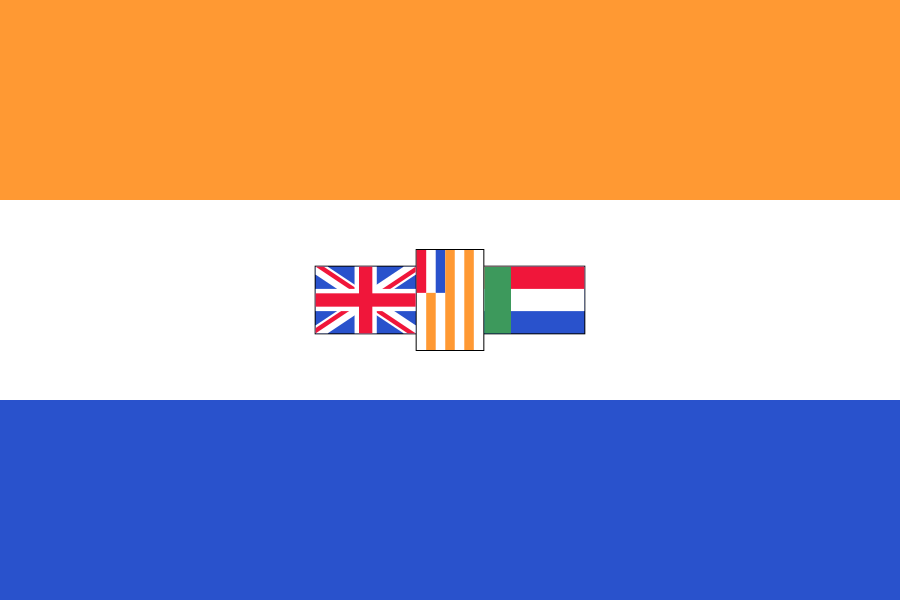
Key facts and distinctions
- Article focus
- Historical flag variants
- Date convention
- Periods describe the illustrated variant
- Scope
- Selected designs; no Nazi flags or symbols
- Variant shown
- Brighter Blue, 1982–1994
- Basic design
- 31 May 1928 to 26 April 1994
- Strips
- Orange, white, blue
- Small flags
- Union Jack, Orange Free State, Transvaal
- Small medium flag
- Flag of Orange Free State displayed vertically
- Political context
- Colonial Heritage and Apartheid
- Successor used for the first time
- 27 April 1994
- Designer of the successor
- Fred Brownell
Three small flags in the white stripe
The large stripes are horizontal: orange above, white in the middle and blue below. In the white field are three small flags next to each other. At the mast is the Union Jack, in the middle the flag of the Orange Free State hangs vertically, and on the outside follows the quadricle of the former South African Republic, often called Transvaal. Thus, a single national flag contains several older state signs.
This structure can be read as a political picture of history. British and Boer traditions were given visible places, while the symbols of the black majority of the population were missing. The small flags were therefore by no means a complete representation of all the people of the country. The older Dutch tradition of orange, white and blue is also related to European settlement and colonial rule on the Cape.
1928 as the beginning, 1982 as a variant indication
The official use of the basic design began on May 31, 1928. The date 1982 in this collection denotes a later lighter blue version and no new founding of the state. Anyone who only sees the years indicated here should therefore distinguish between the lifetime of the pattern and the documented color variant. Old fabrics, photographs and digital reconstructions can also show different hues.
The flag survived the transition from the Union to the Republic in 1961. However, their political significance cannot be derived solely from such constitutional data. It became a widely recognizable sign of a state whose apartheid laws separated people according to racist categories, distributed rights unequally and excluded the black majority from equal political participation.
1994 and the Break with Apartheid
On April 27, 1994, the new South African flag was first used. This was also the beginning of the first general democratic elections in the country. The successor, designed by Fred Brownell, combines various elements of flag history in a new design. The convergence of its forms is intended to express the path of different parts of society towards a common future.
The old flag remains a subject of historical research and social debate. Courts have explicitly treated their meaning as a symbol of racist oppression. An exhibition or an explanatory learning page must therefore make the connection with apartheid visible. The mere description of colours and proportions would not do justice to the experiences of those who suffered under this rule.
Details Worth Remembering
A flag of several flags
The three small signs make the design particularly easy to recognize. Their selection also tells which historical communities preferred the state’s self-expression at that time. A flag can show political agreement among certain groups while concealing the exclusion of other groups.
Color is also history
An altered shade of blue makes the basic pattern appear almost unchanged. Nevertheless, the variant deserves an exact dating. The year 1982 refers here to the picture shown; it sets neither the beginning of apartheid nor the first use of the orange-white-blue national flag.
A Democratic Cut
The change of 1994 combines flagging with the history of political rights. The new flag appeared at a time when the basis of state affiliation changed. Therefore, their relationship to the predecessor is more than a question of different graphic design.
The illustrated signs and variants
Continue exploring
What did you discover?
Take this flag into the quiz
Sources and image credits
This English article draws on the institutional sources listed below. Figures and memberships retain their stated reference dates.
Source record: 2 November 2026. A translation does not change the reference date of a figure or membership list.
- gov.za/about-sa/national-flag-0
- www3.saflii.org/za/cases/ZASCA/2023/58.html
- sahrc.org.za/index.php/sahrc-media/news/item/2097-the-flag-of-hate-is-lowered
- savaflags.org.za/spec/South%20Africa%20-%20National%201928-1994%20-%20sheet%201.pdf