Austria-Hungary's merchant ensign
The common trade flag between Austria and Hungary looks as if two flags have been sewn together. It is precisely this connection that makes its political background visible. Since 1869, it united Austrian and Hungarian elements for merchant shipping. However, it was not a general national flag of all the people and countries of the dual monarchy. Its proper designation is therefore directly part of its historical explanation.
Test your knowledge →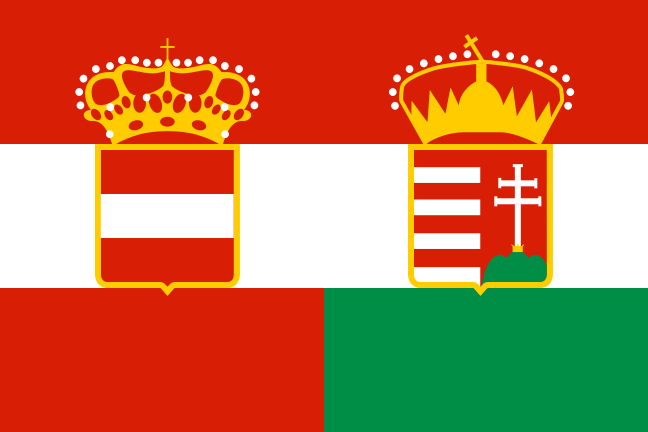
Key facts and distinctions
- Article focus
- Historical flag variants
- Date convention
- Periods describe the illustrated variant
- Scope
- Selected designs; no Nazi flags or symbols
- Use of the template
- 1869–1918
- Introduction to use
- 1 August 1869
- State compensation
- 1867
- Function
- Common commercial flag
- Further use
- Consular flag
- Upper and intermediate track
- Red and white
- Lower track
- Red and Green Shared
- Crested coats
- Austrian Binding Shield and Hungarian Coat of Arms
Two coats of arms and a divided lower path
The upper path is red, the middle one white. Below are the red and green side by side. In the white area there are two crowned coat of arms: the Austrian pad and the Hungarian coat of arms. This results in a common picture in which both halves of the Reich remain explicitly recognizable. A simple naming of three continuous color strips would miss the design.
The Army History Museum dates the use of the new trade flag to 1 August 1869. It was used for merchant ships and as a consulate flag. The span shown here ends in 1918 with the collapse of the dual monarchy. The date 1869 thus denotes the flag pattern and its introduction, while the state compensation with Hungary had already been made in 1867.
What Changed the 1867 Compensation
The settlement created the Austrian-Hungarian dual monarchy with an Austrian and a Hungarian half. The common dynasty and certain common affairs connected them. At the same time, there were different institutions and political traditions. The trade flag translates this structure into a clearly visible graphic combination of two coats of arms and their respective colors.
The Habsburg representation of the Austrian Parliament and the world of the Habsburgs describe this new order as the result of negotiations. It was not a simple merger into a single nation-state. Many populations lived within the monarchy. Therefore, the flag is not a complete pictorial list of all its languages, regions or political interests. Above all, it shows the state division.
Commercial shipping and later remembrance
A trade flag denoted the state affiliation of ships in civil traffic. Their task is different from that of a ruler banner or a flag of the Kriegsmarine. For a historical portscape, this distinction is especially useful: different flags do not have to mean an error there, but can indicate different functions within the same monarchy.
The collection of the MAK preserves an advertising brand with the trade flag issued during the First World War. This small print object shows that maritime state symbols were also distributed outside the port. It proves a contemporary use in utility graphics. From such a presentation, however, one must not conclude that the trade flag has legally become the only national flag of the entire monarchy.
Details Worth Remembering
A composite cloth
The lower orbit breaks the expectation of an ordinary horizontal tricolor. It is precisely there that the merging becomes visible. Anyone who first examines the structure of the cloth and then looks at the coats of arms can understand the common design without knowing heraldic details by heart.
An object as a testimony
An advertising brand is not an official flag ordinance. As a preserved object, however, it shows how a sign should be represented and recognized in everyday life. Museum collection and legal introduction thus answer different questions that complement each other in historical research.
Several countries after 1918
The end of the dual monarchy led to several states and territorial changes. The historical trade flag cannot therefore be assigned exclusively to a current national flag. Austria and Hungary are central to the design, but do not represent the entire successor landscape of the former multi-ethnic empire.
The illustrated signs and variants
Continue exploring
What did you discover?
Take this flag into the quiz
Sources and image credits
This English article draws on the institutional sources listed below. Figures and memberships retain their stated reference dates.
Source record: 2 November 2026. A translation does not change the reference date of a figure or membership list.
- hgm.at/fileadmin/hgm/2024/HGM/pdf/HGM-JaBe2023-FINAL_28.08.2024_Poglayen.pdf
- habsburger.net/de/kapitel/zwei-reichshaelften-der-ausgleich-mit-ungarn
- parlament.gv.at/verstehen/historisches/1848-1918/abschied-kaiserreich/index.html
- sammlung.mak.at/de/collect/werbemarke-der-offiziellen-kriegsfuersorge-flagge-oesterreich-ungarn-handelsflagge-oesterreich-ungarn_353482