Yugoslavia and Serbia and Montenegro
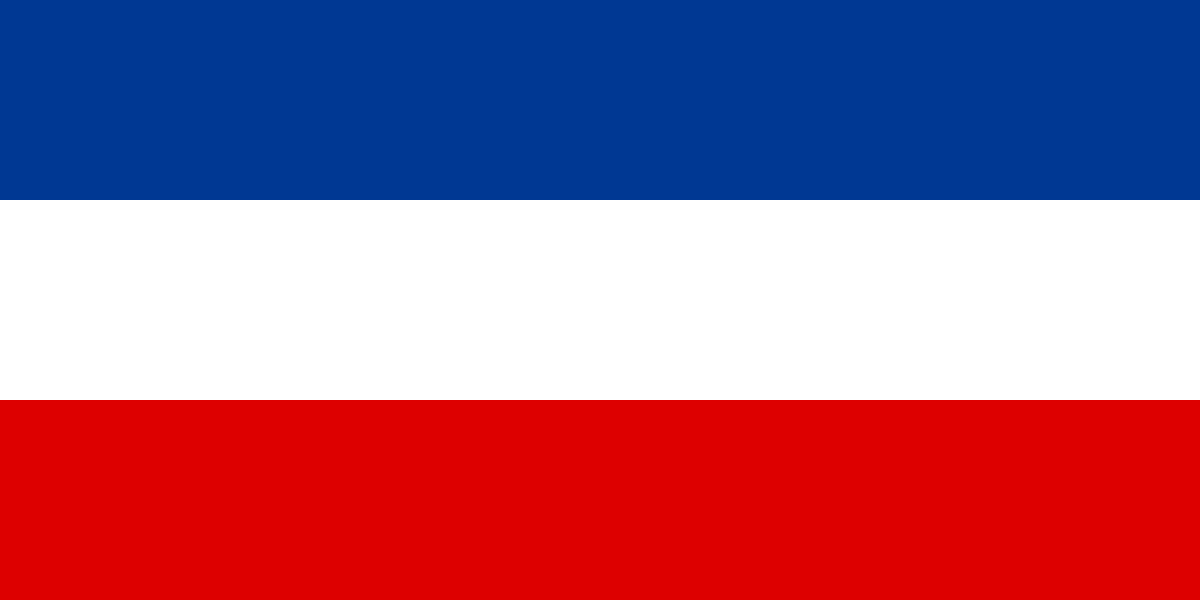
A blue-white-red tricolor connects two different phases of southeastern European history. In socialist Yugoslavia, a golden red star stood in the middle. From 1992 it was missing. The second flag belonged first to the Federal Republic of Yugoslavia and later to the State Union of Serbia and Montenegro. Here, therefore, the same stripes do not mean an unchanged political order or constant state borders.
Test your knowledge →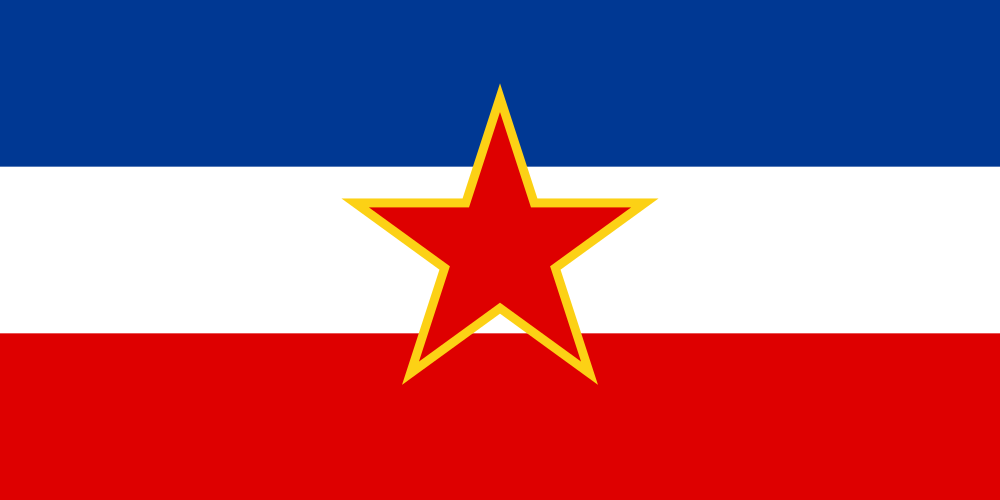
Key facts and distinctions
- Article focus
- Historical flag variants
- Date convention
- Periods describe the illustrated variant
- Scope
- Selected designs; no Nazi flags or symbols
- Common color sequence
- Blue–White–Red
- Socialist Variant
- 1946–1992
- Additional characters
- Red star bordered by gold
- Relationship of the socialist flag
- 1:2
- Former Federation
- Six Republics
- Starless variant
- 1992–2006
- Name of Serbia and Montenegro
- Since 4 February 2003
- Independence of Montenegro
- 3 June 2006
The Socialist Federal Flag 1946–1992
The three equally high stripes run horizontally: blue above, white in the middle and red below. The large red star overlaps the middle surface and has a yellow or gold bezel. The Archives of Yugoslavia explains that the post-war republic adopted the previous color order and supplemented the star as a political sign.
The embodiment shown is assigned to the period 1946 to 1992. The 1946 constitution gave it the ratio of one to two. The state consisted of six republics: Bosnia and Herzegovina, Croatia, Macedonia, Montenegro, Serbia and Slovenia. The common flag cloth represented this federal level and must not be retroactively declared an exclusively Serbian symbol.
The Tricolor Without Star 1992–2006
The second representation shows the same stripes without the central sign. From 1992 it belongs to the Federal Republic of Yugoslavia, which only included Serbia and Montenegro. The name Yugoslavia therefore denotes states with different compositions in different decades. A historical caption needs more than the mere state name if it is to avoid misunderstandings.
On February 4, 2003, the official designation changed in Serbia and Montenegro. The common flag design was retained. The range used in the stock 1992 to 2006 thus comprises two consecutive forms of state law. The State Union of 2003 was not a continuation of the former six-republic state with unchanged membership; its composition was much smaller.
Several successor states instead of a simple line
The United Nations describes the disintegration of the former socialist Yugoslavia on the basis of several new members. Slovenia, Croatia and Bosnia and Herzegovina were incorporated in 1992, today's North Macedonia in 1993. The Federal Republic of Yugoslavia was not accepted as a member until 2000. This chronology prevents different state formations from being drawn together under one flag unnoticed.
Following the referendum in May 2006, Montenegro declared its independence on 3 June. Serbia continued the UN membership of the State Union; Montenegro was admitted on 28 June 2006. However, this particular succession of membership does not make Serbia the only successor state to the whole of former Yugoslavia. For the quiz, the end of the common tricolor is therefore a transition to two present-day countries within a larger historical successor landscape.
Details Worth Remembering
The distant centre
On immediate comparison, the star disappears while the stripes remain. This simple observation is a good start. Only then should the explanation follow, which government, form of state and territorial composition were connected with the respective representation.
One name, different rooms
The term Yugoslavia can mean a monarchy, the later socialist federation or the smaller federal state from 1992. A date usually solves this ambiguity faster than a long list of colors. Flag knowledge and time knowledge directly complement each other here.
Archives help to compare
The Archives of Yugoslavia presents state signs and constitutions side by side. This connection shows that symbols were not a detached decoration. Their design accompanied political decisions, while some familiar elements persisted even over a deep institutional change.
The illustrated signs and variants
Continue exploring
What did you discover?
Take this flag into the quiz
Sources and image credits
This English article draws on the institutional sources listed below. Figures and memberships retain their stated reference dates.
Source record: 2 November 2026. A translation does not change the reference date of a figure or membership list.
- arhivyu.rs/en/leksikon-jugoslavije/drzavni_simboli
- arhivyu.rs/en/leksikon-jugoslavije/konstitutivni_akti_jugoslavije
- un.org/en/node/123222
- history.state.gov/countries/serbia