The flag of the Soviet Union
The red flag of the Soviet Union combines an almost monochrome cloth with a small, politically charged group of signs. Hammer, sickle and star are close to the mast. Shown is the since 1955 regulated execution until 1991. This period describes the concrete flag pattern, while the history of the Soviet federal state began much earlier and encompassed several republics.
Test your knowledge →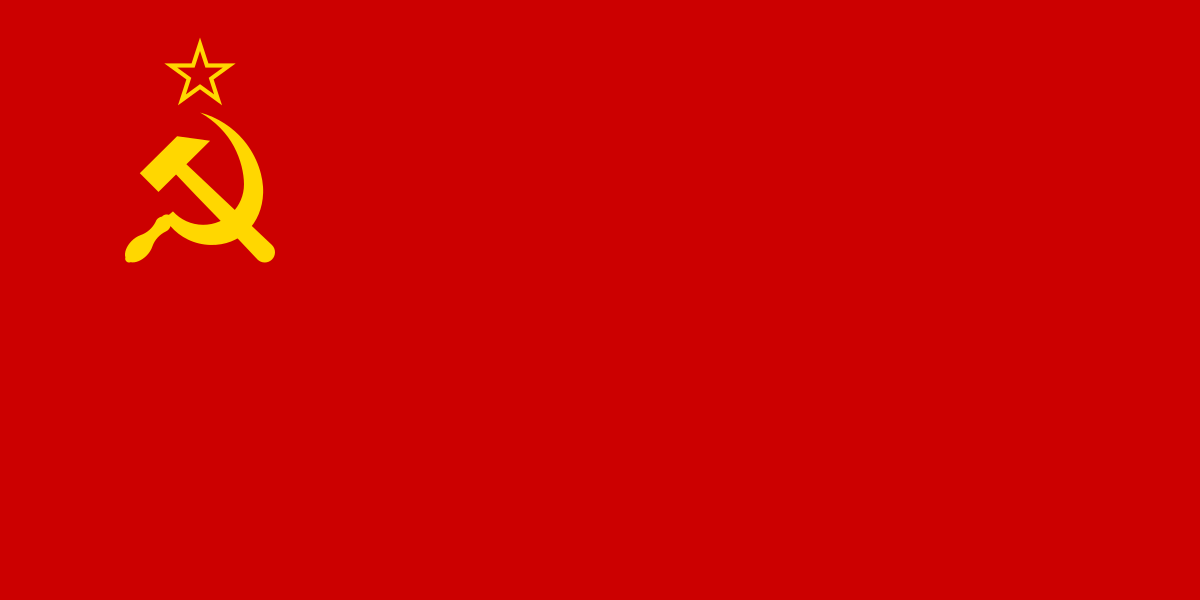
Key facts and distinctions
- Article focus
- Historical flag variants
- Date convention
- Periods describe the illustrated variant
- Scope
- Selected designs; no Nazi flags or symbols
- Variant shown
- 1955–1991
- Flag Regulation
- 19 August 1955
- Primary colour
- Red red
- Tools
- Golden hammer and golden sickle
- Starfish
- Red with golden border
- Side Ratio
- 1:2
- Successor States
- 15 independent republics
- UN membership
- Continued by the Russian Federation
Red, gold and a bordered star
The ground is red; in the upper corner of the mast are a golden hammer and a golden crescent. Above it stands a red five-pointed star with a golden border. So the star is not just a filled yellow area. It is precisely this difference that helps to accurately describe the representation and correct simplified memory images.
The decree of 19 August 1955 described both the signs and their proportions. The ratio of height to length was one to two. It represented the flag as a sign of state sovereignty and as a sign of the alliance of workers and peasants. This formulation is part of the self-image of the then government and can be read as a historical political statement.
A common sign for a federal state
The USSR was founded in 1922 and was a state consisting of union republics. The common Union flag must therefore not be confused with a single republic flag. She represented the Union as a whole on maps, at diplomatic missions or at international events. The fact that several republics had their own symbols at the same time does not contradict this common level.
The 1977 Constitution retained the flag’s central features. Their emergence did not therefore mean a complete graphic new beginning. The Presidential Library documents the Constitution as the successor to the Basic Law of 1936. The unchanged symbol shows that a new constitution and a new flag design are two different historical processes.
1991 and the question of succession
In 1991, the Soviet Union dissolved into fifteen independent republics. The United Nations report describes different populations and starting conditions. So the end of the common flag does not follow a simple assignment to only one present-day country. The map of the successor states is much more diverse than an exchange of red for a single new tricolor.
Within the United Nations, the Russian Federation continued the membership of the Soviet Union. This is an institutional peculiarity and not a statement that all other successor states are mere subdivisions of Russia. The UN archival information explicitly distinguishes between continuation of membership and admission of further former republics of the Union. For flag learning, this legal level should stand alongside political dissolution.
Details Worth Remembering
A contour with great effect
The golden line around the red star makes it visible on the also red ground. For this flag, therefore, the border itself is part of the distinguishing feature. A star of the same color without contour would disappear in the surface and would not reproduce the original correctly.
1955 is not a founding date
The year in the flag stock limits a regulated design. It does not mean that the state was created in 1955, nor that the tool symbols were used for the first time. Historical flag catalogues require this separation between model time and state history.
Multiple Ways to the State
The dissolution led to different state developments and flags. Anyone who recognizes the old Union sign can therefore only name the historical framework. For today’s assignment, the specific location, the republic or the respective successor state is then needed.
The illustrated signs and variants
Continue exploring
What did you discover?
Take this flag into the quiz
Sources and image credits
This English article draws on the institutional sources listed below. Figures and memberships retain their stated reference dates.
Source record: 2 November 2026. A translation does not change the reference date of a figure or membership list.
- ru.wikisource.org/wiki/Указ_Президиума_ВС_СССР_от_19.08.1955_об_утверждении_Положения_о_государственном_флаге_СССР
- prlib.ru/node/619610
- un.org/en/development/desa/policy/wess/wess_archive/1992wes.pdf
- ask.un.org/faq/378083
- statearchive.ru/468
- base.garant.ru/5478733/