The flag of Czechoslovakia
The blue triangle on two horizontal tracks makes the flag of Czechoslovakia easily recognizable. Its design was introduced in 1920 and outlasted several political systems. After the dissolution of the common state, the Czech Republic took over the design. Slovakia introduced another flag. The historical assignment shown from 1920 to 1992 therefore requires a look at interruptions and succession.
Test your knowledge →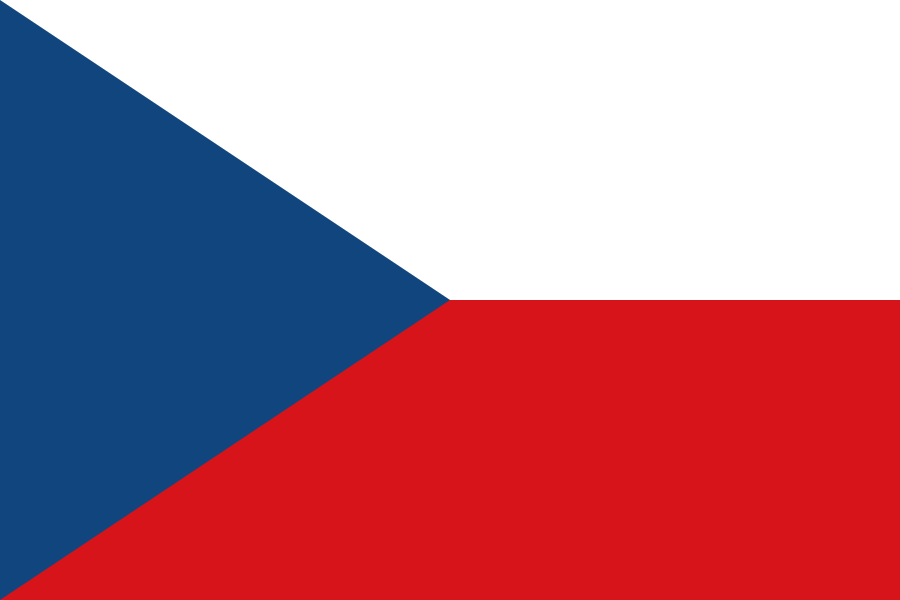
Key facts and distinctions
- Article focus
- Historical flag variants
- Date convention
- Periods describe the illustrated variant
- Scope
- Selected designs; no Nazi flags or symbols
- Introduction of the draft
- 1920
- Historical catalogue phase
- 1920–1992, with interruption at home
- Upper track
- White
- Lower track
- Red red
- Triangle
- Blue, from mast to centre
- Side Ratio
- 2:3
- End of the common State
- 31 December 1992
- UN admission of both successor states
- 19 January 1993
Why the Blue Triangle Came On
There is a white track at the top and a red track at the bottom. From the mast, a blue triangle extends to the center of the cloth. The aspect ratio is two to three. The Czech government describes the draft as the work of Jaroslav Kursa. Due to the triangle, the flag differs significantly from a simple white-red bicolare.
After the founding of Czechoslovakia in 1918, white and red were first used. This combination was already similar to other European flags and was also discussed within the new state. The addition of 1920 created a more independent picture. A declaration of the flag should therefore distinguish the original national colors and the later common state design.
A pattern across different orders
The time of 1920 to 1992 indicates the historical connection of this design with Czechoslovakia. It does not mean seamless use by an unchanged government. During the occupation, the mark was supplanted at home; the foreign movement adhered to it. For photographs from this period, place and political context are therefore indispensable.
The Czech government emphasizes that the restored flag also survived later political and constitutional changes. From their view alone, therefore, one cannot safely infer democracy, socialist government or a particular constitution. A familiar state symbol can live on in very different orders. Accurate dating of an image requires additional clues.
Two successor states from 1993
The Czech and Slovak Federal Republic ended on 31 December 1992. The Czech Republic and Slovakia subsequently applied for admission to the United Nations. Both became members on January 19, 1993. The UN treats them as two successor states and thus provides a clear institutional orientation for the classification of the former common country.
The Czech Republic retained the blue-white-red design with the triangle. Slovakia used its own tricolor with a coat of arms. A flag of the same design shown today can therefore mean the Czech Republic, while an older picture shows Czechoslovakia. Graphical continuity and political identity are not the same; only the caption makes an accurate historical statement out of the recognized pattern.
Details Worth Remembering
The tip as a measuring point
The blue triangle tip lies in the middle of the flag length. This geometric feature helps in recognizing and comparing with freely drawn representations. It is more reliable than a mere reminder of three colors that many other flags also contain.
A picture today needs a date
Anyone who sees the pattern today usually thinks of the Czech Republic. In a historical collection, however, the same design can represent the former common state. The date is therefore not a decorative addition, but an essential part of the identification.
Continuation without sole succession
The adoption of the flag by the Czech Republic can be described as a continuation of a design. This does not result in a sole succession for all the institutions, territories and people of Czechoslovakia. The parallel UN admission of the two new states makes this difference clear.
The illustrated signs and variants
Continue exploring
What did you discover?
Take this flag into the quiz
Sources and image credits
This English article draws on the institutional sources listed below. Figures and memberships retain their stated reference dates.
Source record: 2 November 2026. A translation does not change the reference date of a figure or membership list.
- vlada.gov.cz/en/clenove-vlady/historie-minulych-vlad/historie-statni-vlajky/the-czech-republics-national-flag-19198/
- mzv.gov.cz/riyadh/en/information_about_the_czech_republic/state_symbols_of_the_czech_republic.html
- un.org/en/node/123300