Canada's Red Ensign
In front of the maple leaf, a red cloth with Union Jack and Canadian coat of arms shaped the international image of Canada. The Canadian Red Ensign had a long development and different official uses. Shown here is the last version from 1957 to 1965 with red maple leaves in the shield. Their story explains why flag changes also negotiate about national autonomy and shared belonging.
Test your knowledge →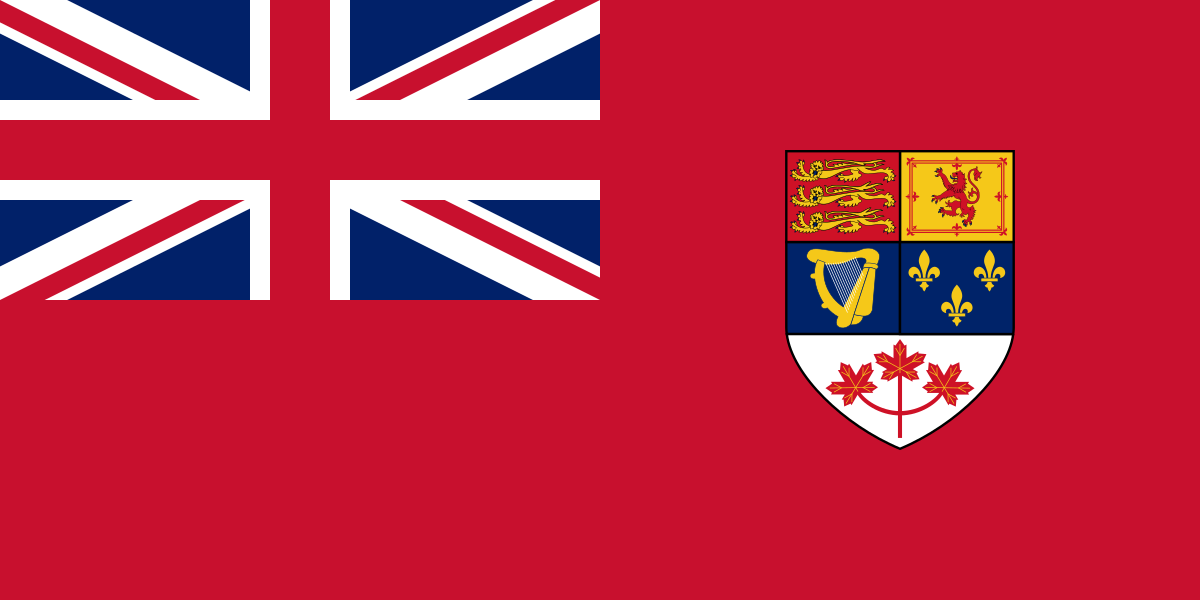
Key facts and distinctions
- Article focus
- Historical flag variants
- Date convention
- Periods describe the illustrated variant
- Scope
- Selected designs; no Nazi flags or symbols
- Variant shown
- 1957–1965
- Primary colour
- Red red
- Upper corner
- Union Jack
- Signs in free field
- Canadian heraldic shield
- Shipping authorisation
- 1892
- Amendment of 1957
- Maple leaves in the shield of green to red
- Great parliamentary flag debate
- 1964
- First raising of the new national flag
- 15 February 1965
A basic British form with a Canadian shield
The Canadian Red Ensign has a red field and the Union Jack in the upper corner on the mast. In the free red area is the Canadian heraldic shield. This connection made visible both the British historical reference and the Canadian identity. The cloth should therefore not be described as a pure British flag nor as a mere predecessor version of today’s maple leaf motif.
The public heraldic register of the Governor General documents several historical statements. Earlier shields connected the coats of arms of provinces. After the award of its own Canadian coat of arms in 1921, a corresponding version of the Red Ensign was introduced. The picture history of the shield is thus an essential part of the flag development, even if the red base field and the upper corner remained familiar.
Why the status needs to be described in more detail
In 1892, the Red Ensign was officially approved for Canadian ships. On land, it was also used as a national sign. The state timeline long describes him as an unofficially used national flag alongside the Union Jack. Different formulations about the meaning of the Red Ensign often arise from the fact that legal status, actual use and later memory do not answer the same question.
The version shown here begins in 1957. At that time, the color of the maple leaves in the heraldic shield changed from green to red. A small detail distinguishes this last variant from previous representations. The time of 1957 to 1965 does not therefore refer to the entire history of the Red Ensign, but exactly the version shown in the stock with the changed shield.
The Debate and Change of 1965
In 1964, the search for an independent national flag became an important parliamentary task. A committee reviewed numerous drafts. Parks Canada ranks this decision in preparation for the Confederacy’s centenary of 1967. The political task was to find a common sign for the country that was widely understood.
The new red-and-white maple leaf flag was hoisted on Parliament Hill on February 15, 1965. She replaced the Red Ensign in his previous national role. The transition significantly changed the graphic statement: Instead of a small collection of signs next to the Union Jack, a single large maple leaf is the focus. The former flag remains important as a historical symbol, but should be connected in the quiz with its concrete variant and its period.
Details Worth Remembering
Small leaves date the picture
The color of the leaf in the heraldic shield can easily be overlooked by a cursory glance. However, it is crucial to distinguish between the last two Red Ensign versions. Historical flag research therefore often works with details that are smaller than the obvious base color.
National Role Has Multiple Levels
A sign can represent a country in everyday life, although its official status is only strictly regulated for certain uses. The Red Ensign makes this difference particularly clear. A careful explanation therefore mentions both shipping and its widespread use on land.
From the sign to the individual motif
Switching to the large maple leaf greatly simplified the visible structure. In historical comparison, this should not be understood as a judgment about the quality of the older flag. It describes how differently both designs combine national affiliation graphically and make it recognizable at a distance.
The illustrated signs and variants
Continue exploring
What did you discover?
Take this flag into the quiz
Sources and image credits
This English article draws on the institutional sources listed below. Figures and memberships retain their stated reference dates.
Source record: 2 November 2026. A translation does not change the reference date of a figure or membership list.
- gg.ca/en/heraldry/public-register/project/1146
- canada.ca/en/canadian-heritage/services/flag-canada-history/timeline-national-flag.html
- parks.canada.ca/culture/designation/evenement-event/drapeau-flag
- canada.ca/en/canadian-heritage/services/flag-canada-history.html
- canada.ca/en/canadian-heritage/services/flag-canada-origin.html