The US flags with 48 and 49 stars
The flags of the USA with 48 and 49 stars differ mainly in their blue upper corner. The first was from 1912 to 1959, the second only from 1959 to 1960. New states led to new stars, while the thirteen red-and-white stripes unchanged reminded of the original states. Decisive are the respective introductory days.
Test your knowledge →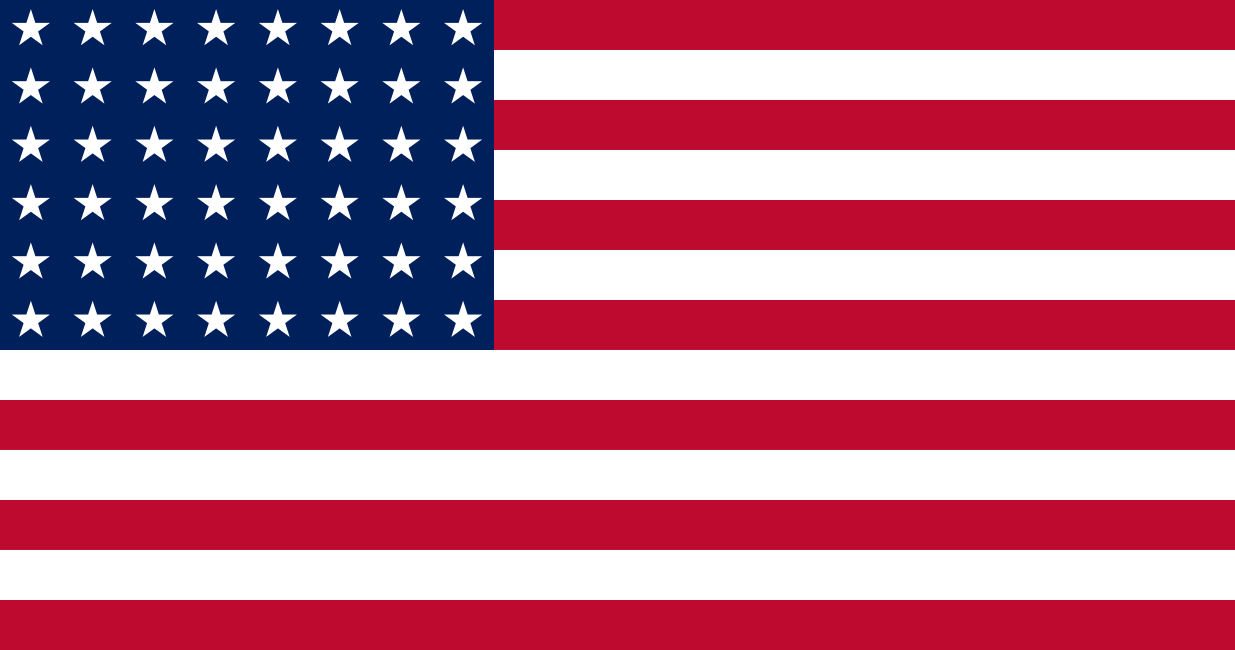
Key facts and distinctions
- Article focus
- Historical flag variants
- Date convention
- Periods describe the illustrated variant
- Scope
- Selected designs; no Nazi flags or symbols
- 48 stars officially
- 4 July 1912 to 3 July 1959
- Grid with 48 stars
- Six rows with eight stars each
- States admitted in 1912
- New Mexico and Arizona
- Alaska's recording
- 3 January 1959
- 49 stars officially
- 4 July 1959 to 3 July 1960
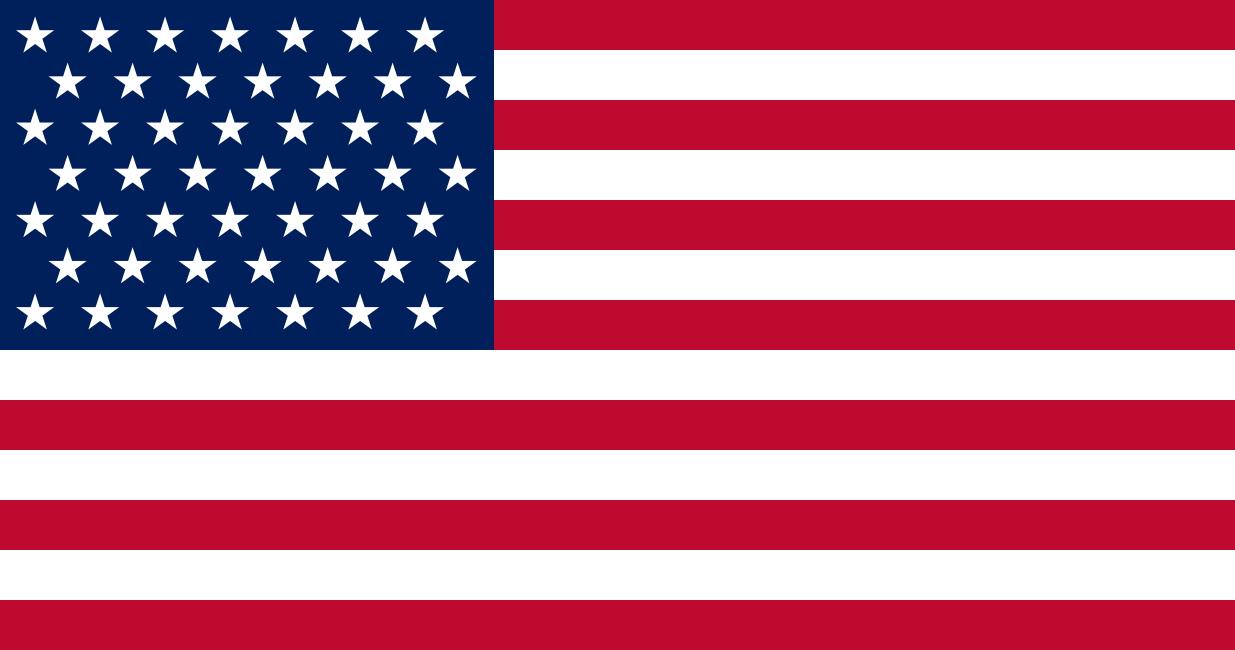
- Grid with 49 stars
- Seven staggered rows with seven stars each
- Hawaiian Recording
- 21 August 1959
- 50 stars officially since
- 4 July 1960
48 stars in a regular grid
The 48-star flag shows six horizontal rows with eight stars each. This clear grid facilitates recognition and counting. President William Howard Taft had the arrangement and proportions fixed in 1912. New Mexico and Arizona were admitted as states in the same year. The new flag entered into official use on 4 July 1912.
The pattern persisted until July 3, 1959. It thus belongs to a long period of American history and is encountered in numerous historical photographs. However, a recording from this time cannot be dated to a specific year by the stars alone. The unchanged version covers almost 47 years, and older flags could subsequently continue to exist.
Alaska and a Star for a Year
Alaska became a state on January 3, 1959. For the added star, a new arrangement of seven rows with seven stars each emerged. These rows are offset against each other. So the transition was not simply adding a star to the previous rectangular grid: the entire group of stars had to be redesigned.
The 49-star flag became official on July 4, 1959. It remained the valid execution until 3 July 1960. Hawaii joined the Union on 21 August 1959, but the corresponding change of flag followed only on 4 July 1960. Therefore, a 49-star flag was also officially correct for part of the time with already 50 states.
Why 4 July Matters
American law combines the admission of a state with an additional star and sets the next 4th of July. There is therefore often a transitional period between political accession and visible change. For a historical quiz, you have to separate the date of state accession from the date of the valid flag version. Both describe different processes.
The thirteen stripes remained unchanged. The stars represent the growing Union, while the stripes maintain a historical starting point. This double time reference explains why the flag retained its basic form and was nevertheless rearranged several times. The 48- and 49-star versions shown here are former official variants of the same state sign, not flags of different successor states.
Details Worth Remembering
Counting with System
At 48 stars, the grid leads directly to the bill six times eight. At 49 stars, it is seven times seven. However, the offset position of the second variant prevents both star fields from acting like similar tables. Together, the number of rows and alignment form a reliable recognition feature.
A Year with Two Numbers
In the later year 1959, there were already 50 states, while the official flag still showed 49 stars. That is not a contradiction. The legally established day of introduction explains the temporal shift and makes the short variant a particularly vivid historical learning example.
Drafts before introduction
The Eisenhower Presidential Library preserves documentation for the preparation of new star arrangements. Such documents show that a seemingly small addition required planning. Designers had to find a symmetrical and reproducible overall arrangement that could function on flags large and small.
The illustrated signs and variants
Continue exploring
What did you discover?
Take this flag into the quiz
Sources and image credits
This English article draws on the institutional sources listed below. Figures and memberships retain their stated reference dates.
Source record: 2 November 2026. A translation does not change the reference date of a figure or membership list.
- postalmuseum.si.edu/object-group/flag-day/flag-facts
- archives.gov/education/lessons/alaska/statehood.html
- eisenhowerlibrary.gov/research/online-documents/design-49-and-50-star-flags
- govinfo.gov/content/pkg/USCODE-2022-title4/html/USCODE-2022-title4-chap1-sec1.htm