Spain Flag, Capital and Country Facts
Spain includes most of the Iberian Peninsula, the Balearic Islands in the Mediterranean and the Canary Islands in the Atlantic. The red-yellow-red flag combines an easily noticeable stripe image with a multi-part coat of arms. The country has a distinct regional and linguistic diversity; Madrid is located far inwards and is therefore not a typical port capital.
Test your knowledge →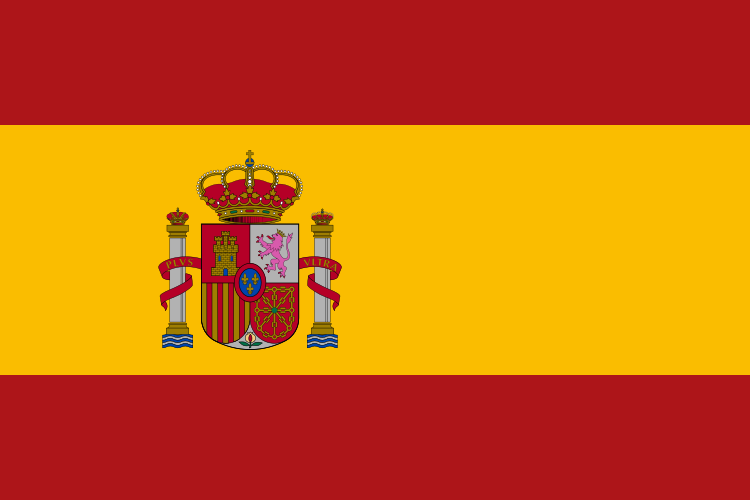
Spain at a glance
- Capital
- Madrid
- Quiz continent
- Europe
- Languages in reference record
- Spanish (Castilian); regional among others Catalan, Galician and Basque with official status
- Currency
- Euro (EUR)
- Population
- 49,355,143 (2025, World Bank)
- Area
- 505,992 km²
- Coastal setting
- Not landlocked
- ISO codes
- ES / ESP
- Internet country suffix
- .es
- Highest mountain
- Teide in Tenerife, 3,718 m
- Central plateau
- Meseta
- Atlantic island group
- Canaries
- Mediterranean island group
- Balearic Islands
- National holiday
- 12 October
- Large border river
- Duero/Douro with Portugal
Spain Flag: Design, Meaning and History
Three horizontal stripes are red, yellow and red. The yellow middle stripe is twice as wide as any red one. The coat of arms of the state lies therein offset to the rod side. Especially the wide yellow center distinguishes the motif from tricolors of equal width. The coat of arms is an important detail of the state flag shown here.
In the sign are among others Castile, León, Aragon and Navarra, below a pomegranate Granada complements. The lateral pillars and the motto Plus Ultra refer to the pillars of Hercules and the extension beyond Europe. The present-day coat of arms summarizes historical domains; it does not simply represent the present-day administrative structure.
Capital: Madrid
Madrid is located on the central plateau of the Iberian Peninsula. The capital brings together government, administration and transport links. Their internal situation explains a clear difference to Barcelona or Valencia: the political center and large Mediterranean ports are spatially separated. Spain’s cities can therefore not be understood solely through coastal tourism.
The royal court was permanently settled in Madrid in the 16th century. Museums and representative urban spaces document the later development of the centre of power. The UNESCO country overview also shows the cultural landscape of Aranjuez south of the capital as well as the monastery and palace complex El Escorial. These places belong to the further historical environment of the monarchy.
Practise this capital →Spain: Geography, History and Culture
Inside is the Meseta, divided by mountain ranges and river basins. The wetter north differs significantly from the drier southeast. However, the highest mountain in Spain, Teide, is not on the peninsula, but on Tenerife. The belonging of the Canary Islands thus shifts the geographical view far into the Atlantic. The Tajo originates in Spain and reaches the Atlantic as a Tejo through Portugal. The Duero also continues beyond the border: river landscapes and water management connect the Iberian neighbouring states.
Spanish or Castilian is the official language of the state. In addition, several regional languages have an official status in their territories. Basque does not belong to the Romance language family. Linguistic diversity corresponds to a long history of different domains and is not merely a question of different pronunciations of the same language.
The UNESCO heritage ranges from prehistoric cave art in Altamira to Roman facilities in Mérida and Islamic buildings in Córdoba and Granada. This sequence makes it possible to understand how different epochs have left visible traces. The factbook archive status of 2025 serves as a supplement to basic geographical indications; current government offices are deliberately not used here to explain historical structures.
Alhambra and Granada
Alhambra, Generalife and Albaicín are on the World Heritage List together. The entry links palace complexes, gardens and a historic district.
Altamira
The World Heritage includes the cave of Altamira and other Paleolithic cave art of northern Spain. It goes back far behind the Roman and medieval eras.
Aranjuez
The cultural landscape Aranjuez is a UNESCO World Heritage Site. It shows that consciously designed landscapes and their relationship to a residence can also be protected.
Explore neighbouring and related places
 Andorra
 France
 Portugal
 Morocco
Cities and regions in this country
 Barcelona
 Madrid
 Catalonia
 Andalusia
What did you discover?
Sources and image credits
This English article draws on the institutional sources listed below. Figures and memberships retain their stated reference dates.
Source record: 2 November 2026. A translation does not change the reference date of a figure or membership list.
- github.com/factbook/factbook.json/blob/144d6977b2b01ac1cbd220de754c0a005616760b/europe/sp.json
- data.worldbank.org/indicator/SP.POP.TOTL
- whc.unesco.org/en/statesparties/es
- github.com/mledoze/countries