Andalusia: Regional Flag, Capital and Regional Profile
Andalusia is located in the south of Spain and has a capital of great historical importance with Seville. The green-white-green flag combines landscape references with the history of regional self-government. Eight provinces form the autonomous community. Between Granada’s medieval urban landscapes and the wetlands of Doñana, there is a region with very different cultural and natural spaces.
Test your knowledge →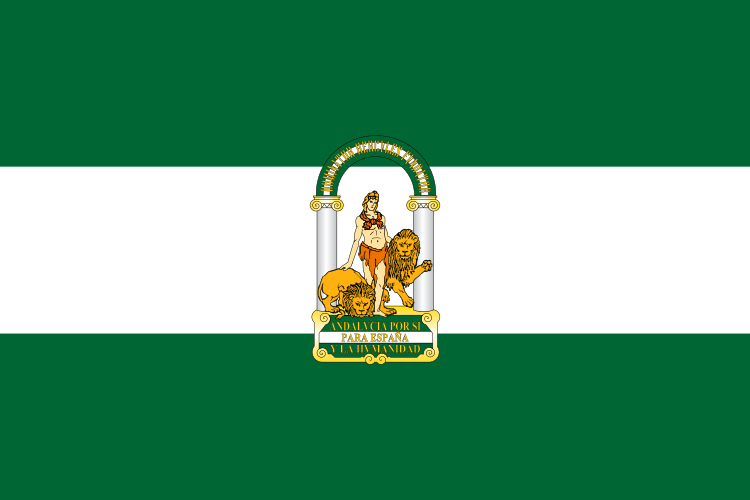
Andalusia at a glance
- Name
- Andalusia
- Country
- Spain
- Profile type
- Autonomous community
- Administrative seat in source record
- Seville
- Administrative structure
- Eight provinces
- Eastern Province
- Almería
- Regional Court
- Higher Court with seat in Granada
- Regional holidays
- 28 February
- Strip decision
- Assembly of Ronda, 1918
- River in Granada
- Darro between Alhambra and Albayzín
- Doñana location
- Right bank of the Guadalquivir estuary on the Atlantic
- Generalis
- Gardens of an emiral country residence of the 13th and 14th centuries
The Flag of Andalusia
The flag shown carries three equally wide horizontal stripes in green, white and green. In the middle stands the regional coat of arms with Hercules between two pillars and two lions. For the recognition, therefore, both the stripe sequence and the central group of figures are helpful; the depicted frame is not just an unadorned three-strip.
The strip design was decided in 1918 by the Assembly in Ronda. The junta combines colors with the Andalusian landscape as well as purity and hope. Hercules belongs to the classical symbolic language of the coat of arms. This official declaration must be distinguished from a supposedly uniform natural meaning of each detail.
Andalusia: Location and Territorial Role
The territory includes Almería, Cádiz, Córdoba, Granada, Huelva, Jaén, Malaga and Seville. The enumeration names provinces, not eight equal capitals of Andalusia. Seville is the seat of Parliament, Presidency and Government Council. The upper regional court, on the other hand, has its seat in Granada, as a result of which institutional tasks are distributed among different cities.
Granada is also a focal point of historical heritage. The Alhambra and the Albayzín are located on neighboring hills that the Darro River separates from each other. Its spatial opposite makes visible two different parts of the medieval city: a palace city and a developed residential district with its own street structure.
Landscape, History and Culture
East of the Alhambra are the gardens of the Generalife. They belong to a rural residence of the Emires, whose complex dates back to the 13th and 14th centuries. Palaces, residential quarters and garden space complement each other as evidence of an urban culture in which water, slopes and designed open spaces were closely connected.
Doñana is located on the right bank of the Guadalquivir where the river flows into the Atlantic Ocean. Lagoons, marshes, dunes, bush landscapes and forest form different habitats next to each other. The connection between the river and the sea explains the ecological richness of this protected area better than the idea of a single, universally similar marsh landscape.
The Andalusian holiday is celebrated on February 28. The flag, anthem and coat of arms are enshrined in the Statute of Autonomy and form part of the Community's institutional self-expression. The Statute combines regional self-government with the Spanish constitutional order; it is therefore at the same time a text on identity and on specific competences of political institutions.
Alhambra, Generalife and Albayzín
The Alhambra was a fortified palace town, while the Albayzín preserved residential areas. Together with the Generalife, they are part of the World Heritage. The connection is crucial: the residence, garden and residential district tell different aspects of the same city history and can be related by their location above the modern lower city.
Doñanas habitat mosaic
In Doñana, water levels and living conditions change with the year. The area is of great importance for migratory and water birds. Solid and migratory dunes stand alongside wetlands, so protected species rely on different habitats. Its World Heritage status focuses on this working mosaic and not only on individual rare animals.
Hercules in the coat of arms
The coat of arms motif shows Hercules holding two lions, between pillars. The official interpretation combines this with strength and mastery of instincts. As a picture of classical lore, it tells something different than a topographic map: its task is symbolic representation, not the exact depiction of a local scene that can be visited today.
Explore this country and nearby profiles
 Spain
 Barcelona
 Madrid
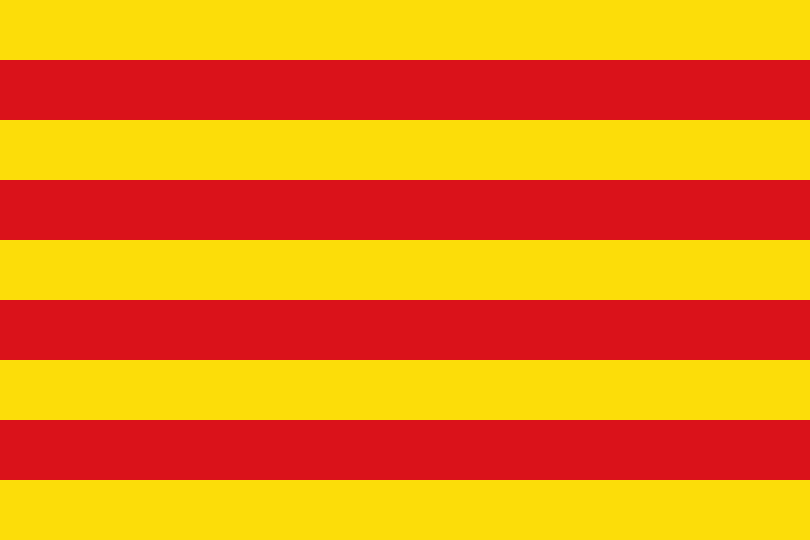 Catalonia
What did you discover?
Take this flag into the quiz
Sources and image credits
This English article draws on the institutional sources listed below. Figures and memberships retain their stated reference dates.
Source record: 2 November 2026. A translation does not change the reference date of a figure or membership list.
- juntadeandalucia.es/organismos/transparencia/informacion-institucional-organizativa/simbolos.html
- ws040.juntadeandalucia.es/sedeboja/lconsolidada/eli/es-an/lo/2007/03/19/2/con/20230101/spa/html/LE0000242262_20230101.html
- juntadeandalucia.es/presidencia/28f/memoria-autonomica/escudo-de-andalucia/
- whc.unesco.org/en/list/314
- whc.unesco.org/en/list/685