Catalonia: Regional Flag, Capital and Regional Profile
Catalonia connects Barcelona and the Mediterranean with mountainous landscapes of the Pyrenees. The autonomous community in northeastern Spain has its own language and historical institutions. Her senyera is recognizable by four red stripes on yellow. Between the Romanesque churches of the Vall de Boí and Gaudí's architecture, the great cultural span of the region becomes visible.
Test your knowledge →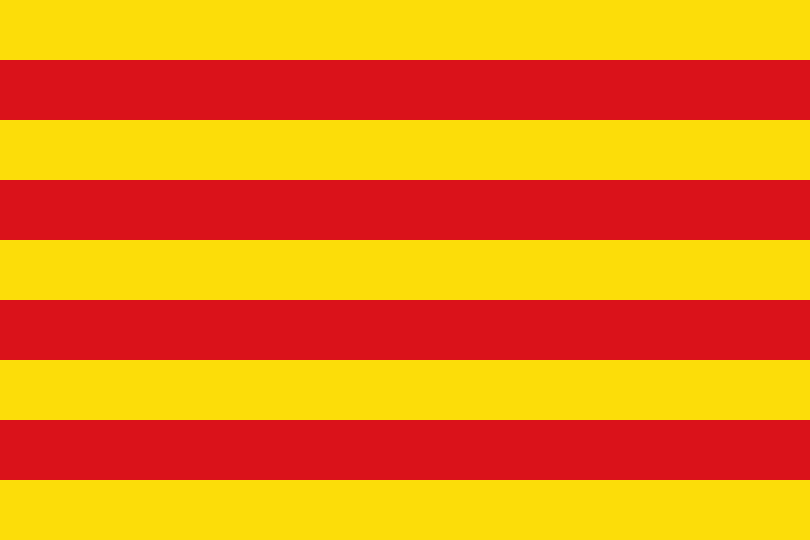
Catalonia at a glance
- Name
- Catalonia
- Country
- Spain
- Profile type
- Autonomous community
- Administrative seat in source record
- Barcelona
- Official languages
- Catalan, Spanish and Occitan/Aranese
- Regional institutions
- Generalitat with Parliament, Presidency and Government
- Nationality
- Diada on September 11
- Mountainous area
- Pyrenees with the Vall de Boí
- Romanesque World Heritage Site
- Eight churches and a hermitage, since 2000
- Church in Taüll
- Sant Climent de Taüll’
- Gaudí World Heritage Site
- Seven works in Barcelona and the surrounding area
- Part of the Sagrada Família in World Heritage
- Birth Facade and Crypta
The Flag of Catalonia
The Senyera shown here consists of a yellow cloth with four continuous horizontal red stripes. Between them and at the edges, a total of five yellow tracks remain visible. The motif requires neither coat of arms nor writing and can therefore be determined from the clear sequence of colors.
The Statute of Autonomy explicitly describes the flag as a traditional flag with four red bars on a yellow background. The shape shown can be distinguished from the Estelada, which additionally contains a triangle with a star. Stories about the creation of the stripes by bloody fingers belong to the legendary tradition and are not treated here as proven origin.
Catalonia: Location and Territorial Role
Barcelona is the permanent seat of Parliament, Presidency and Government of the Generalitat. However, the autonomous community encompasses much more than urban space. The Vall de Boí is located in the Pyrenees and shows a rural mountain area, whose historical settlements and churches are a special focus of Catalan culture.
Catalan and Spanish are official languages. In addition, there is Occitan, in Aran called Aranese, whose own regional anchorage is recognized in the Statute. This multi-layered language landscape explains why Catalonia cannot be described solely via Barcelona or a single everyday language. Regional identities also remain significant within the community.
Landscape, History and Culture
The Romanesque churches of Vall de Boí have been a UNESCO World Heritage site since 2000. Eight churches and a hermitage form a common ensemble. Its importance lies in the link between Romanesque architecture, mountain landscape and villages. Slender bell towers make individual buildings widely visible, while the common style connects the scattered places.
Antoni Gaudí’s works open up a view of a much later architectural history. The UNESCO site comprises seven works in Barcelona and the surrounding area, including Park Güell, Casa Milà and Casa Batlló. The birth facade and crypt of the Sagrada Família are also part of this; the World Heritage status does not describe every part of the entire church building.
The different cultural sites continue to fulfil different tasks. Several churches of the Vall de Boí are used religiously, while Sant Climent de Taüll serves mainly culture and sightseeing. Gaudí’s buildings also combine different functions: residential buildings, public green spaces and sacred spaces show how architecture remains integrated into everyday and social spheres of life.
Romanesque in the mountain valley
Sant Climent and Santa Maria in Taüll are among the most famous churches of the ensemble. Together with other churches and the hermitage Sant Quirc de Durro, they form a coherent cultural route in the valley. The proximity of the places allows to compare variants of the same building tradition with each other, instead of just looking at an isolated masterpiece.
Gaudí beyond the Sagrada Família
The world heritage site of the Gaudí works shows an independent combination of architecture, construction, garden art and decoration. Park Güell and the townhouses have very different tasks, but share the experimental design approach of their architect. It is precisely the comparison between them that makes Gaudí’s contribution to architecture around 1900 understandable.
Senyera in public life
The Senyera is named in the statute together with the holiday and anthem as the national symbol of Catalonia. The Diada is celebrated on September 11. For the flag quiz, the simple stripe version counts: Their distinction from variants with star helps to distinguish institutional sign and other political expressions.
Explore this country and nearby profiles
 Spain
 Barcelona
 Madrid
 Andalusia
What did you discover?
Take this flag into the quiz
Sources and image credits
This English article draws on the institutional sources listed below. Figures and memberships retain their stated reference dates.
Source record: 2 November 2026. A translation does not change the reference date of a figure or membership list.
- portaljuridic.gencat.cat/ca/normativa/dret-a-catalunya/lestatut/
- justicia.gencat.cat/ca/departament/llengua/catala-administracio-justicia/marc-normatiu/normativa-ambit-judicial/estatut-dautonomia/
- presidencia.gencat.cat/web/.content/ambits_actuacio/desenvolupament_autogovern/iea/publicacions/12_llibres-fora-de-coleccio/FC_arxius-i-vincles/fc_Comentaris-sobre-lEstatut-I.pdf
- whc.unesco.org/en/list/988
- whc.unesco.org/en/list/320