Duisburg: City Flag, History and Identity
Duisburg is where the Rhine and Ruhr come together. The city combines a long trade history with port economy, industry and the reuse of former plant areas. Between Burgplatz, Inner Harbour and Landscape Park Duisburg-Nord, these layers are particularly visible. Its flag carries a castle and imperial eagle, reminding of a past that begins far before the blast furnaces.
Test your knowledge →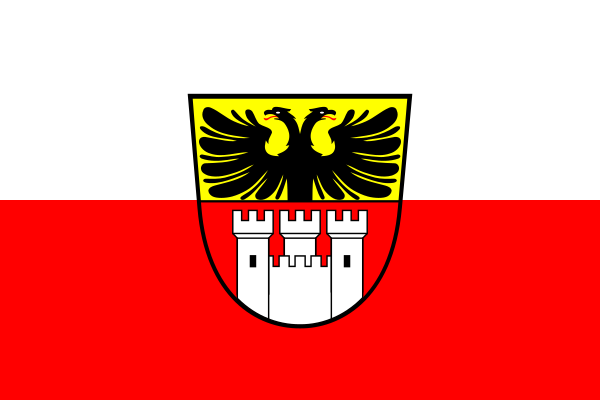
Duisburg at a glance
- Name
- Duisburg
- Country
- Germany
- Profile type
- City
- Rivers
- Rhine and Ruhr
- Early Scripture Source
- Mentioned in the year 883
- Flow change
- Relocation of the Rhine after 1200
- Church construction
- Gothic Salvator Church since 1316 under construction
- Start of work
- Construction of the Meiderich metallurgical plant from 1901
- First blast furnace
- Start of production in 1903
- Closure of Meiderich
- 1985
- Parking opening
- First subdivisions 1994 publicly available
The Flag of Duisburg
On the red-and-white tracks of the flag shown lies the city coat of arms. It combines a castle representation with a black eagle on a golden field. If you want to recognize the flag, you should look at both parts together: The city gate or the castle and the eagle arranged above it give a different picture than a stand-alone imperial eagle.
The signs belong to the historical city representation. They must not be immediately understood as a map of the present port. The visible coat of arms is a heraldic representation with simplified forms, not a true-to-scale image of a particular modern structure. Red and white provide the background, while the compound motif makes the flag distinguishable within similar color combinations.
Duisburg: Location and Territorial Role
Duisburg belongs to North Rhine-Westphalia and is located on the western edge of the Ruhr area. The Rhine and Ruhr explain the traffic situation, but today's city floor plan is also characterized by changes in river flows. The Rhine moved its course away from the old city after 1200; this development is particularly important for the later port history.
Burgplatz and Salvatorkirche mark the older city centre. The urban chronicle mentions Duisburg for the first time in writing in connection with the year 883. Subsequent expansions and mergers considerably increased the urban area. Therefore, one should spatially distinguish the history of the old town, the port areas and the various communal places, even if they belong to a commune today.
Landscape, History and Culture
The inner harbour shows how closely urban development and waterways are connected. Previously, the site was an economically used harbour space; its conversion combines working, living and leisure on the water. The redesign was part of the Emscher Park International Building Exhibition. Remaining storage and new uses make the transition between industrial past and present urban space visible.
In the Meiderich metallurgical plant, August Thyssen began construction in 1901. The first blast furnace began production in 1903, and the plant was shut down in 1985. This chronological sequence initially describes a specific location, not the end of the entire Duisburg steel industry. It is precisely this distinction that prevents the history of a monument from being confused with the economy of the whole city.
Since 1994, parts of the later landscape park have been opened to the public. Former production facilities were given leisure and cultural functions: a blast furnace serves as a viewpoint, halls are used for events. The terrain thereby preserves its industrial spatial effect, while plants, pathways and new activities create an additional level of use and perception.
Landscape Park Duisburg-Nord
The park can be read as a transformed working landscape. Blast furnaces, bunkers and halls are still in their technical context, but are opened up by pathways and new offers. It is particularly impressive that an earlier metallurgical plant was not completely eroded, but continues to exist as a large public space with industrial history and vegetation.
Interior port
In the inner harbour, the structural change at the waterline becomes traceable. Former port areas have become part of a city quarter where different uses come together. The reference to history is preserved by the harbour basin and older buildings. Anyone who looks at the plant also sees why Duisburg’s development has had to react time and again to changing traffic and economic conditions.
Burgplatz and Salvatorkirche
The older city history is particularly present at Burgplatz and the Salvatorkirche. The Gothic church building was already under construction in 1316. These places complement the port and blast furnaces with a medieval perspective and show that Duisburg was an urban center with political, religious and economic tasks long before industrialization.
Explore this country and nearby profiles
 Germany
 Munich
 Cologne
 Frankfurt am Main
 Stuttgart
 Düsseldorf
 Dresden
What did you discover?
Take this flag into the quiz
Sources and image credits
This English article draws on the institutional sources listed below. Figures and memberships retain their stated reference dates.
Source record: 2 November 2026. A translation does not change the reference date of a figure or membership list.
- duisburg.de/wohnenleben/historie/chronik
- landschaftspark.de/hintergrundwissen/chronik/
- landschaftspark.de/besucherinformationen/landschaftspark/
- innenhafen-portal.de/standort/historie/geschichte-und-industrielle-entwicklung/
- commons.wikimedia.org/wiki/File%3AFlag_of_Duisburg.svg