Cologne: City Flag, History and Identity
Cologne is located on the Rhine and combines Roman city history with an ecclesiastical tradition that is still visible today. The red-and-white flag carries a shield with three crowns and eleven black flames. Cathedral, town hall and coat of arms tell different stories: of saints, municipal self-government and a building project that stretched over centuries.
Test your knowledge →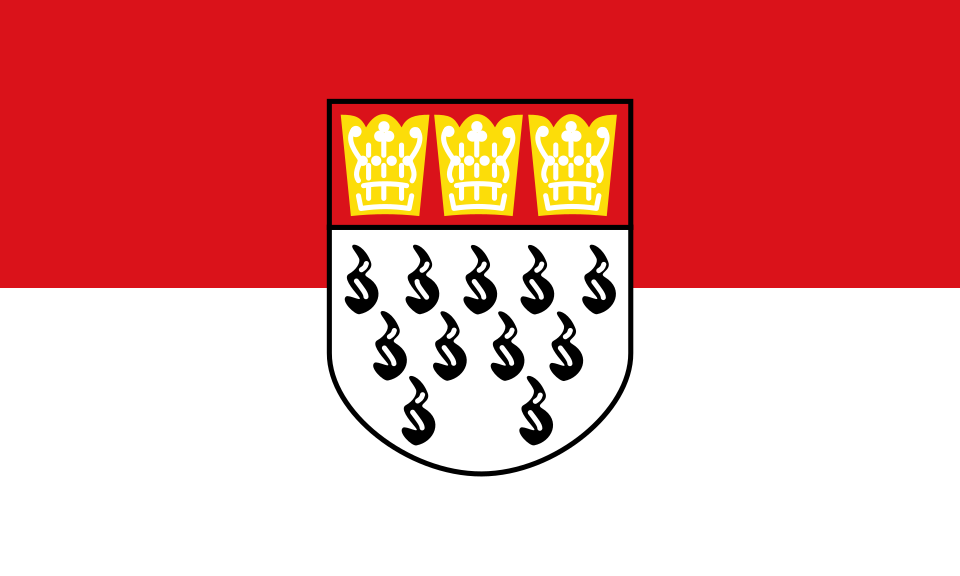
Cologne at a glance
- Name
- Cologne
- Country
- Germany
- Profile type
- City
- River
- Rhine
- Federal Republic of Germany
- North Rhine-Westphalia
- Roman colony
- Ranking in year 50
- Ancient Shortcut
- CCAA
- Start of construction of the cathedral
- 1248
- Completion of the Dome
- 1880
- UNESCO image of the cathedral
- 1996
- City patron in the coat of arms
- Saint Ursula
- Crown symbolism
- Three Holy Kings
The Flag of Cologne
The flag shown has a red upper and a white lower track. In the middle is the Cologne heraldic shield: three golden crowns on red above, including eleven black, flame-like signs on white. The sign thus continues the two basic colors, but adds motifs that make Cologne unmistakable within this frequent color combination.
The crowns refer to the Three Kings. The eleven flames stand in the heraldic tradition for Saint Ursula and her companions. The story of eleven thousand virgins belongs to the legend of saints and is not a verified number of a historical event. The city museum explains this symbolism on the basis of a preserved coat of arms relief.
Cologne: Location and Territorial Role
Cologne is located in North Rhine-Westphalia on the Rhine. The historic city developed on the left bank, but today’s commune encompasses areas on both sides of the river. For the understanding of the city, the Rhine is at the same time traffic route and spatial border. Bridges connect districts whose historical development was quite different.
The name Cologne goes back to the Roman colonia. In the year 50, the settlement under Emperor Claudius received the rank of a Roman colony; his wife Agrippina, who was born here, played an important role in this. The letters CCAA abbreviate the ancient name Colonia Claudia Ara Agrippinensium and meet in urban historical representations.
Landscape, History and Culture
The location on the large river explains the long-term importance as a place of trade and meeting. However, the story does not end with the Roman city. Later, Cologne became an archbishop's center and developed an independent communal order. The town hall therefore offers a different access to the past than the widely visible cathedral.
Cologne Cathedral was started in 1248 and was not completed until 1880. The long construction period does not mean a random collection of arbitrary styles. UNESCO highlights the connection to the Gothic design, which has been preserved over many generations. Building history can be understood here as an unusually long-term cooperation that extended far beyond a single lifetime.
The Cologne City Museum collects testimonies of urban life and its political orders. A coat of arms relief presented there shows how urban signs were also used on representative buildings. Such objects combine crafts with administrative history. After all, a coat of arms was not only jewelry, but also marked belonging and public authority in urban space.
Cologne Cathedral
The cathedral has been a UNESCO World Heritage Site since 1996. Its importance is based on architecture and equipment as well as its testimony to European religious history. The towers are a striking orientation point, but for the classification also worth the view of the building. Especially the consistent Gothic overall effect makes the long time of creation particularly remarkable.
Historic Town Hall
The town hall leads to the history of citizenship. In the municipal representation, the historical arc extends from the ancient colony to the archbishop's city to the bourgeois administration. A visit to the town hall therefore complements the view of churches and relics. He recalls that urban identity has always been shaped by political rights and community decisions.
Cologne's early film history
On April 20, 1896, a film program with the Cinématographe Lumière was shown to a paying audience on Augustinerplatz. The entrepreneur Ludwig Stollwerck had brought the technology to Cologne. Already in May, Charles Moisson filmed Dom and urban everyday life. This early media history complements the more well-known Roman and medieval chapters with a concrete awakening of modernity.
Explore this country and nearby profiles
 Germany
 Munich
 Frankfurt am Main
 Stuttgart
 Düsseldorf
 Dresden
 Leipzig
What did you discover?
Take this flag into the quiz
Sources and image credits
This English article draws on the institutional sources listed below. Figures and memberships retain their stated reference dates.
Source record: 2 November 2026. A translation does not change the reference date of a figure or membership list.
- whc.unesco.org/en/list/292/
- stadt-koeln.de/mediaasset/content/verwaltung/stk_br_ko%CC%88lner_rathaus_a5_rz_web-pdf__003_.pdf
- koelnisches-stadtmuseum.de/en/sammlung/skulptur-objektkunst/die-stille-rueckkehr-eines-verlorenen-schaetzchens/
- koelnisches-stadtmuseum.de/entdecken/presse-newsroom/
- commons.wikimedia.org/wiki/File%3AFlagge_K%C3%B6ln.svg