Düsseldorf: City Flag, History and Identity
Düsseldorf is the state capital of North Rhine-Westphalia and a city on the Rhine and Düssel. Their flag combines red and white with the mountain lion and an anchor. Between the old town, Königsallee and Hofgarten, it becomes understandable how a settlement on a river mouth became a political center with a pronounced trade and garden culture.
Test your knowledge →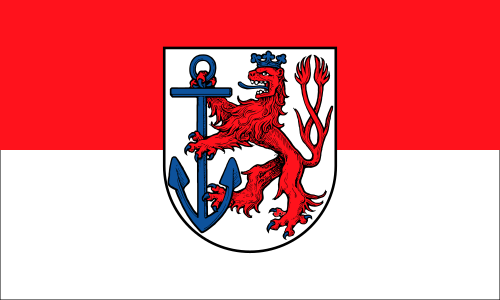
Düsseldorf at a glance
- Name
- Düsseldorf
- Country
- Germany
- Profile type
- City
- Smaller river
- Düssel
- Large electricity
- Rhine
- Urban survey
- 14 August 1288
- Urban lifters
- Count Adolf von Berg
- Historical context
- Battle of Worringen 1288
- Provincial capital
- Since 1946
- Historical Park
- Hofgarten at Jägerhof Palace
- Boulevard
- King's Avenue
- Other water areas
- Kaiserteich and Schwanenspiegel
The Flag of Düsseldorf
The figure shows a red upper and a white lower path. In the middle is the white heraldic shield with a red, blue crowned lion. In his paws he holds a blue anchor. The flag thus uses a striking animal motif and a sign of navigation, instead of relying on its stripes alone.
The lion belongs to the Bergish rule tradition. The anchor refers to the relationship of citizenship to Rhine shipping. Both motives have different historical backgrounds. A modern coat of arms sign offered for private use has a different color design and must not be confused with the actual city coat of arms shown here.
Düsseldorf: Location and Territorial Role
Düsseldorf is located on the Lower Rhine in North Rhine-Westphalia. The city name leads to the Düssel, whose mouth was important for the early settlement. The proximity of the large stream created transport and trade relations. The current state capital can therefore be accessed via two river names, even if the Rhine appears much wider and more striking in the cityscape.
On 14 August 1288 Count Adolf von Berg raised the place to the city. This decision followed the Battle of Worringen, in which the opponents of the Cologne Archbishop won. The city elevation thus belongs to a regional power shift. It was not an isolated administrative act, but part of the political competition in the Lower Rhine in the late Middle Ages.
Landscape, History and Culture
The city later developed as a residence and administrative place. Since 1946 it has been the capital of North Rhine-Westphalia. Historical old town and political function therefore belong to different layers of time. Who walks on the Rhine, moves through a city whose tasks have changed several times and whose history is considerably older than today's federal state.
Düsseldorf has a long tradition of public parks. The Hofgarten in front of Schloss Jägerhof dates back to the 18th century. Elector Carl Theodor made it a public walk. This distinguishes this complex from a garden reserved exclusively for the court and explains its place in the history of urban recreation.
With the industrial growth of the 19th century, the demand for green spaces also increased. The city history of the parks makes it clear that recreation was part of urban development. Public gardens, squares and street trees did not emerge independently of growth, but as a response to new living and living conditions. The green urban space therefore has a social history.
Königsalle and water areas
Königsallee is a particularly well-known boulevard. Their water and green spaces are linked in the cityscape with the surroundings of the old town. The urban representation also mentions Kaiserteich and Schwanenspiegel as parts of a green belt. A consideration of these spaces complements the widespread image of a pure shopping street with scenic and planning connections.
Hofgarten
The Hofgarten offers an access to the older garden culture. Its location at Schloss Jägerhof makes the historical starting point recognizable, but its public function goes beyond that. In a city comparison, this connection is worthwhile: a formerly stately-initiated facility became part of everyday community life and still shapes the orientation between different urban areas today.
Schloss Jägerhof and Parktradition
Jägerhof Palace marks the historical starting point of the public court garden. In the 18th century, the complex was still at the gates of the city. Their later environment shows the change of borders: what was once on the edge was integrated into the growing city. The history of the park thus documents not only garden art, but also the spatial extent of Düsseldorf.
Explore this country and nearby profiles
 Germany
 Munich
 Cologne
 Frankfurt am Main
 Stuttgart
 Dresden
 Leipzig
What did you discover?
Take this flag into the quiz
Sources and image credits
This English article draws on the institutional sources listed below. Figures and memberships retain their stated reference dates.
Source record: 2 November 2026. A translation does not change the reference date of a figure or membership list.
- duesseldorf.de/touristik/duesseldorf-vom-fischerdorf-zur-metropole
- duesseldorf.de/stadtgruen/historie
- duesseldorf.de/stadtarchiv/stadtgeschichte/aufsaetze/aufsaetze/stadtwappen
- commons.wikimedia.org/wiki/File%3AFlagge_Duesseldorf.svg