Frankfurt am Main: City Flag, History and Identity
Frankfurt am Main can be understood through its historical squares as well as through its well-known high-rise backdrop. On the Römerberg, in the cathedral area and in the Paulskirche are important locations of German history close together. The city flag shown here relies on white and red as well as a silver eagle in the red heraldic shield on the mast.
Test your knowledge →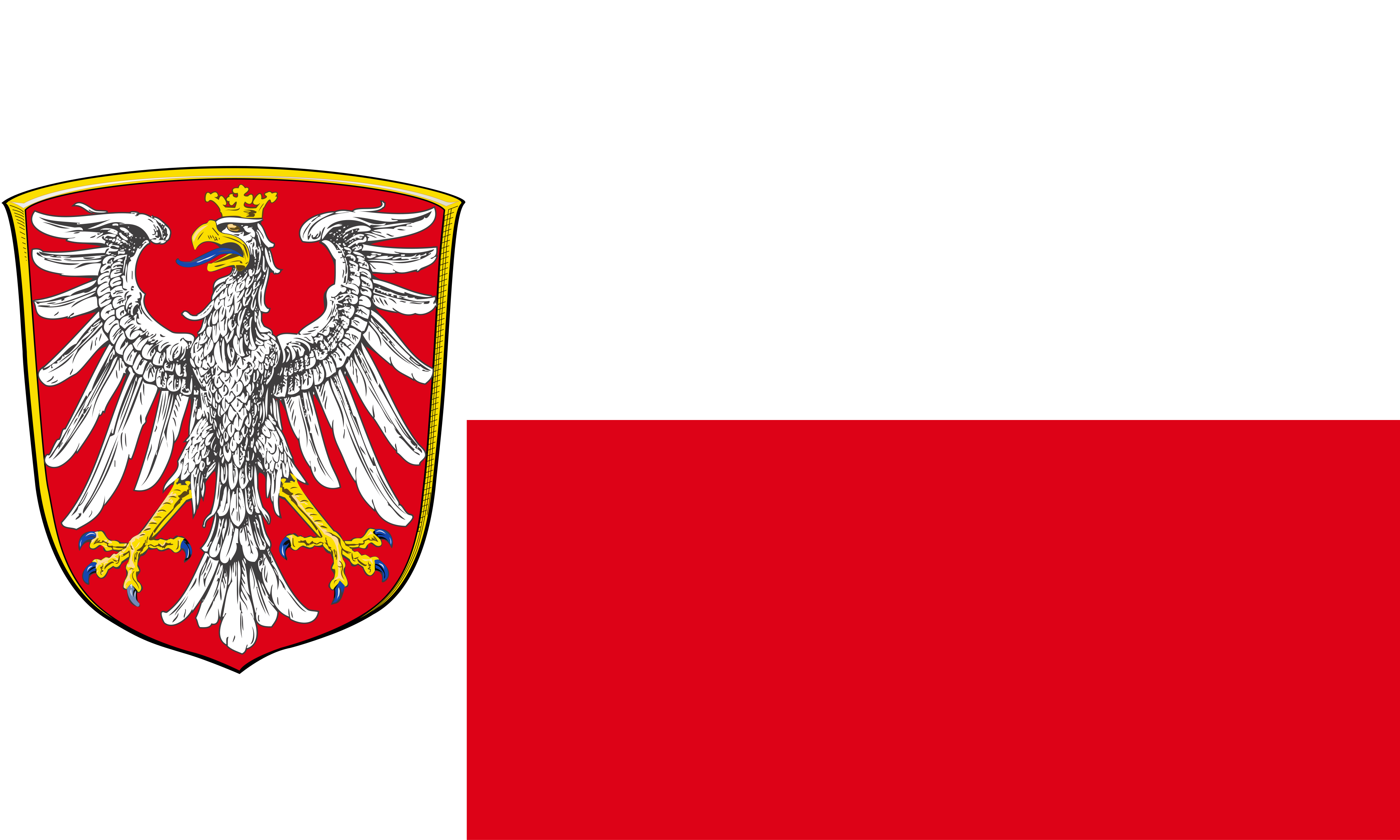
Frankfurt am Main at a glance
- Name
- Frankfurt am Main
- Country
- Germany
- Profile type
- City
- River
- Mainland
- Federal Republic of Germany
- Hessen
- First documentary mention
- 794
- Free Imperial City
- Since 1372
- Historic Town Hall
- Romani
- Parliamentary location
- Paul's Church
- National Assembly
- 1848
- Church Consecration of Paul's Church
- 1833
- Historic Place
- Römerberg
The Flag of Frankfurt am Main
The figure shows a white upper area and a red lower track, which begins only to the right of the hoist-side coat of arms field. On the left is the red shield with a silver-white, golden crowned eagle. This is therefore not a uniformly continuous red-white strip material with a central shield. The concrete arrangement helps with recognition.
The eagle belongs to the Frankfurt coat of arms tradition and refers to the historical connection to the Empire. The city sign should be distinguished from today's national eagle: in the illustration it has its own sign and a different color scheme. The earlier history of the Reichsstadt explains the political background better than a general interpretation as a sign of strength.
Frankfurt am Main: Location and Territorial Role
Frankfurt is located in Hessen am Main. The river is so important for the exact naming that it forms the city’s name suffix. This prevents confusion with Frankfurt on the Oder. The historic old town is located north of the Main and belongs to the core of the municipality described here, not to its own neighboring city.
The Municipal Institute of Urban History mentions 794 as the first documentary mention. In the Middle Ages and early modern times, Frankfurt gained importance as a place of choice and coronation. Since 1372 it was Free Imperial City. Thus, the city was assigned directly to the emperor and had a political status that strongly influenced its communal development.
Landscape, History and Culture
The old town bundles Römer, Römerberg, Kaiserdom and Paulskirche in a manageable vicinity. The places represent various functions: municipal administration, public squares, coronation tradition and parliamentary history. Who recognizes these differences, reads the city center more closely. The well-known city silhouette is therefore only one of several possible views on Frankfurt and its long development.
Another historical trace leads to trade. The Institut für Stadtgeschichte describes Frankfurt’s development as an important market and trade fair location. Political meetings and economic contacts strengthened each other. The historical significance of the city is therefore explained by an interplay of location, privileges and encounters, not just a single large institution.
The Paulskirche was consecrated in 1833 as the main evangelical Lutheran church. Their large elliptical hall was later suitable for political meetings. In 1848, the National Assembly met there. The building thus changed its historical role: a church space became the meeting place of a parliamentary movement whose constitutional work occupies a special place in German democratic history.
Römerberg
The Römerberg is a good starting point for arranging the historical center spatially. The Roman stands for the city administration and the long continuity of the town hall. The surrounding buildings convey a complex picture of reconstruction and historical memory. The current appearance of the old town is therefore always to be considered together with its construction and reconstruction history.
Paul's Church
The Paulskirche opens up a different scale of the city's history. The National Assembly of 1848 was an all-German event in a specific Frankfurt location. This explains the translocal significance of a communal building. Anyone who understands the church as a historic meeting room will more easily see why Frankfurt is connected with democratic constitutional work in addition to trade and city politics.
Main and Old Town
The Main places the historical center in a larger spatial context. The old town is located north of the river; the Römerberg and the surrounding historical places form a dense core here. Banks and bridges link this area with other parts of the city. The name suffix on the Main also captures the special geographical location in everyday usage.
Explore this country and nearby profiles
 Germany
 Munich
 Cologne
 Stuttgart
 Düsseldorf
 Dresden
 Leipzig
What did you discover?
Take this flag into the quiz
Sources and image credits
This English article draws on the institutional sources listed below. Figures and memberships retain their stated reference dates.
Source record: 2 November 2026. A translation does not change the reference date of a figure or membership list.
- stadtgeschichte-ffm.de/de/stadtgeschichte/zeittafel
- frankfurt.de/frankfurt-entdecken-und-erleben/stadtportrait/stadtteile/altstadt
- frankfurt.de/frankfurt-entdecken-und-erleben/sehenswuerdigkeiten/fuer-historisch-interessierte/paulskirche
- commons.wikimedia.org/wiki/File%3AFlag_of_Frankfurt_am_Main.svg