Stuttgart: City Flag, History and Identity
Stuttgart is the state capital of Baden-Württemberg and has a topography of valleys, slopes and the Neckar space. The black horse on the yellow coat of arms is a particularly easily recognizable city symbol. Together with Schlossplatz and older settlement sites, it shows how closely landscape, residence history and the tradition of a stud farm are connected.
Test your knowledge →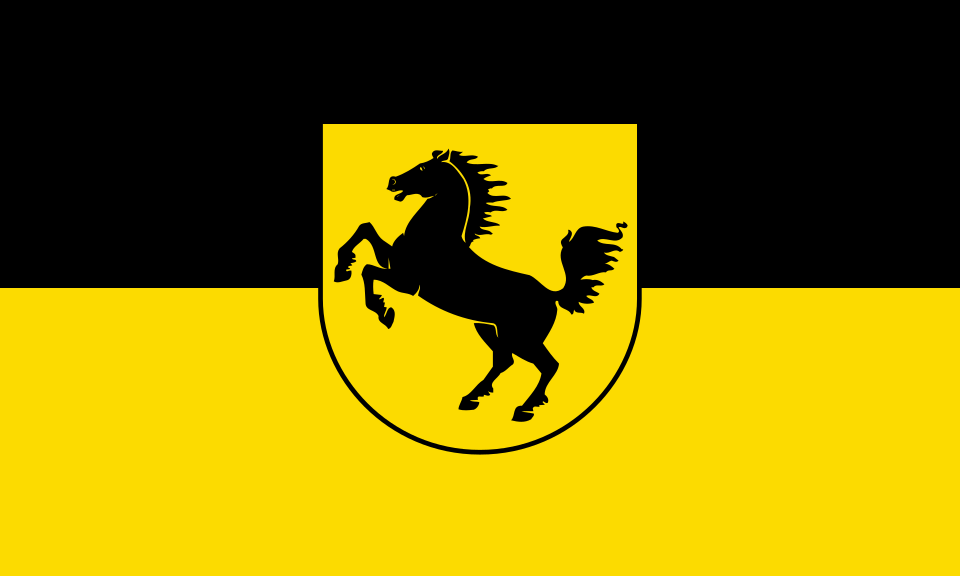
Stuttgart at a glance
- Name
- Stuttgart
- Country
- Germany
- Profile type
- City
- River area
- Neckar
- Federal Republic of Germany
- Baden-Württemberg
- First placement received
- 1229
- Older settlement core
- Canstatt
- Roman reference
- Reiterkastell near Cannstatt at the end of the 1st century
- Central Square
- Schlossplatz
- Column at the Schlossplatz
- Anniversary Column, about 30 meters
- Residential construction
- New castle
- Tradition of names
- Stuotgarten as a horse stud
The Flag of Stuttgart
The flag shown here is divided horizontally black and golden yellow. In the middle stands a golden shield with an erect black horse. The sign lies above both tracks and remains clearly visible even on the black upper field. For the identification, horse, shield and order of colors therefore belong together.
The horse alludes to the name tradition of Stuttgart. The town traces its origin to the Stuotgarten, a ducal horse stud around 950. This tradition should be named as such: The Federal Centre for Political Education points out that a concrete stud foundation is not directly documented.
Stuttgart: Location and Territorial Role
Stuttgart is located in the southwest of Germany and, as the state capital, performs central political functions for Baden-Württemberg. The center and the Neckar space do not form congruent landscape sections. The history of the city can be better understood if one considers the different settlement nuclei. Cannstatt in particular has its own long prehistory, which is older than the first written mention of Stuttgart.
The Neckar connects Stuttgart with other places in Baden-Württemberg. The urban representation traces its course from the area near Villingen-Schwenningen to the mouth in the Rhine near Mannheim. Within the urban area, the river opens up a different perspective than the city centre. River lanes, cultural places and historical traditions are spatially related here.
Landscape, History and Culture
The topography makes Stuttgart a city of changing views. From the center, paths lead to other altitudes; on the Neckar, in turn, own urban spaces open up. These differences help explain why not a single panorama represents the whole city. Rather, the Schlossplatz and the river area show two different sides of the same state capital.
The urban history knows medieval development and later residence functions. The name Stuokarten appears in the tradition before the first surviving mention of the place from 1229. From this, no exact foundation date should be constructed. Written initial documents, site development and older traces of settlements answer different historical questions and must be carefully distinguished.
The Schlossplatz is one of the central public spaces of the city centre. The city describes it as its largest inner-city square. Its complex combines lawns and baroque garden design with fountains and music pavilion. As a result, the space can be experienced simultaneously as a historical setting, place of encounter and everyday living space within the city centre.
Schlossplatz
In the middle of the Schlossplatz stands the approximately thirty-meter-high anniversary column. Behind the square lies the Neue Schloss, while Königsbau and Kunstmuseum determine other sides of the ensemble. The juxtaposition of different designs makes the place a good starting point for orientation: it mediates between representation, culture and public city life.
Roman Cannstatt
Cannstatt opens up a longer historical horizon. The Federal Centre for Political Education refers to a Roman equestrian castle above the Neckar at the end of the first century. The history of today’s Stuttgart does not begin everywhere at the same time. A modern city name may include older places whose past has been handed down under their own names.
Fishing stings on the Neckar
On the Neckar, traditional fishing stinging is one of the local events. The urban representation of the river area combines such customs with nature, culture and historical places along the water. As a result, the Neckar acquires a social dimension in addition to its transport and landscape significance. The river bank is a separate part of Stuttgart city life and complements the representative places in the center.
Explore this country and nearby profiles
 Germany
 Munich
 Cologne
 Frankfurt am Main
 Düsseldorf
 Dresden
 Leipzig
What did you discover?
Take this flag into the quiz
Sources and image credits
This English article draws on the institutional sources listed below. Figures and memberships retain their stated reference dates.
Source record: 2 November 2026. A translation does not change the reference date of a figure or membership list.
- stuttgart.de/kultur/stadtgeschichte/stadtgeschichte-im-ueberblick
- stuttgart.de/tourismus/stadtportraet/
- stuttgart.de/tourismus/sehenswuerdigkeiten/flusserlebnis-am-neckar
- bpb.de/shop/zeitschriften/apuz/stuttgart-2021/326243/stuttgart-ein-gang-durch-die-stadtgeschichte/
- commons.wikimedia.org/wiki/File%3AFlagge_Stuttgart.svg