Dortmund: City Flag, History and Identity
Dortmund can be understood in very different places: at the medieval Reinoldikirche, at the culturally used Dortmund U or at the artificial PHOENIX lake. The city in the eastern Ruhr region combines older trade history with industrial change. Its red-and-white flag with the black eagle, on the other hand, shows a city symbol that rejects far before the modern industrial city.
Test your knowledge →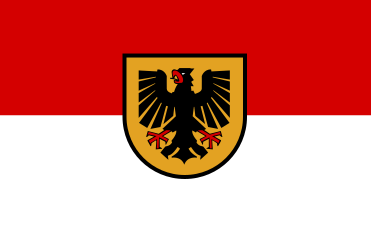
Dortmund at a glance
- Name
- Dortmund
- Country
- Germany
- Profile type
- City
- Main Historical Church
- St Reinoldi
- City patron
- Reinoldus
- Downtown axis
- Hello way
- Lake in the district
- Phoenix Lake in Hörde
- Opening of the sea
- Spring 2011
- Waterway
- About 3.2 kilometers
- Cultural Centre
- Dortmund U
- Parking landmarks
- Florian Tower in Westfalenpark
The Flag of Dortmund
On the displayed flag are red and white color tracks behind the city coat of arms. In the yellow coat of arms is a black eagle. The combination is crucial for the quiz: red and white alone occur in many cities, the eagle in the placed sign makes this representation much more specific and easier to assign.
The eagle belongs to the tradition of the imperial city of Dortmund. It should therefore not be read as a reflection of today's industry or as a club sign. The flag combines the city colors with the historical coat of arms motif. This representation contains the coat of arms; a mere red-and-white color surface would be a simplified form and would not reproduce all visible details.
Dortmund: Location and Territorial Role
Dortmund is located in North Rhine-Westphalia on the eastern part of the Ruhr area. With the Reinoldikirche, the city centre has a historical center, which has remained legible despite many subsequent changes. The Hellweg is one of the important axes of this space. Old trade routes and modern transport hubs overlap here directly in the center of the city.
However, the city consists of more than its core. In Hörde lies the PHOENIX lake, while the Westfalenpark forms another large leisure area. Such places are not interchangeable green spaces: the lake was created on a former steelworks site, the park combines gardens, events and views. Both tell their own story of urban planning.
Landscape, History and Culture
Lake PHOENIX was opened in spring 2011. The artificially created water combines recreation with flood protection and ecological tasks. As a result, in addition to the visible leisure value, it also has a technical function. The transformation of the former steel site makes it particularly clear how new urban landscapes can emerge from industrial areas without completely erasing their prehistory.
St. Reinoldi was closely associated with the municipal council in the Middle Ages. In and at the church, public events took place that went beyond worship. Trade agreements, council elections and foundations linked the construction with the citizenship’s self-image. The name refers to Reinoldus, the city patron, whose importance is still present in Dortmund today.
With the Dortmunder U, the city has a centre for art, media and creativity. It complements the historic churches and the large leisure spaces with a cultural focus. Together, the different places show a city whose identity is composed of several layers: commerce, civic representation, industry and new forms of use of older urban spaces.
Reinoldikirchen
The Reinoldikirche stands at an intersection of central inner city axes. Anyone who looks at their situation will see the connection between the market, the way and public life. The building is therefore not only suitable as an artistic monument, but also as a starting point for understanding the medieval urban order and the importance of the council in what was then Dortmund.
PHOENIX Sea
A circular path of about 3.2 kilometers opens up the shore of the lake. The water is part of a larger conversion in Hörde and stands for the conversion of an earlier steelworks area. Walks, nature observation and water sports meet here on a deliberately planned urban landscape, which at the same time takes over tasks of water management.
Westfalenpark’
In the Westfalenpark gardens and florian tower are among the defining elements. The observation tower makes the terrain recognizable from a greater distance, while paths and different garden spaces divide the park at ground level. As a supplement to the city centre and PHOENIX lake, it shows how diverse the public leisure spaces are distributed within Dortmund.
Explore this country and nearby profiles
 Germany
 Munich
 Cologne
 Frankfurt am Main
 Stuttgart
 Düsseldorf
 Dresden
What did you discover?
Take this flag into the quiz
Sources and image credits
This English article draws on the institutional sources listed below. Figures and memberships retain their stated reference dates.
Source record: 2 November 2026. A translation does not change the reference date of a figure or membership list.
- dortmund.de/themen/freizeit-und-kultur/parks-seen-und-zoo/phoenix-see/
- dortmund.de/dortmund-erleben/
- dortmund.de/themen/freizeit-und-kultur/parks-seen-und-zoo/westfalenpark/
- sanktreinoldi.de/st-reinoldi
- commons.wikimedia.org/wiki/File%3AFlag_of_Dortmund.svg
- rathaus.dortmund.de/dosys/gremrech2.nsf/0/2BC75A63CCA11117C125810700452072/$FILE/Anlagen_07175-17.pdf