Bern: City and Canton Flag, History and Identity
Bern is the federal city of Switzerland and at the same time the capital of the canton of Bern. The city and canton share the well-known flag with the black bear on a golden oblique beam in red field. The old town is located in an Aare loop and combines medieval planning with later buildings without losing its coherent historical floor plan.
Test your knowledge →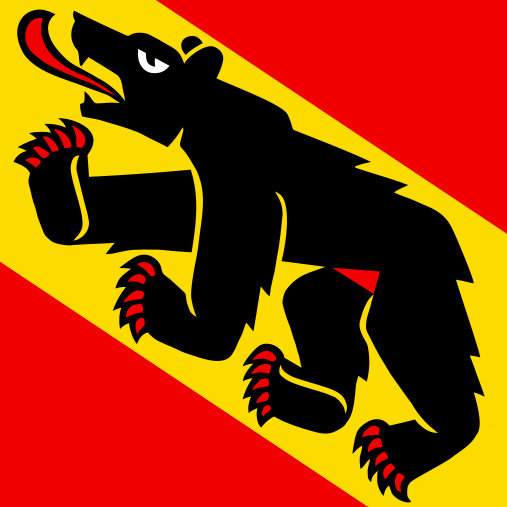
Bern at a glance
- Name
- Bern
- Country
- Switzerland
- Profile type
- City
- Shared design
- City and canton use the same flag
- River
- Aerials
- Large landscape
- Swiss Mittelland
- Year of birth transmitted
- 1191
- Traditional city founder
- Berchtold V of Zähringen
- World Heritage View of the Old Town
- 1983
- Opening of the Bear Park
- 2009
- Bridge at Bärenpark
- Nydegg Bridge
- Typical road space element
- Arbors or arcades
The Flag of Bern
On the red cloth, a broad golden beam runs diagonally from the upper hoist side to the lower free side. Then a black bear walks up. Its red details and clear color distribution give the flag a very striking face. The bear is the official coat of arms of both the city and the canton.
A well-known story traces the name and coat of arms to a hunt by the city founder: The first animal killed had determined the name. The city itself characterizes this derivation as a later tradition. The actual origin of the name is uncertain; therefore, the pretty history must not be used as a reliable language-historical proof.
Bern: Location and Territorial Role
The city of Bern is located in the Swiss Mittelland between Jura and the Alps. Its historical settlement was built on a hill surrounded by the Aare. The river location provided a clearly limited space for development. Today’s cantonal area is much larger and includes very different landscapes that do not belong to the municipality.
The term federal city refers to Bern’s special role as the seat of the Swiss federal authorities. In addition, the city has its municipal tasks and functions as the cantonal capital. These three levels explain why the name Bern can mean different things in political news: the municipality, the canton or the federal institutions working locally.
Landscape, History and Culture
The founding year is handed down in 1191; the founding is attributed to Duke Berchtold the Fifth of Zähringen. UNESCO highlights the planned development between the twelfth and fourteenth centuries. The growth took place in several extensions, which adapted to the special terrain of the Aare Peninsula instead of imposing a completely regular floor plan.
The old town has been a UNESCO World Heritage site since 1983. Its importance lies in a coherent urban ensemble, not just in an isolated landmark. Arcades, fountains and the building code, which has been continued for centuries, show how a city can accommodate different eras and still preserve a strikingly closed form.
The bear is also present outside of the heraldry. Its attitude in the city has a long history with multiple changing locations. Today’s bear park was opened in 2009. He connects the urban symbol with a real place on the banks of the Aare and at the same time makes visible that the handling of animals changes historically.
Old town in the Aareschleife
The old town can be read as an adaptation to a river peninsula. Streets and rows of houses follow an evolved planning concept, while the river bounds space on several sides. This connection is at the heart of their special cityscape and explains the World Heritage recognition more accurately than the mere designation of a beautiful old city.
Laurels
The arbors are among the striking elements of the Bernese street spaces. They connect building fronts with protected public roads. Together with fountains and house lines, an urban space is created that cannot be reduced to individual facades alone. The quality lies precisely in the combination of many recurring structural elements.
Bear Park
The bear park near the Nydegg Bridge translates the old coat of arms into today's city experience. Its opening marks a change from earlier narrower facilities. The history of the place should therefore be told separately from the legend of the name: a real date of the park does not automatically make the medieval hunting story historically true.
Explore this country and nearby profiles
 Switzerland
 Zurich
 Geneva
 Vaud
 Ticino
 St Gallen
 Graubünden
What did you discover?
Take this flag into the quiz
Sources and image credits
This English article draws on the institutional sources listed below. Figures and memberships retain their stated reference dates.
Source record: 2 November 2026. A translation does not change the reference date of a figure or membership list.
- bern.ch/zu-gast-in-bern/bern-stellt-sich-vor/stadtgeschichte
- whc.unesco.org/en/list/267/
- bern.ch/themen/stadt-recht-und-politik/informationen-im-stadtarchiv/archivtrouvaillen/baerenstark-fuer-bern
- lt.bkd.be.ch/de/start/traditionen/baerensymbolik.html
- bern.ch/themen/planen-und-bauen/denkmalpflege/unesco-weltkulturerbe