Graubünden: Canton Flag, Capital and Regional Profile
Graubünden combines alpine landscapes with an unusually diverse language culture. The Swiss canton is administered in German, Romanesque and Italian; even the schools show this diversity. His flag tells of the historic Three Flies, while the Rhaetic Railway and the Swiss National Park open two very different accesses to the mountain world.
Test your knowledge →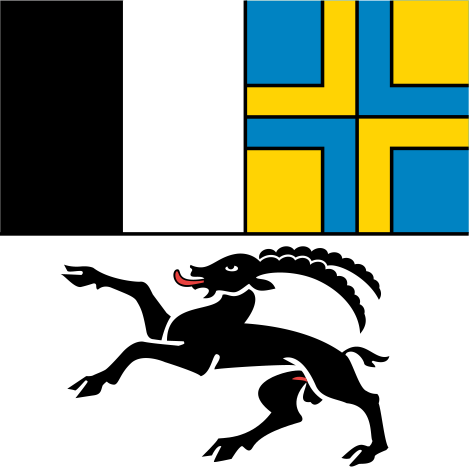
Graubünden at a glance
- Name
- Graubünden
- Country
- Switzerland
- Profile type
- Swiss canton
- Administrative seat in source record
- Chur
- Official languages
- German, Romanesque and Italian
- Cantonal emergence
- 1803
- Historical associations
- Grey Covenant, House of God Covenant and Ten Courts Covenant
- National Park Establishment
- 1 August 1914
- National Park location
- Engadin and Val Müstair
- Railway World Heritage
- Albula and Bernina landscapes, since 2008
- Cross-border heritage
- The railway station is located in Switzerland and Italy
- School language
- Determined by the municipalities according to language legislation
The Flag of Graubünden
The square flag shown puts together several coat of arms images. At the top are a black and white divided field and a blue and golden fourth cross next to each other. The lower white half bears an erect black Capricorn. It is precisely this division that distinguishes Graubünden from cantonal flags with a single simple sign.
The elements refer to the Grey Covenant, the Ten Judgment Covenant and the House of God. The Capricorn belongs to the covenant of churches, whose older history is connected with the Chur bishops. The present merger was cantonally established in 1932 and approved by the Federal Council in 1933; it replaces the former juxtaposition of three individual heraldic shields.
Graubünden: Location and Territorial Role
The main town of Chur belongs to a canton whose landscape and cultural connections extend far beyond a single city. The Engadin and the Val Müstair are also located in Graubünden. This is where the Swiss National Park is located, whose task expressly combines nature conservation, scientific research and information.
The three cantonal official languages do not mean a completely uniform trilingualism in every place. Municipalities determine their official and school language according to the language legislation. That is why there are German-speaking, Romance-speaking and Italian-speaking schools. Regional differences become visible in public life instead of being obscured by a single language of instruction.
Landscape, History and Culture
In the national park, the focus is on the free development of natural processes. Its foundation on 1 August 1914 made it the oldest national park in the Alps. The strict concept of protection allows us to understand landscape as a research space: we observe how habitats develop when human interventions are absent as far as possible.
The Albula and Bernina lines of the Rhaetian Railway, on the other hand, show how humans have technically developed high mountains. Bridges, tunnels and meticulous lines are part of a coherent landscape experience. UNESCO pays tribute to the interplay between architecture, railway technology and mountain landscape, which has had a lasting influence on the development of human activities in the mountains.
Language policy is also an everyday educational task here. In Italian- and Romance-speaking primary schools, German is taught as the first foreign language; German-speaking schools start with Italian or Romanesque. This mutual orientation makes neighbouring languages a concrete part of teaching and explains why multilingualism goes far beyond multilingual place signs.
Railways as a World Heritage Site
Since 2008, the Rhaetian railway lines in the Albula and Bernina landscapes have been on the World Heritage List. The cross-border site concerns Switzerland and Italy. A technical ensemble is protected in its spatial context, i.e. more than a single spectacular train or an isolated bridge.
National Park in the Southeast
The national park is located in the Engadin and in the Val Müstair. Although his headquarters as a foundation are located in Bern, his protected landscape is in Graubünden. This distinction helps to keep a clean distinction between the administration of an institution and its actual geographical scope.
Three frets in the picture
The flag can be read like a small historical map: three different political traditions are combined into a cantonal sign. The blue-golden cross belongs to the ten-court covenant, the Capricorn to the covenant of churches. Together they tell more about the formation of the canton than a general symbolism of color.
Explore this country and nearby profiles
 Switzerland
 Zurich
 Bern
 Geneva
 Vaud
 Ticino
 St Gallen
What did you discover?
Take this flag into the quiz
Sources and image credits
This English article draws on the institutional sources listed below. Figures and memberships retain their stated reference dates.
Source record: 2 November 2026. A translation does not change the reference date of a figure or membership list.
- gr.ch/DE/kanton/wappen/Seiten/Kantonswappen.aspx
- gr.ch/DE/institutionen/verwaltung/ekud/avs/Schulbetrieb/sprachen/Seiten/default.aspx
- nationalpark.ch/about/nationalpark/
- whc.unesco.org/en/list/1276