Rhineland-Palatinate: State Flag, Capital and Regional Profile
In western Germany, Rhineland-Palatinate connects river valleys, wine landscapes and a dense historical heritage. Mainz is the state capital. The black-red-golden flag carries a coat of arms with a cross, wheel and lion. These signs are reminiscent of older dominions, while today's federal state was formed from previously differently assigned territories only after the Second World War.
Test your knowledge →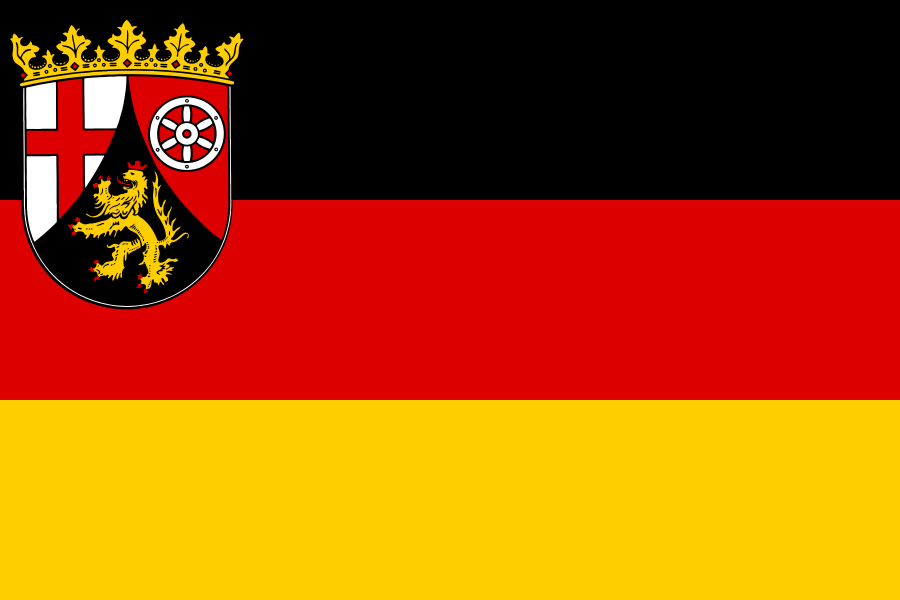
Rhineland-Palatinate at a glance
- Name
- Rhineland-Palatinate
- Country
- Germany
- Profile type
- German federal state
- Administrative seat in source record
- Mainz
- Establishment
- 30 August 1946
- Founding power
- French military government
- Previous territorial affiliations
- Among others Prussia, Hesse and Bavaria
- First state elections
- 1947
- Relocation of national institutions
- 1951 from Koblenz to Mainz
- Important rivers
- Rhine and Moselle
- World Heritage Site Upper Middle Rhine Valley
- Since 2002
- World Heritage Trier
- Roman buildings, cathedral and Liebfrauenkirche since 1986
- Historical coat of arms references
- Kurtrier, Kurmainz and Kurpfalz
The Flag of Rhineland-Palatinate
The background colors follow the order black, red and gold from top to bottom. The coat of arms sits in the upper area near the mast and not freely in the middle of the entire flag. Its winery crown and the three different coat-of-arm fields make the representation of a simple German federal flag distinguishable.
In the coat of arms stand the red cross for Trier, the silver wheel for Mainz and the golden lion for the Palatinate. This refers to historical electoral territories and their symbols, not just three contemporary cityscapes. The vineyard crown forms a further regional reference. Together, the coat of arms brings together different historical traditions in today's country.
Rhineland-Palatinate: Location and Territorial Role
Rhineland-Palatinate is located in the west of Germany. Mainz fulfils the function of the state capital and is the seat of the state government and state parliament. This role has a special post-war history: Initially, the state institutions worked in alternative quarters in Koblenz before moving to the restored capital in 1951. Thus, the determination of the capital and the actual place of work fell apart at times.
The Rhine and Moselle form important orientation lines for the country. Its valleys connect traffic routes, settlements and viticulture. The Upper Middle Rhine Valley also crosses the border with Hesse. Natural and cultural landscapes therefore do not always follow the boundaries of an individual federal state, even if they are particularly important for its self-image.
Landscape, History and Culture
On the thirtieth of August 1946, Rhineland-Palatinate was founded by the French military government. Its components had previously belonged, among others, to Prussia, Hesse and Bavaria. A long common history in the current border did not exist. The new federal state therefore had to establish connections between regions that brought with them different administrations and traditions.
In 1947, the first state elections took place and a state constitution gave the new order a democratic basis. The history of the country can thus be distinguished from the much older history of its territory. Roman cities, medieval dominions and modern reorganizations form different layers that must not be confused with the founding date of the federal state.
The Upper Middle Rhine Valley was included in the UNESCO World Heritage List in 2002. Between Bingen, Rüdesheim and Koblenz, castles, historical places and vineyards illustrate the long interaction between people and a striking river landscape. The recognition concerns a spatial ensemble and not all sections of the entire Rhine from the source to the estuary.
Upper Middle Rhine Valley
In the Upper Middle Rhine Valley there are paths, settlements and castles in close relation to the river. The steep slopes make the landscape particularly impressive, while vineyards show the long use. The World Heritage View therefore combines natural form and cultural history, instead of viewing the valley exclusively as a beautiful view or as a technical transport corridor.
Trier's multi-faceted legacy
Trier has an extraordinary Roman heritage. Roman buildings, cathedral and Liebfrauenkirche were jointly declared a UNESCO World Heritage site in 1986. The connection between different epochs is essential: Ancient buildings and Christian successor buildings show how a city developed further on existing structures. The heritage thus extends far beyond a single well-known city gate.
Koblenz and Mainz
The relocation of the state institutions from Koblenz to Mainz in 1951 is a concrete key to recent history. It shows how much the construction of the new federal state depended on the conditions of reconstruction. Today’s unequivocal role as the capital arose in practical steps and was not fully realized spatially from day one.
Explore this country and nearby profiles
 Germany
 Munich
 Cologne
 Frankfurt am Main
 Stuttgart
 Düsseldorf
 Dresden
What did you discover?
Take this flag into the quiz
Sources and image credits
This English article draws on the institutional sources listed below. Figures and memberships retain their stated reference dates.
Source record: 2 November 2026. A translation does not change the reference date of a figure or membership list.
- lav.rlp.de/geschichte-entdecken/landesgeschichte/land-rheinland-pfalz
- rlp.de/service/wappen-und-landessiegel
- landtag-rlp.de/de/parlament/der-landtag-und-seine-aufgaben/deutschhaus-und-wappen/das-landeswappen.htm
- whc.unesco.org/en/list/1066
- whc.unesco.org/en/list/367
- lpb.rlp.de/themen/unser-land/landesgeschichte