North Rhine-Westphalia: State Flag, Capital and Regional Profile
North Rhine-Westphalia connects the Rhine, Ruhr area, Westphalian landscapes and Lippe in a common federal state. Düsseldorf is its state capital. The flag shown here consists of three horizontal paths in green, white and red. Their colours are reminiscent of historical parts of the country, while today’s country was created by the reorganization after the Second World War and subsequently expanded.
Test your knowledge →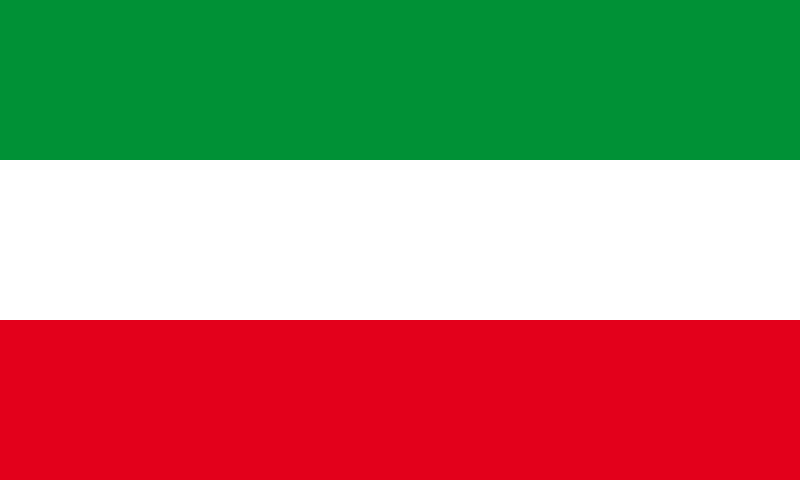
North Rhine-Westphalia at a glance
- Name
- North Rhine-Westphalia
- Country
- Germany
- Profile type
- German federal state
- Administrative seat in source record
- Düsseldorf
- Date of establishment
- 23 August 1946
- Accession of Lippes
- 1947
- Government districts
- Five
- District seats
- Düsseldorf, Cologne, Münster, Detmold and Arnsberg
- Historic third part of the country
- lip
- Lowland areas
- Westphalian Bay
- Central mountainous areas
- Sauerland and Siegerland
- World Heritage in Essen
- Zeche Zollverein since 2001
- Further landscape
- Weserbergland’
The Flag of North Rhine-Westphalia
At the top is green, in the middle white and at the bottom red. No coat of arms can be seen on this simple country flag. Especially with a familiar three-coloredness is worth the exact look at the order. The national service flag additionally contains the coat of arms; this more detailed official version is not the variant shown here.
The colors were combined from the historical provincial colors of the Rhineland and Westphalia. The coat of arms complements the river reference, the Westphalian horse and the lippian rose. Thus, the flag and the coat of arms can be read together without equating them: the simple tricolor condenses the traditions into colors and dispenses with the individual heraldic figures.
North Rhine-Westphalia: Location and Territorial Role
North Rhine-Westphalia is located in western Germany. Düsseldorf is the seat of state politics, while Cologne, Essen, Dortmund and many other cities each form their own urban centers. The name Ruhrgebiet in turn denotes a larger intertwined space. It is neither another word for the entire federal state nor a single municipality with a unified city administration.
The country historically consists of Rhineland, Westphalian and Lipean areas. Its administration is divided into five administrative districts: Düsseldorf, Cologne, Münster, Detmold and Arnsberg. This level lies between state government and municipal tasks. The common national flag thus stands above a diverse political and cultural internal structure, which cannot be explained by the largest cities alone.
Landscape, History and Culture
North Rhine-Westphalia was established on 23 August 1946 by a decree of the British military government. Initially, the province of Westphalia and the northern part of the Rhine Province were connected. In 1947, Lippe joined. The current name of the country does not explicitly mention this third historical component, but in the coat of arms it is permanently represented by the rose.
Westphalia has a share in the North German lowlands and the Middle Mountain zone. The natural structure includes the Westphalian Bay, the Weserbergland as well as Sauerland and Siegerland. These differences complement the often predominant picture of the industrial and metropolitan region. A federal state with many densely populated areas can at the same time comprise extensive rural and mountainous landscapes.
The Zollverein colliery in Essen has been a UNESCO World Heritage site since 2001. The preserved industrial complex comprises not only production towers, but also plants for coal processing, coking plant and transport infrastructure. Its importance lies in the overall context of a large industrial system and in the architectural design of important buildings of the twentieth century.
Zollverein colliery
Zollverein allows a concrete look at the history of the coal industry. Production, processing and further processing required interconnected facilities. The monument therefore illustrates more than a single machine: it shows the spatial organization of industrial production and complements the current use of the site with a traceable historical structure.
Westphalian Bay
The Westphalian Bay forms a lowland area within the country. Their comparison with Sauerland and Siegerland explains why Westphalia itself is not a uniform mountain landscape. Regional names can be used historically, culturally or natural. For the orientation, one should ask which of these meanings is meant in the concrete context.
Lippian history
Lippe received his place in the federal state in 1947. The government district of Detmold and the lippian rose in the coat of arms help to make this often overlooked component visible. History reminds us that a compound country name only explains part of the origin and does not have to bear every regional identity expressly in the wording.
Explore this country and nearby profiles
 Germany
 Munich
 Cologne
 Frankfurt am Main
 Stuttgart
 Düsseldorf
 Dresden
What did you discover?
Take this flag into the quiz
Sources and image credits
This English article draws on the institutional sources listed below. Figures and memberships retain their stated reference dates.
Source record: 2 November 2026. A translation does not change the reference date of a figure or membership list.
- landtag.nrw.de/home/der-landtag/funktionen-und-aufgaben.html
- im.nrw/themen/verwaltung/provinzen-fluss-und-pferd
- westfalen-regional.de/de/landesteile/
- whc.unesco.org/en/list/975
- zollverein.de/zollverein-unesco-world-heritage-site/history/