Florida: State Flag, Capital and Regional Profile
Florida is a water-dominated state in the southeast of the USA. Its peninsula, the Everglades and the island world in the south convey a different landscape than the northern seat of government Tallahassee. The flag connects a red oblique cross with the state seal. History and nature can be viewed separately here and then brought together.
Test your knowledge →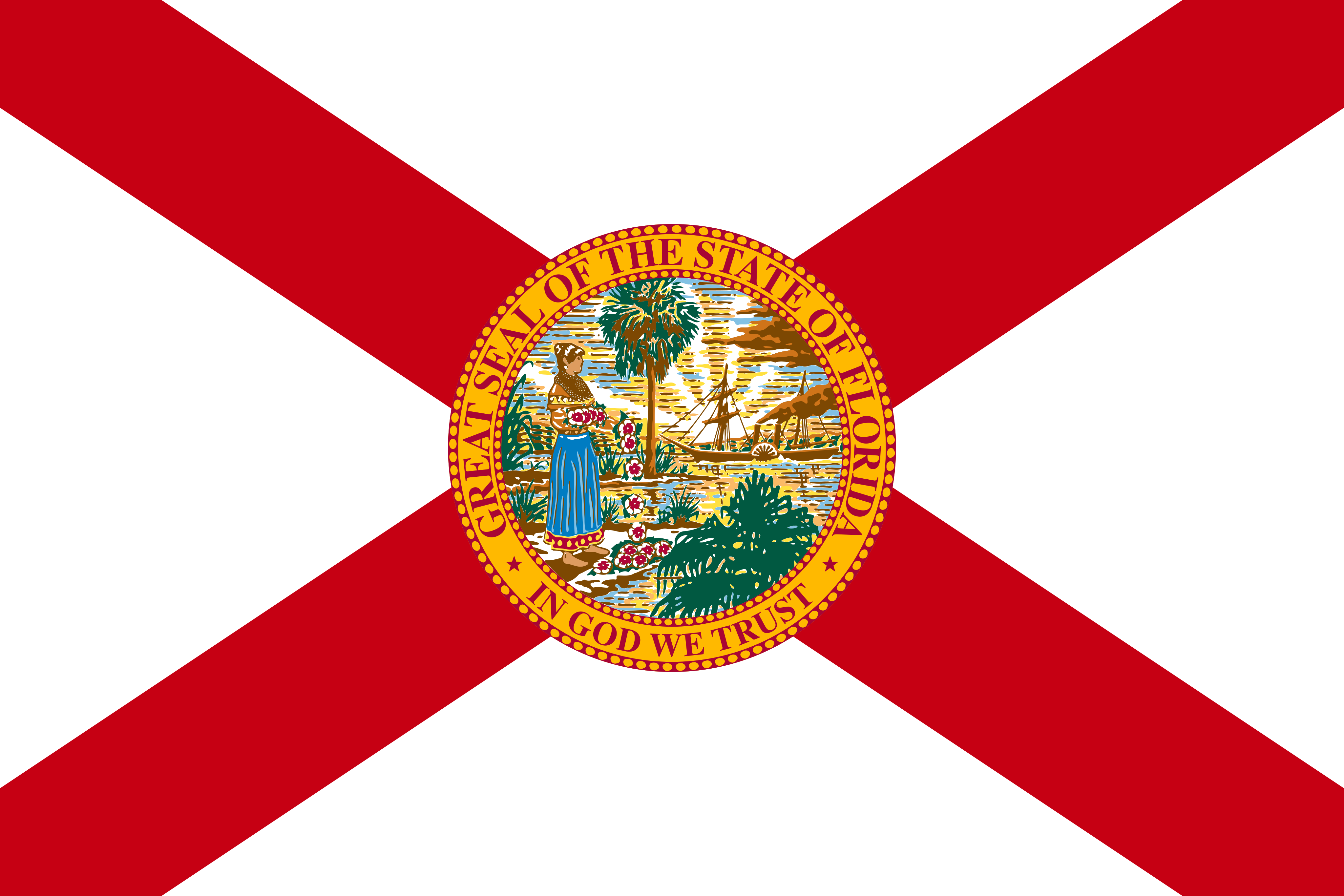
Florida at a glance
- Name
- Florida
- Country
- United States
- Profile type
- US state
- Administrative seat in source record
- Tallahassee
- Taking up of the State
- March 3, 1845 as the 27th federal state
- U.S. change of rule
- 1821
- Capital decision
- Tallahassee became the seat of government in 1824.
- Former colonial capitals
- St. Augustine and Pensacola
- Largest lake
- Lake Okeechobee
- Longest river according to the Department of State
- St Johns
- Everglades World Heritage Site
- Since 1979
- Foundation of St. Augustine
- 1565 as a Spanish settlement
The Flag of Florida
On the white flag lies a red diagonal cross whose arms run from the corners to the center. At the center is the round state seal with landscape representation and writing. For recognition, the combination is crucial: A red oblique cross alone would not be a sufficiently clear feature for Florida.
The basic pattern with the red diagonal bars was adopted in 1900. Previously, the state flag between 1868 and 1900 consisted of a white cloth with seal. The Department of State also explains the addition by saying that a limp flag hanging from the mast should not appear like a mere white flag.
Florida: Location and Territorial Role
Tallahassee was designated as the seat of government of the territory at that time in 1824. This means that the capital is located in the northern part of Florida and not in Miami or Orlando. Older history explains this situation: During British rule, East and West Florida had their own main towns, St. Augustine and Pensacola.
The Everglades, on the other hand, are at the southern tip of the peninsula. Your national park protects part of a much larger water and wetland system. To equate him with the entire Everglades would be inaccurate. Natural processes within the park depend closely on how water is distributed and used in areas further north.
Landscape, History and Culture
Florida’s countryside offers lakes, springs, coasts and rivers. The St. Johns is considered the longest river in the state in the official collection of facts, Lake Okeechobee as the largest lake. These inland waters complement the familiar picture of the beaches and show that water plays a central role even far away from the immediate sea coast.
The Everglades connect subtropical and temperate wildlife. Alligators, crocodiles, manatees and the Florida Panther are among the species for which the area is of particular importance. Open wetlands, mangroves and coastal areas do not form independent backdrops, but a coherent ecological impact area with interconnected food chains.
Historically, Florida alternated several times between Spanish and British rule before coming under US administration. The formal change of rule was carried out in 1821; in 1845 it was accepted as the 27th federal state. This sequence helps to distinguish colonial local history, time as a territory and later state history from each other.
Tallahasse's capital role
The decision of 1824 ended a phase with two older administrative centers. St. Augustine and Pensacola had served as capitals in different periods of rule. The current political centre can therefore be explained by territorial history and not only by the size or prominence of modern cities.
Everglades as a World Heritage Site
Since 1979, the National Park has been a UNESCO World Heritage Site. The property is a living ecosystem with very different aquatic habitats. Its preservation demands more than the preservation of a landscape: water quality, influx and the temporal course of flooding directly affect plants and animals.
Saint Augustine
The official collection of facts mentions St. Augustine as a permanent European settlement founded by Spain in 1565. This gives a clearly named colonial historical reference. The phrase expressly denotes European settlement and must not be understood as if Florida’s history only began with this event.
Explore this country and nearby profiles
 United States
 New York City
 Chicago
 Washington, D.C.
 Los Angeles
 San Francisco
 California
What did you discover?
Take this flag into the quiz
Sources and image credits
This English article draws on the institutional sources listed below. Figures and memberships retain their stated reference dates.
Source record: 2 November 2026. A translation does not change the reference date of a figure or membership list.
- dos.fl.gov/florida-facts/florida-state-symbols/state-flag/
- dos.fl.gov/florida-facts/quick-facts/
- dos.fl.gov/historical/about/division-faqs/florida-history/
- whc.unesco.org/en/list/76