California: State Flag, Capital and Regional Profile
California extends from the Pacific to the Sierra Nevada mountains. His bear flag commemorates a brief political episode of 1846 and later became a state sign. For a more precise picture, it is worth taking a look at two protected landscapes: the granite forms of Yosemite and the old coastal redwood forests in the north.
Test your knowledge →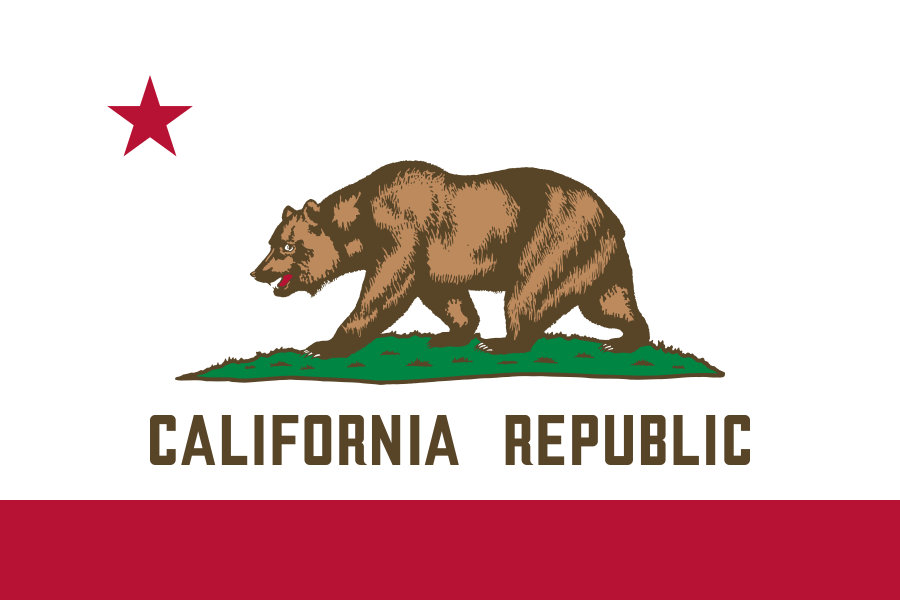
California at a glance
- Name
- California
- Country
- United States
- Profile type
- US state
- Administrative seat in source record
- Sacramento
- Mountains
- Sierra Nevada
- Yosemite landforms
- Granite walls and glacier-shaped valleys
- Known rock formations
- Half Dome and El Capitan
- Yosemite National Park
- Established in 1890
- Yosemite World Heritage Site
- Since 1984
- Redwood National Park
- Created in 1968
- State flower
- Californian poppy
- State tree
- California redwood
The Flag of California
On a white background, a brown bear runs over a green strip of ground. On the upper left is a red star; a red stripe forms the lower end. In between, the inscription California Republic appears. This writing is expressly part of the motif and explains why the flag is more than a pure animal image.
Today's Bear Flag picks up the flag of the Sonoma uprising in 1846. The state park administration describes star, red stripes, bears and writing as standardized basic elements. The Californian Grizzly was also declared a state animal in 1953, although this bear population no longer exists in California.
California: Location and Territorial Role
Sacramento is the capital of the state. California, however, is not on par with this city, nor with Los Angeles or San Francisco. The Yosemite and Redwood National Parks are located in different natural areas: Yosemite in the Sierra Nevada, Redwood in the northern coastal area on the Pacific.
The Redwood National and State Parks connect a federal national park with three older state parks. These include Prairie Creek Redwoods, Del Norte Coast Redwoods and Jedediah Smith Redwoods. This example shows that nature reserves in the USA have been created by different levels of government and can be looked after jointly.
Landscape, History and Culture
Yosemite’s distinctive forms were created by the interaction of granite rock and repeated glaciation. Steep rock faces, rounded crests, hanging valleys and waterfalls make these processes vivid. Half Dome and El Capitan are therefore not only well-known photo motifs, but also particularly recognizable testimonies to the geological history of the Sierra Nevada.
The coastal sequoias convey a different scale of landscape. The Redwood World Heritage site protects ancient forests in their connection with running waters, coast and neighboring habitats. What is crucial is the contiguous habitat; individual very tall trees alone would not fully explain the ecological significance of the protected area.
California’s state natural signs pick up on this diversity. In addition to the Grizzly, the state runs the Californian poppy as the official flower and the redwood as the state tree. Such symbols simplify a very diverse landscape, but provide good entry points: bear flags, flowering open spaces and old forests tell different stories.
Yosemite Valley
The Yosemite Valley is a glacier-shaped valley with high granite walls. UNESCO emphasizes how clearly the effect of ice on the initial rock can be seen here. The park has been a World Heritage Site since 1984; the national park status was established in 1890.
Redwood as a protective compound
The Redwood National Park was created in 1968. The three embedded state parks had already been established in the 1920s. Their joint protection preserves old coastal forests along with the landscapes that surround them and shows the importance of long-term cooperation between federal and state administration.
Sonoma and the bear flag
The words California Republic keep the memory of the bear flag episode of 1846 present. The flag shown today is a later, unified state flag. Its recurring elements can therefore be read at the same time as a historical retrospective and as a consciously established modern mark of recognition.
Explore this country and nearby profiles
 United States
 New York City
 Chicago
 Washington, D.C.
 Los Angeles
 San Francisco
 New York
What did you discover?
Take this flag into the quiz
Sources and image credits
This English article draws on the institutional sources listed below. Figures and memberships retain their stated reference dates.
Source record: 2 November 2026. A translation does not change the reference date of a figure or membership list.
- parks.ca.gov/
- ca.gov/about-california/
- whc.unesco.org/en/list/308/
- whc.unesco.org/en/list/134
- capitolmuseum.ca.gov/state-symbols/state-animal-grizzly-bear/