Los Angeles: City Flag, History and Identity
Los Angeles combines a historic foundation on the river with a vast urban landscape in southern California. Its flag stands out through jagged green, gold and red tracks. The city seal in the center complements this strong formal language with references to the changing political affiliations and the early history of the city on the Pacific.
Test your knowledge →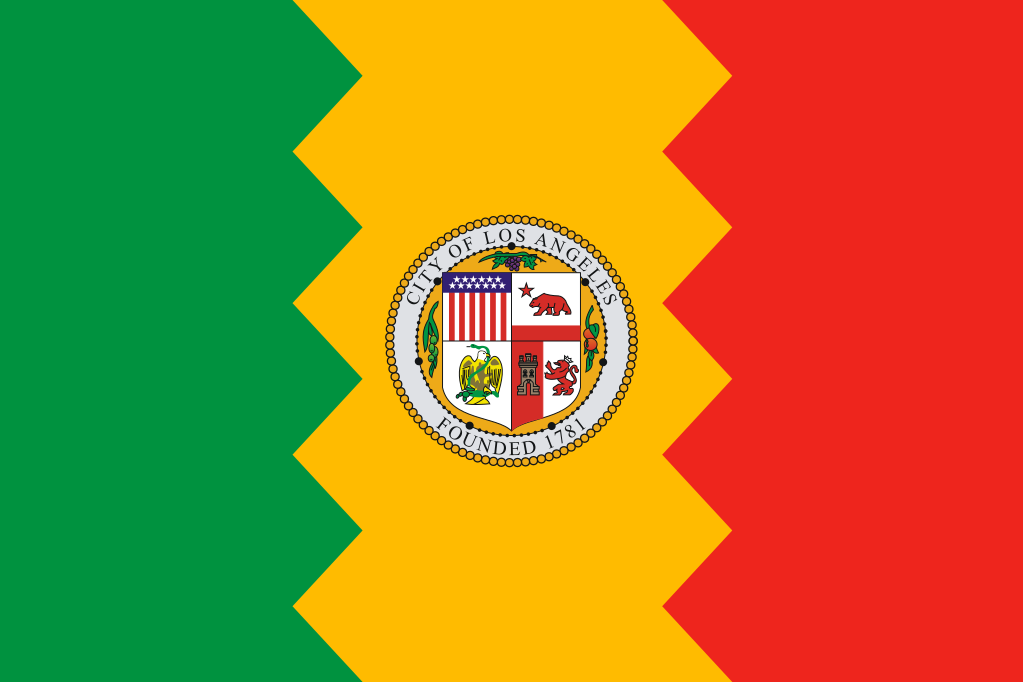
Los Angeles at a glance
- Name
- Los Angeles
- Country
- United States
- Profile type
- City
- Founding day
- 4 September 1781
- Early settlement form
- Agricultural Pueblo
- Indigenous geographical reference
- Yangna
- Historical monument
- El Pueblo de Los Angeles
- Opening of the Observatory
- 1935
- Opening of the Greek Theatre
- 1930
- Mountain at the Observatory
- Mount Hollywood
- Quarter under the Observatory
- Los Feliz
The Flag of Los Angeles
The three color webs run perpendicularly and are separated from one another by zigzag lines. Green stands on the mast, gold in the middle and red at the free end. Above it lies a round city seal. The restless dividing lines are a particularly useful recognition feature, because they distinguish the cloth from an ordinary straight tricolor.
The urban representation combines green with olives, gold with oranges and red with vineyards. At the same time, these colors also appear in the flags of Spain and Mexico, whose history is important for Los Angeles. The seal bundles political memories; the flag should therefore not be understood as a simple picture of today's city plan.
Los Angeles: Location and Territorial Role
Los Angeles is a city in the US state of California. It can be distinguished from the county of the same name, which also includes other independent cities. This distinction is especially important when talking about the entire metropolitan region: a well-known place name or a common economic region does not yet make other municipalities districts.
The historic center of El Pueblo offers a different scale than the vast contemporary city. This is the symbolic core of the founding story. Griffith Park, on the other hand, makes the topographical diversity clear: On the slopes of Mount Hollywood stands the observatory over Los Feliz and connects the densely built city with its mountain landscape.
Landscape, History and Culture
The official day of its founding is the fourth of September 1781. The settlement was established as an agricultural Pueblo in the Spanish colonial area. The National Park Service points out that the place was created nearby or at the square of the indigenous village Yangna. The history of the city therefore does not begin with the arrival of European settlers.
El Pueblo is preserved today as a historical monument. The history conveyed there includes indigenous, African, Spanish, Mexican and other cultural contributions. This diversity is essential for the early city. A single origin label would not do justice to the people who built and changed the place and the different experiences of its inhabitants.
Griffith Observatory opened in 1935. Its purpose from the outset was to make astronomy and observation accessible to a broad public. Thus, the building is not only part of the history of science, but also of public education and urban leisure activities. Its location also makes it a striking viewpoint.
El Pueblo
The historic El Pueblo preserves the reference to the early settlement. Those who look at its buildings and squares can trace the big city back to a manageable starting space. The monument thus serves not only the memory of a date, but also explains the spatial and cultural development of the place.
Griffith Park
Griffith Park was created from a land donation by Griffith Jenkins Griffith. Its development includes the Greek Theatre, which was created in 1930, and the later Observatory. The context shows how public green spaces, stages and scientific institutions could be planned together instead of fulfilling exclusively separate tasks in distant districts.
Griffith Observatory
The observatory is located on the southern slope of Mount Hollywood above the Los Feliz district. This concrete location explains the wide view over the city. When compared with the flag, it is noticeable that the actual mountain landscape is not depicted there; the cloth rather condenses history into colors, teeth and seals.
Explore this country and nearby profiles
 United States
 New York City
 Chicago
 Washington, D.C.
 San Francisco
 California
 New York
What did you discover?
Take this flag into the quiz
Sources and image credits
This English article draws on the institutional sources listed below. Figures and memberships retain their stated reference dates.
Source record: 2 November 2026. A translation does not change the reference date of a figure or membership list.
- lacity.gov/government/history-los-angeles
- home.nps.gov/places/el-pueblo-de-los-angeles-historical-monument.htm
- griffithobservatory.lacity.gov/about/
- recreation.parks.lacity.gov/department/history
- codelibrary.amlegal.com/codes/los_angeles/latest/laac/0-0-0-7234
- commons.wikimedia.org/wiki/File%3AFlag_of_Los_Angeles%2C_California.svg