Chicago: City Flag, History and Identity
Chicago lies on Lake Michigan and tells its story with an unusually memorable flag. Four red stars stand between light blue stripes on white. Behind this simple picture hides a city fire, two exhibitions and an early military post. At the lakeside, Chicago’s connection between urban planning, culture and water can be understood.
Test your knowledge →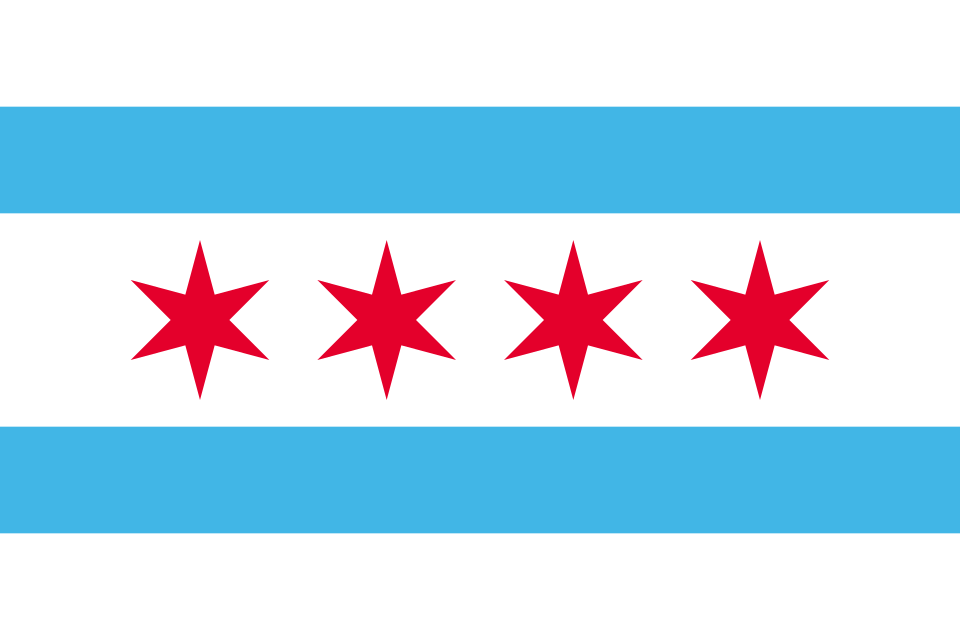
Chicago at a glance
- Name
- Chicago
- Country
- United States
- Profile type
- City
- Sea
- Lake Michigan
- State
- Illinois
- Urban survey
- 4 March 1837
- Municipal constituencies
- 50 Wards According to City Clerk
- Flag designers
- Wallace Rice
- Adoption of the draft
- 1917
- Recalled fire
- The Great Fire of 1871
- Recalled exhibition
- World's Columbian Exposition 1893
- Cultural area on the shore
- Museum Campus at the Loop
The Flag of Chicago
The flag used here has a white background, two horizontal light blue stripes and four red stars in a row. Each star has six peaks. The wide white midfield makes the stars stand out clearly. This form is more important for recognition than a general reference to American star motifs.
Wallace Rice designed the 1917 adopted flag. Originally it contained only two stars; the present group of four was formed later. The events behind the stars are Fort Dearborn, the Great Fire of 1871, the World's Fair of 1893 and the Century of Progress exhibition of 1933/34.
Chicago: Location and Territorial Role
Chicago is part of the US state of Illinois. Lake Michigan determines the eastern orientation of the city, while the Chicago River forms an additional spatial axis. A city description should not treat the lake as a river and Chicago as the capital of Illinois. The communal identity and political function of the state are different things.
The city council works with constituencies, the so-called wards. The City Clerk office names fifty such districts and explains their representation in the City Council. The history of the constitution begins with the city elevation of March 4, 1837. The then smaller administrative area subsequently developed into a much more differentiated municipal organization.
Landscape, History and Culture
The light blue flag strips take up the water landscape. The upper one stands for Lake Michigan and the northern river arm, the lower one for the southern river arm and the shipping channel. The three white areas are assigned to the northern, western and southern sides of the city. A map helps to understand this symbolism spatially.
The fire of 1871 is one of the central historical cuts commemorated on the flag. In addition, the exhibitions stand for the claim to present themselves internationally. The stars therefore do not form a mere decoration: they place very different moments of an urban narrative on an equal footing in a common row.
On the lakefront is the Museum Campus near the business and entertainment district Loop. The communal portrait of this site describes a cultural and leisure space that has changed over a long time. Museums, nature education and sport meet there. The waterfront and the city centre are thus connected via public facilities and designed open spaces.
Museum Campus on the Lake
The Museum Campus offers good access to Chicago as a planned lake town. Its development is traced from the city to early considerations of 1909. The current site is the result of several conversions. Anyone who looks at it therefore does not see a completed individual planning, but an urban space continuously adapted to new uses.
Chicago History Museum
The Chicago History Museum raises the question of a possible fifth star for the culture of remembrance itself. This makes it understandable that a flag makes historical selections. Four events are recorded; many more experiences of the city remain outside this picture. A city sign can be concise without depicting the entire past.
City Council and Wards
The fifty wards divided Chicago for the work of the City Council. Each district sends a representation to the city council. The municipal organization makes it clear that behind the common city flag are numerous local interests. The City Clerk Office describes this structure as a further development of the original six constituencies from the first city statute of 1837.
Explore this country and nearby profiles
 United States
 New York City
 Washington, D.C.
 Los Angeles
 San Francisco
 California
 New York
What did you discover?
Take this flag into the quiz
Sources and image credits
This English article draws on the institutional sources listed below. Figures and memberships retain their stated reference dates.
Source record: 2 November 2026. A translation does not change the reference date of a figure or membership list.
- chicityclerk.com/about-city-council
- chicagohistory.org/exhibition/fifth-star-challenge/
- chicago.gov/city/en/sites/museum-campus-working-group/home/the-museum-campus.html
- architecture.org/online-resources/architecture-encyclopedia/the-chicago-flag
- commons.wikimedia.org/wiki/File:Flag_of_Chicago,_Illinois.svg