Historic flags of Rwanda and Zaire
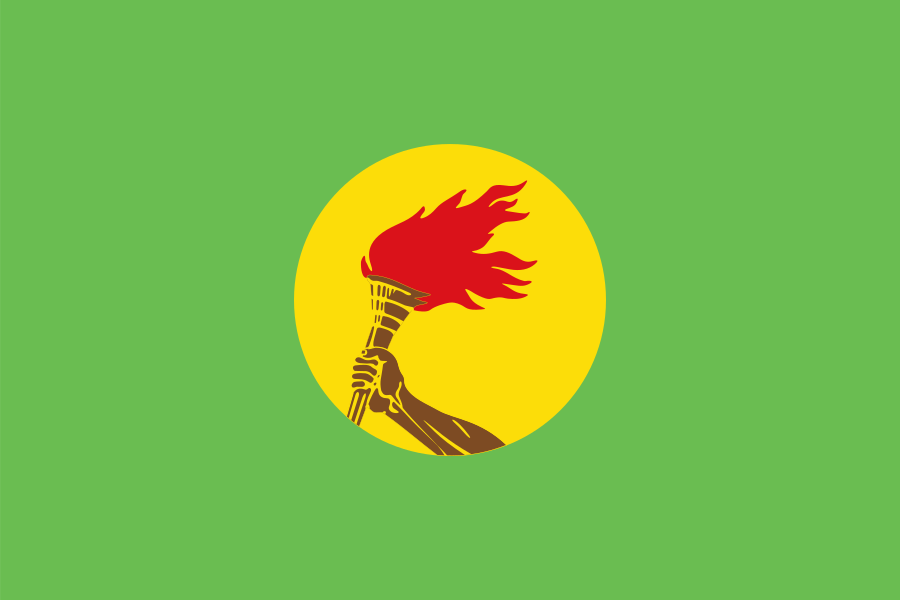
Rwanda’s former flag with a black R and the green flag of Zaire belong to two different African state histories. Rwanda’s version is dated from 1961 to 2001, Zaires from 1971 to 1997. The first draft puts a letter on a tricolor, the second a torch-bearing arm in a yellow disc.
Test your knowledge →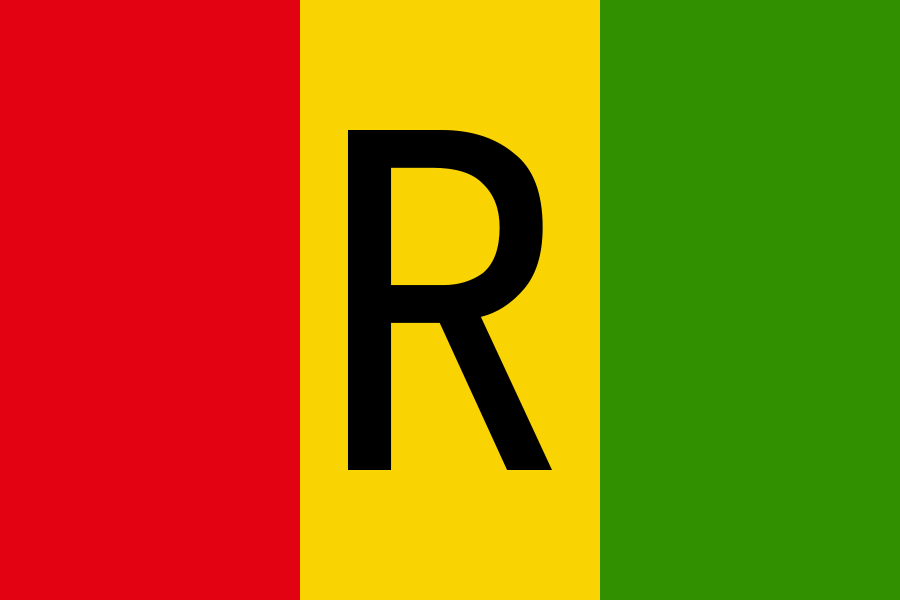
Key facts and distinctions
- Article focus
- Historical flag variants
- Date convention
- Periods describe the illustrated variant
- Scope
- Selected designs; no Nazi flags or symbols
- Rwandan image variant
- 1961–2001
- Rwandan stripes
- Vertical red, yellow, green
- Identification mark of Rwanda
- Black R on yellow
- Rwanda's independence
- 1 July 1962
- Zaire's period of painting
- 1971–1997
- Zaire's motive
- Arm with burning torch in yellow disc
- Political Context of Zaire
- Mobutu's dictatorial rule and authenticity policy
- Name of country after 1997
- Democratic Republic of the Congo
An R on red, yellow and green
The former Rwandan flag consists of three equally wide vertical paths. From the mast follow red, yellow and green. On the yellow midway lies a large black R. The letter shall be the defining distinguishing feature of this version. Without him, the mere combination of the three colors would be less helpful for a clear historical assignment.
The collection dates the R-pattern shown to 1961–2001. Rwanda’s independence followed on 1 July 1962; the picture period thus begins before this constitutional cut. A museum object from the Museum of Memory and Tolerance describes its use since 1962. Such different initial information must be distinguished: the time of a variant, the independence and the dating of a single cloth obtained are not automatically identical.
The torch in the political project Mobutus
Zaire's flag has a green field. In a yellow disc appears an angled arm with a burning torch. A press card from the Smithsonian collection used in 1972 repeats this pattern. It was worn at a congress of the state party MPR and illustrates the close connection between the state symbol and party rule at that time.
The name Zaire and the new flag belonged to Mobutu Sese Seko’s policy of so-called authenticity. The state self-expression invoked African autonomy and a departure from colonial influences. This rhetoric must not obscure the dictatorial rule and the compulsion for political adaptation. After the end of Mobutu in 1997, the country was again called the Democratic Republic of Congo; the Zaire flag was replaced.
New flags and the loading of old signs
Rwanda replaced the R flag in 2001 with a blue-yellow-green design with sun. The Museum of Memory and Tolerance explains the exchange with the old flag connection to violence during the genocide. In 1994, Tutsi and people who opposed the perpetrators were murdered. The history of this symbol must therefore be read together with the history of persecution and the subsequent social reorientation.
The two changes must not be merged into a common story. Rwanda’s flag change occurred years after the genocide; Zaire’s end coincides with a change of power and a renaming of the country. In both cases, the new state sign helps with the temporal orientation. However, it does not explain all the causes of the violence nor the experiences of all the people who lived under the respective regimes.
Details Worth Remembering
A letter as orientation
The R is not a small tail, but is clearly visible on the midway. When learning, it is worthwhile first to recognize this sign and then the stripe direction. The combination is more accurate than a memory that relies only on the common colors red, yellow and green.
An object outside the flagpole
The Smithsonian press pass shows how a flag motif could be transferred to everyday and event objects. The symbol accompanied a party congress and thus conveys a concrete historical use. A museum object description can thus provide information about its political environment in addition to the flag image.
State history and pictorial history
1961, 1962, 1971, 1997 and 2001 denote different kinds of changes. Some concern a flag, others independence or a country name. Whoever separates these levels avoids the false notion that any new draft means the creation of a completely new country.
The illustrated signs and variants
Continue exploring
What did you discover?
Take this flag into the quiz
Sources and image credits
This English article draws on the institutional sources listed below. Figures and memberships retain their stated reference dates.
Source record: 2 November 2026. A translation does not change the reference date of a figure or membership list.
- artsandculture.google.com/asset/rwanda-flag/QwGJ8_QQCfhl0Q
- anacostia.si.edu/collection/object/acm_1991.0076.0130
- un.org/en/preventgenocide/rwanda/historical-background.shtml
- history.state.gov/countries/rwanda
- zms.bundeswehr.de/resource/blob/5324254/8ef0bae1a1e7ca2d4e6a1489ee1748dd/wegweiser-kongo-data.pdf
- gov.rw/government/publications/national-symbols