Historic flags of Libya and Egypt
Libya’s single-color green flag and Egypt’s red-white-black flag with two green stars show different political projects in North Africa. The Libyan execution belongs to the years 1977 to 2011, the Egyptian to 1958 to 1971. Their periods follow the patterns shown: Neither the states themselves nor all political associations existed exactly during these respective years.
Test your knowledge →
Key facts and distinctions
- Article focus
- Historical flag variants
- Date convention
- Periods describe the illustrated variant
- Scope
- Selected designs; no Nazi flags or symbols
- Libyan image variant
- 1977–2011
- Libyan basic pattern
- Monochrome green
- Egyptian image variant
- 1958–1971
- Egyptian stripe sequence
- Red, white, black
- Middle sign of Egypt
- Two green five-pointed stars
- Beginning of the Egyptian-Syrian Union
- 1958
- Syria's exit
- 1961
- New Libyan flag at UN headquarters
- 20 September 2011
A single green field in Libya
The Libyan flag of this collection is entirely green. It has neither writing nor coat of arms, star or crescent. The absence of other signs is their most striking distinguishing feature. Compared to many multicolored flags, it is graphically extremely reduced; its historical statement is therefore particularly evident from the political period of its use.
The version was introduced in 1977 during the rule of Muammar Qaddafi and replaced in 2011 in the course of the uprising and civil war. Green stood in the context of the state ideology of that time and its self-expression. The flag must therefore not be understood as a timeless sign of the whole of Libya. The country had other national flags before this period and then changed its state symbols again.
Two stars for the Egyptian-Syrian Union
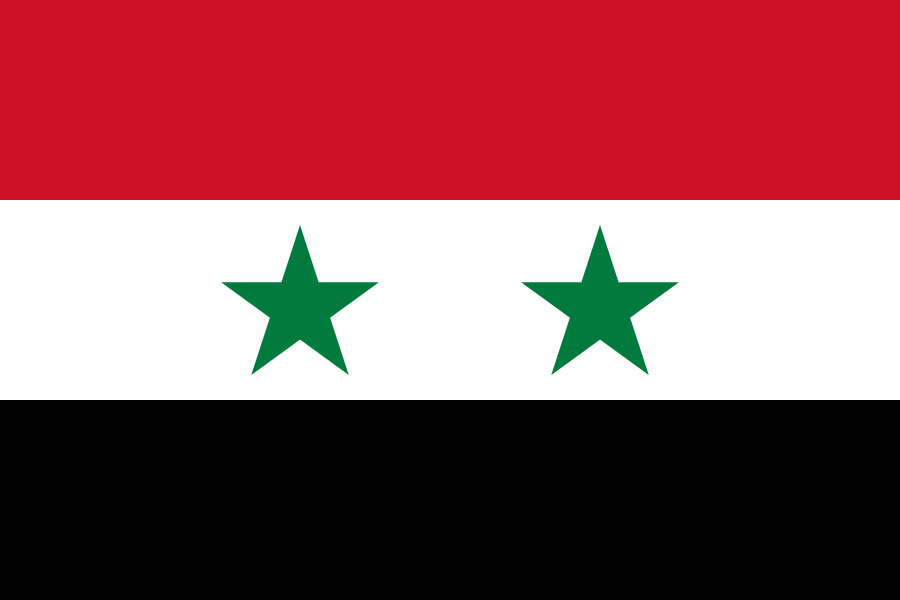
Egypt's flag shown here has three equally wide horizontal paths: red above, white in the middle, black below. Two green five-pointed stars lie next to each other in the white stripe. The Egyptian Presidential Office assigns this model to the United Arab Republic and dates it from 1958 to 1971.
The design was created after the merger of Egypt and Syria in 1958. The two stars originally referred to these two parts of the Union. Syria left the union in 1961. Egypt, however, continued to carry the flag. Thus, this very pattern provides an important counterexample to the assumption that the number of stars at any given time must reflect the current political composition unchanged.
Flag change is not a uniform timeline
Egypt replaced the two-star version with the transition to the flag of the Federation of Arab Republics at the turn of the year 1971/72. The collection ends at 1971 because it shows the expiring two-star variant. For the actual duration of the Egyptian-Syrian Union, on the other hand, 1961 is the decisive dividing line.
In Libya, the change in 2011 is also documented at international level. On September 20, the new Libyan flag flew for the first time in front of the United Nations headquarters. Such institutional events mark a concrete place of recognition and representation; they do not mean that every old flag disappeared throughout the country on the same day. Historical dating simplifies an often uneven political transition.
Details Worth Remembering
Little graphics, lots of politics
A completely green cloth initially seems easier to read than a flag with several emblems. Its historical classification nevertheless requires knowledge about the system of rule at that time. Graphical simplicity does not mean that a symbol can be understood without political prerequisites.
Stars can survive their starting position
The Egyptian stars were preserved after the end of the joint union with Syria. Their original reference and their later state use thus fall apart. When learning historical flags, it is helpful to consider the emergence of a sign separately from its further use.
A change in a certain place
The documented change of flag at the United Nations makes the Libyan upheaval internationally visible. It is an accurately dated event within a prolonged conflict. For the dating of a historical image, therefore, additionally count place, occasion and the question of which institution used the respective flag.
The illustrated signs and variants
Continue exploring
What did you discover?
Take this flag into the quiz
Sources and image credits
This English article draws on the institutional sources listed below. Figures and memberships retain their stated reference dates.
Source record: 2 November 2026. A translation does not change the reference date of a figure or membership list.
- presidency.eg/en/مصر/معلومات-أساسية/العلم-الوطنى/العلم-المصري-في-عهد-الثورة/
- presidency.eg/en/مصر/معلومات-أساسية/العلم-الوطنى/العلم-المصرى-في-عصر-السادات/
- un.org/en/node/122883
- un.org/sg/en/content/former-secretary-general/statements/2011-09-20/secretary-generals-remarks-high-level-meeting-libya
- un.org/sg/en/content/highlight/2011-09-20.html