Ukraine Flag, Capital and Country Facts
Ukraine is located in Eastern Europe and connects vast plains with the Carpathians and coasts of the Black Sea. The Dnipro runs through the country from north to south. The flag is blue over yellow and does not carry a coat of arms. Their current fame must not hide the fact that the colors have a longer history.
Test your knowledge →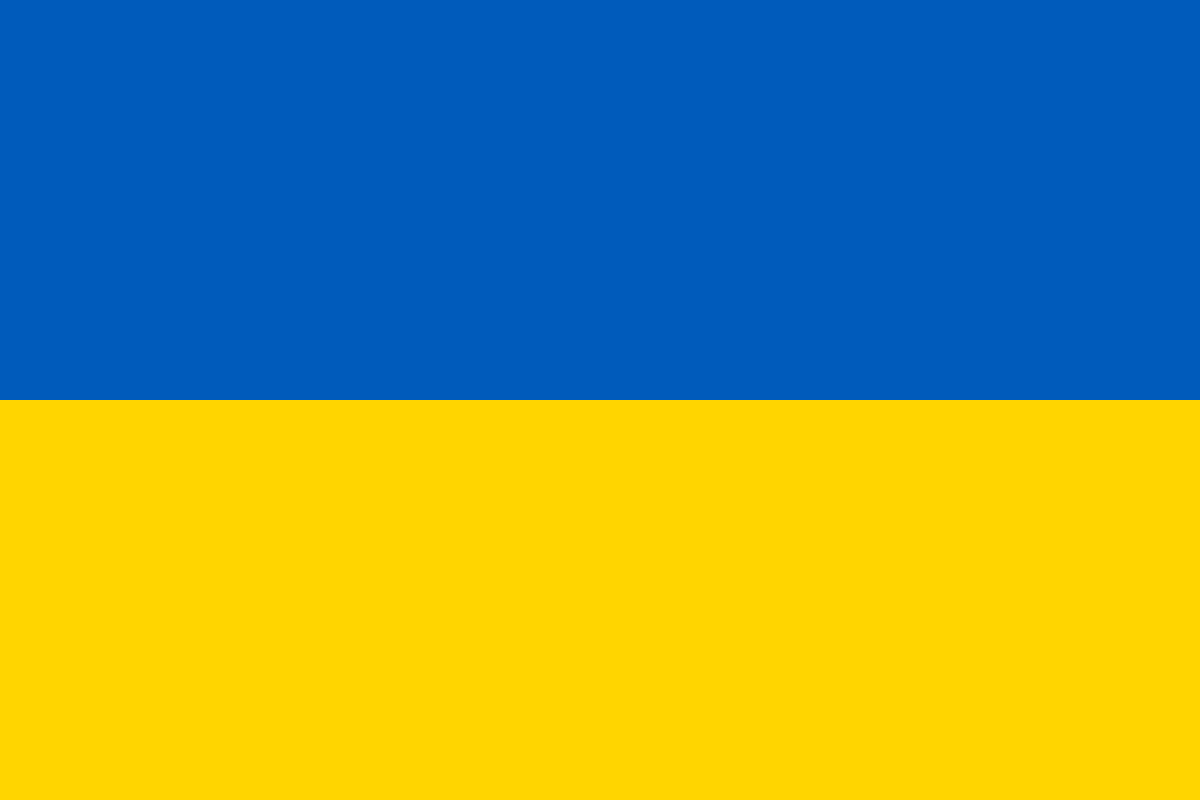
Ukraine at a glance
- Capital
- Kyiv
- Quiz continent
- Europe
- Languages in reference record
- Ukrainian; other minority languages
- Currency
- Hryvnia (UAH)
- Population
- 38,980,376 (2025, World Bank)
- Area
- 603,500 km²
- Coastal setting
- Not landlocked
- ISO codes
- UA / UKR
- Internet country suffix
- .ua, .укр
- Highest mountain
- Howerla, 2.061 m
- Large river
- Dnipro
- Mountains in the West
- Carpathians
- Declaration of Independence
- 24 August 1991
- Black Sea port
- Odesa
- Currency unit
- Hryvnia
Ukraine Flag: Design, Meaning and History
Two equally high horizontal stripes form the Ukrainian flag. Above is blue, below yellow; stars, lettering and coats of arms are missing in the basic national motif. Order is the key learning trait. A vertical or reverse color structure would be a different design, even if the same two colors were still used.
Blue and yellow are in historical heraldic contexts. The often used interpretation of a blue sky over a yellow field of grain is vivid, but should be treated as a common interpretation and not as the only sure explanation of origin. Thus, the motif can be remembered well, without equating a later interpretation of the picture with its entire historical origin.
Capital: Kyiv
Kyiv is located on the Dnipro in the northern part of the country. The city is the political and an important cultural center of Ukraine. Its history as an important place of medieval Rus dates back far before the present state. From this older meaning, however, no equating of medieval dominions with modern state borders follows.
The Sophien Cathedral with its associated monasteries and the cave monastery Kyiv-Petchersk have been on the UNESCO list since 1990. They illustrate the long religious and architectural history of the capital. Other important cities have their own focuses: Lviv is known for its historic center, Odesa for its Black Sea port and its also recognized historical center.
Practise this capital →Ukraine: Geography, History and Culture
Large parts of the territory consist of plains and hilly landscapes with fertile soil. To the west are the Carpathians with the Howerla as the highest mountain in the country. The Dnipro is an important geographical point of reference. Area indications and maps are based on internationally recognised borders; military control and state affiliation are not synonymous terms. This distinction applies irrespective of the design of a single card.
Ukrainian is the state language. In addition, other languages are spoken, the distribution of which is regionally different. Independence was declared in 1991. The Russian interventions since 2014 and the large-scale invasion of 2022 form a fundamentally recent context. The United Nations reaffirms the territorial integrity of Ukraine within its internationally recognized borders.
In addition to cities, the UNESCO heritage also includes wooden churches of the Carpathian region and common European beech forest areas. The wooden churches form a cross-border site with Poland. Thus, the cultural heritage shows historical connections across today's national borders. Such cultural commonalities exist alongside the autonomy of states and do not constitute automatic political or territorial belonging.
Two colors in a fixed order
Blue is above yellow. The cornfield under the sky is a common reminder, but not a complete historical explanation.
World Heritage Site in Kyiv
Sophienkathedrale and cave monasteries have been recognized since 1990. The capital thus possesses important testimonies of much older epochs.
Common cultural heritage
The wooden churches of the Carpathian region are located in Poland and Ukraine. A joint UNESCO site connects cultural history across national borders.
Explore neighbouring and related places
 Belarus
 Hungary
 Moldova
 Poland
 Romania
 Russia
What did you discover?
Sources and image credits
This English article draws on the institutional sources listed below. Figures and memberships retain their stated reference dates.
Source record: 2 November 2026. A translation does not change the reference date of a figure or membership list.
- github.com/factbook/factbook.json/blob/144d6977b2b01ac1cbd220de754c0a005616760b/europe/up.json
- data.worldbank.org/indicator/SP.POP.TOTL
- whc.unesco.org/en/statesparties/ua
- mandates.un.org/mandate/A/RES/ES-11/4
- github.com/mledoze/countries