Romania Flag, Capital and Country Facts
Romania lies between the Carpathians, the Lower Danube and the Black Sea. The arch of the mountains surrounds the Transylvanian highlands, while wide plains connect to the south and east. Bucharest is in the south. The Danube Delta, historic cities and different regional cultural landscapes expand a country image that is often prematurely associated only with the Carpathians.
Test your knowledge →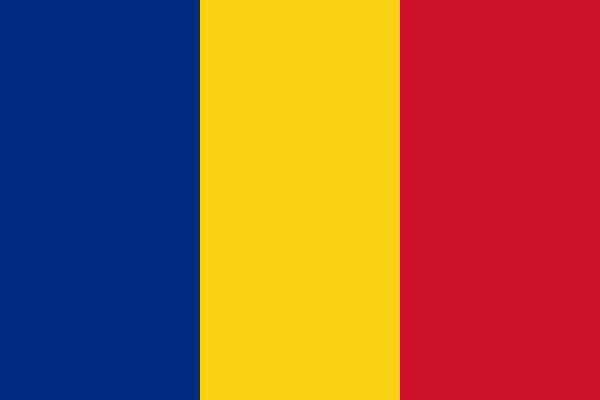
Romania at a glance
- Capital
- Bucharest
- Quiz continent
- Europe
- Languages in reference record
- Romanian; also, among others, Hungarian and Romani
- Currency
- Romanian leu (RON)
- Population
- 19,020,271 (2025, World Bank)
- Area
- 238,391 km²
- Coastal setting
- Not landlocked
- ISO codes
- RO / ROU
- Internet country suffix
- .ro
- Highest mountain
- Moldoveanu, 2,544 m
- Capital river
- Dâmbovița
- National holiday
- 1 December
- Mountain arch
- Carpathians
- Natural heritage
- Danube delta
- UNESCO Old Town
- Sighișoara’
Romania Flag: Design, Meaning and History
The flag has three equally wide vertical stripes in blue, yellow and red. Blue is on the mast. There is no coat of arms in the national flag shown here. The similarity with the flag of Chad is very great; in particular, the shade of blue may differ, so a safe assignment solely on the basis of a tiny image remains difficult.
The colors are based on the historical principalities of Wallachia and Moldova. The vertical tricolor is also based on a European flag form of the 19th century. The central coat of arms formerly present in some state versions does not belong to today's simple motive. For the quiz, the three continuous color areas are decisive.
Capital: Bucharest
Bucharest is located in the Wallachian plain on the river Dâmbovița. The capital is therefore located outside the inner Carpathian arch. This location distinguishes it from Transylvanian cities such as Cluj-Napoca or Brașov. Political centrality and geographic center of the country do not have to coincide; Bucharest is a good example of this difference.
The city grew as a residence and administrative center and has buildings from different eras. Its current metropolitan scale stands next to smaller historical city centers inland. The name Bucharest should not be confused with Budapest: the similar sounding capitals belong to Romania or Hungary and are located on different rivers.
Practise this capital →Romania: Geography, History and Culture
The Carpathians form the defining mountain arch. The Moldoveanu reaches 2,544 meters and is the highest mountain in the country. In the south, the Danube runs over longer sections as a border river before it is divided into several arms in the delta. The path from the mountains to the sea thus connects very different landscapes.
The Danube Delta is a UNESCO natural heritage site and has extensive water, reeds and wetlands. It is an important antithesis to the mountain landscapes. UNESCO also has churches with exterior paintings in Moldova, wooden churches of the Maramureș and the historical center of Sighișoara; different building and settlement traditions are thus visible.
Romanian is one of the Romance languages and thus differs linguistically from many neighboring languages. In addition, Hungarian and Romani are spoken. The National Day on December 1 commemorates the unification of 1918. Historical regions such as Wallachia, Moldova and Transylvania help to organize the formation of today's territory in time and space.
Danube delta
The UNESCO area protects a large wetland area at the transition from the river to the Black Sea. Its branched water arms show a completely different type of landscape than the Carpathians, making the Lower Danube an important geographical guide for Romania.
Romance Language in the East
The linguistic affinity of Romanian with Italian, French or Spanish is not immediately visible on the map of Europe. It shows why neighbourhood and language family are different systems of order and do not automatically result in the same groups of countries.
Bucharest and Budapest
The similar sounding names can be distinguished by their rivers: Bucharest is located on the Dâmbovița, Budapest on the Danube. The capital function belongs to a different state, even if the two names are easily confused in German.
Explore neighbouring and related places
 Bulgaria
 Hungary
 Moldova
 Serbia
 Ukraine
What did you discover?
Sources and image credits
This English article draws on the institutional sources listed below. Figures and memberships retain their stated reference dates.
Source record: 2 November 2026. A translation does not change the reference date of a figure or membership list.
- github.com/factbook/factbook.json/blob/144d6977b2b01ac1cbd220de754c0a005616760b/europe/ro.json
- data.worldbank.org/indicator/SP.POP.TOTL
- whc.unesco.org/en/statesparties/ro/
- github.com/mledoze/countries