Malta Flag, Capital and Country Facts
Malta is a small island nation in the central Mediterranean south of Sicily. The capital Valletta is located on a narrow peninsula between natural ports. Despite its small area, the country has several very different historical layers: prehistoric temples, the reign of the Order of St. John and the British period. Maltese and English reflect different connections of this island space.
Test your knowledge →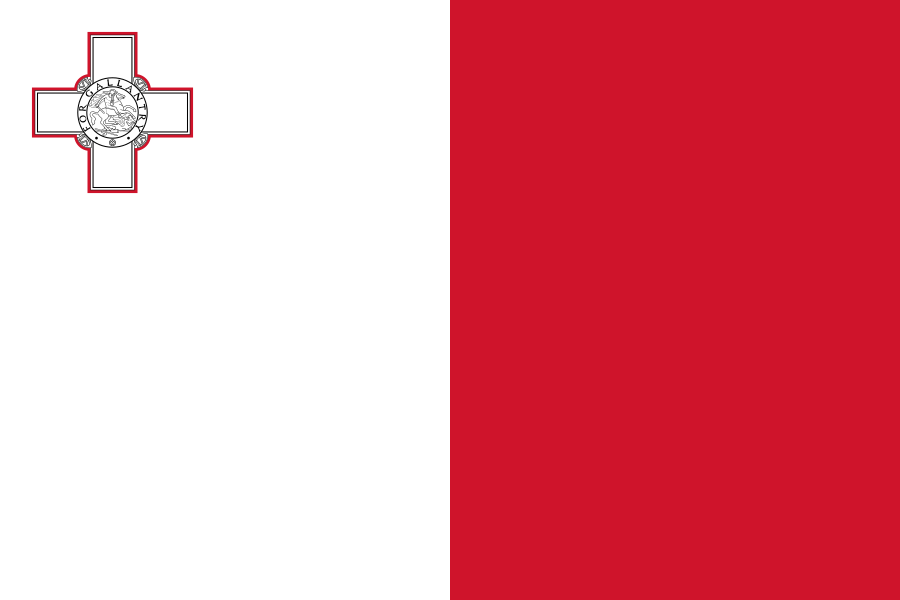
Malta at a glance
- Capital
- Valletta
- Quiz continent
- Europe
- Languages in reference record
- Maltese and English
- Currency
- Euro (EUR)
- Population
- 579,704 (2025, World Bank)
- Area
- 316 km²
- Coastal setting
- Not landlocked
- ISO codes
- MT / MLT
- Internet country suffix
- .mt
- Main Islands
- Malta, Gozo and Comino
- Independence
- 21 September 1964
- Republic since
- 13 December 1974
- Foundation of Valletta
- 1566
- Award on the flag
- George's Cross of 1942
- Port of Valletta
- Grand Harbour
Malta Flag: Design, Meaning and History
The flag is vertically divided into a white left half and a red right half. In the upper left corner is the grey George's Cross with a red border. It is not the eight-pointed Maltese Cross. This difference is crucial for an accurate flag description, even though both crosses are linked to Malta.
The George Cross was awarded to the islanders in 1942 for their courage in the Second World War. It became part of the national flag after independence in 1964. The origin of red and white is often associated with the Order of St. John. The story that Count Roger left a piece of his banner in 1091, on the other hand, should be treated as a tradition and not as a secure explanation.
Capital: Valletta
Valletta is located on a hilly peninsula between Grand Harbour and Marsamxett Harbour. The fortified city was built in 1566 under the Order of St. John and named after Grand Master Jean de la Valette. The port space was an important prerequisite for its military and political importance.
UNESCO has listed Valletta as a World Heritage Site since 1980. In a confined area, planned streets, bastions, churches and administrative buildings are connected. The actual capital community is small; the adjoining agglomeration reaches far beyond them. A size comparison based solely on municipal population figures would therefore only show a section of urban Malta.
Practise this capital →Malta: Geography, History and Culture
The main islands are Malta, Gozo and Comino. Their limestone landscape is predominantly low and strongly divided by the sea. Large natural rivers are lacking, and water availability is a fundamental issue. The short distance between locations must therefore not obscure the fact that land use, dense construction and technical supply are in close competition on the islands.
Maltese belongs to the Semitic area in terms of language history, but is written with Latin script. Italian and English influences are evident in vocabulary and history. English is also an official language. This combination distinguishes Malta from many other European small states and illustrates the situation as a point of contact between North Africa and southern Europe.
The prehistoric temples are much older than the city of Valletta. Later, the Mediterranean situation and natural ports made the islands significant to different powers. Malta became independent from Britain in 1964 and republic in 1974. The two data describe different policy steps. The image of the country therefore includes not only fortresses and holiday coasts, but also a long succession of changing economic and dominion areas.
Fortified Planned City
Valletta was created in the 16th century and has been a UNESCO World Heritage Site since 1980. Its peninsular position connects urban planning with the two port basins.
Two different crosses
The cross of George is on the flag. The eight-pointed Maltese Cross belongs to another symbolic tradition of the Order of St. John.
Language between cultural regions
Maltese has Semitic foundations and is written in Latin. The language area thus shows connections that do not result solely from a map of Europe.
Explore neighbouring and related places
 Albania
 Andorra
 Austria
 Belarus
 Belgium
 Bosnia & Herzegovina
What did you discover?
Sources and image credits
This English article draws on the institutional sources listed below. Figures and memberships retain their stated reference dates.
Source record: 2 November 2026. A translation does not change the reference date of a figure or membership list.
- github.com/factbook/factbook.json/blob/144d6977b2b01ac1cbd220de754c0a005616760b/europe/mt.json
- data.worldbank.org/indicator/SP.POP.TOTL
- whc.unesco.org/en/list/131
- github.com/mledoze/countries