Grenada Flag, Capital and Country Facts
Grenada is an island nation in the southeastern Caribbean region. The country includes the main island of Grenada as well as Carriacou, Petite Martinique and other small islands. The capital of St. George’s is located on a protected bay. On the conspicuously framed flag, a nutmeg appears – a direct reference to the special agricultural history of the country.
Test your knowledge →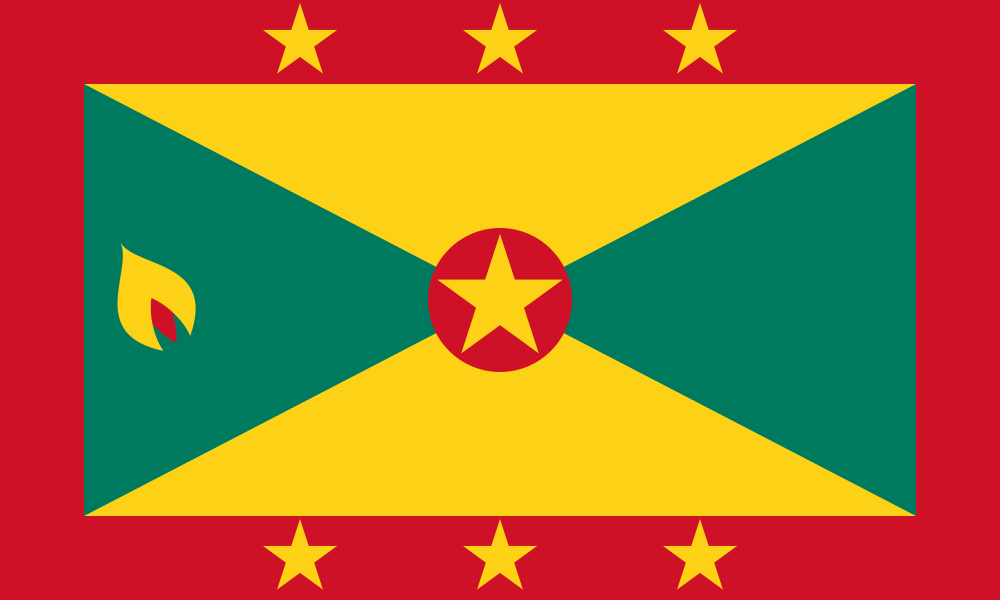
Grenada at a glance
- Capital
- St. George's
- Quiz continent
- North America
- Languages in reference record
- English (official language); also Creole language forms
- Currency
- Eastern Caribbean Dollar (XCD)
- Population
- 117,303 (2025, World Bank)
- Area
- 344 km²
- Coastal setting
- Not landlocked
- ISO codes
- GD / GRD
- Internet country suffix
- .gd
- Highest mountain
- Mount Saint Catherine, 840 m
- Independence
- 7 February 1974
- Another island
- Carriacou
- Other smaller islands
- Petite Martinique
- Flag stars
- 7
- Flag plant
- Nutmeg
Grenada Flag: Design, Meaning and History
A wide red frame surrounds an inner field divided into yellow and green triangles. In the frame are three yellow stars at the top and bottom; another star lies in the middle on a red disk. On the left is a stylized yellow-red nutmeg. In total, there are seven stars.
The Factbook archive assigns the stars to the administrative units and highlights the central star as a sign for St. George’s. Green is associated with vegetation and agriculture, yellow with sun and red with cohesion and courage. Nutmeg provides a particularly concrete meaning: it refers to an important crop product.
Capital: St. George's
St. George’s is located on the southwest coast of the main island. Port and bay-rich coastline determine the city floor plan more than a large hinterland. The capital is therefore well understood by its maritime position: it forms a political and economic center in a state whose land area is distributed over several islands.
The city initially bore a French name; after the change of British rule, it was named after the patron saint of England. UNESCO lists the historic district and the fortification system on Grenada’s list of proposals. This is an important distinction: a proposed site is not yet a registered World Heritage site.
Practise this capital →Grenada: Geography, History and Culture
The main island is volcanic and has a mountainous interior. Mount Saint Catherine reaches 840 meters. On the coasts are settlements, coves and beaches, while the interior offers other vegetation and use spaces. The neighbouring Grenadine Islands complement this picture; Grenada is therefore neither a single shallow coral island nor exclusively the large main island.
Nutmeg and other spices are closely linked to Grenada’s economic history. The often used nickname “Spice Island” thus has a concrete agricultural background. However, it describes neither all sectors of activity nor the entire culture of the country. English is an official language, and Creole language forms refer to the diverse historical connections of the Caribbean region.
Grenada became independent from the United Kingdom on 7 February 1974. Previously, the islands were temporarily under French and later British rule. Place names and fortifications preserve traces of these changes. The situation in the Caribbean also poses a threat from tropical hurricanes; coasts, agriculture and infrastructure are thus closely linked to weather and climate issues.
A fruit on the flag
The nutmeg is visible on the left side of the indoor field. Few national flags show such a concrete agricultural product. For the quiz, this detail is a more reliable indication than the colors red, yellow and green that are also common elsewhere.
Several islands
Carriacou and Petite Martinique belong politically to Grenada. So the island state does not end at the edge of its main island. This distinction also helps not to equate Grenada with the more northerly archipelago as a purely geographical term.
Properly classify world heritage
The UNESCO country page lists proposals for the historic St. George’s and the Grenadines. Such lists of proposals document possible future nominations. They must not be confused with the actual World Heritage List, on which Grenada had no registered site at the time of call.
Explore neighbouring and related places
 Antigua & Barbuda
 Bahamas
 Barbados
 Belize
 Canada
 Costa Rica
What did you discover?
Sources and image credits
This English article draws on the institutional sources listed below. Figures and memberships retain their stated reference dates.
Source record: 2 November 2026. A translation does not change the reference date of a figure or membership list.
- github.com/factbook/factbook.json/blob/144d6977b2b01ac1cbd220de754c0a005616760b/central-america-n-caribbean/gj.json
- data.worldbank.org/indicator/SP.POP.TOTL
- whc.unesco.org/en/statesparties/gd
- github.com/mledoze/countries