China Flag, Capital and Country Facts
China stretches from the high mountains of Central Asia to the coasts of the Pacific. There are great differences between the dry western landscapes and the densely populated eastern plains. The red flag with five yellow stars is simple, but the position of the four small stars forms a well-defined pattern.
Test your knowledge →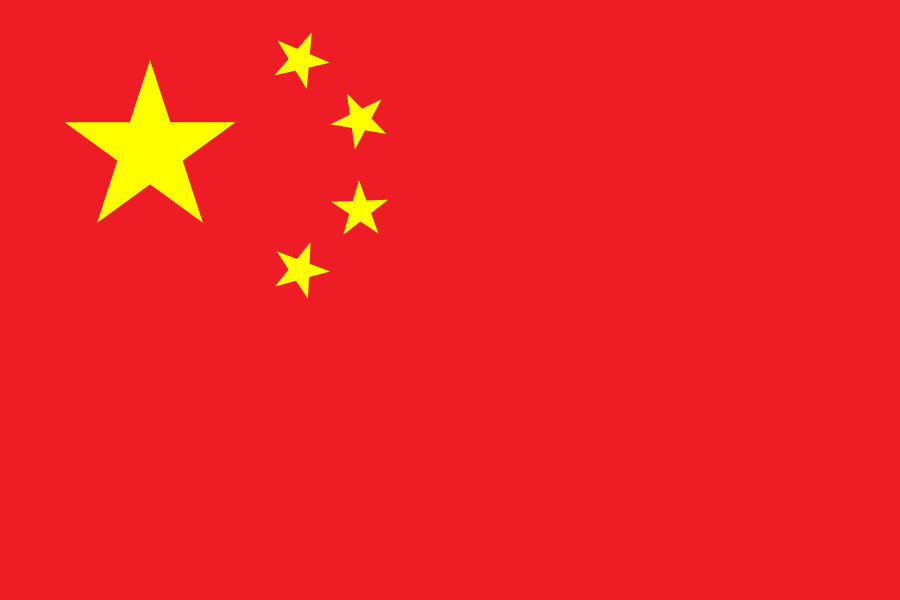
China at a glance
- Capital
- Beijing
- Quiz continent
- Asia
- Languages in reference record
- Standard Chinese (Mandarin); numerous other languages
- Currency
- Renminbi, unit of yuan (CNY)
- Population
- 1,406,585,000 (2025, World Bank)
- Area
- 9,706,961 km²
- Coastal setting
- Not landlocked
- ISO codes
- CN / CHN
- Internet country suffix
- .cn, .中国, .中國, .公司, .网络
- Large electricity
- Jangtse / Chang Jiang
- Another large river
- Huang He
- Desert
- Taklamakan
- Highland
- Tibetan highlands
- Historical transport route
- Great Canal
- Flag stars
- One large and four small
China Flag: Design, Meaning and History
The flag has a red ground. On the upper left is a large yellow five-pointed star, on the right of which four smaller stars are arranged in an arc. The small stars are aligned with the large ones. There are no horizontal stripes or an additional coat of arms; the number, size difference and arrangement of the stars are crucial.
The red color refers to the revolution. The group of stars is declared as a unity under the leadership of the Chinese Communist Party; the four smaller stars refer to four social groups in the historical interpretation. The motif belongs to the People's Republic founded in 1949. It is thus clearly distinguishable from older Chinese state flags and from regional flags.
Capital: Beijing
Beijing, internationally mostly called Beijing, is located in the north of the densely populated eastern half of the country. The capital is the political center and has a long history as the residence of several dynasties. Its role differs from Shanghai, which is known further south on the coast as a commercial and economic metropolis. Both city names are therefore not interchangeable capital answers.
The historical order of Beijing can be read particularly well on the central north-south axis. UNESCO included this urban ensemble in the World Heritage List in 2024. In addition, the Imperial Palaces and the Temple of Heaven are among the well-known cultural sites of the capital. Urban planning, ceremonial spaces and the history of domination are closely related here.
Practise this capital →China: Geography, History and Culture
To the west are the highlands of Tibet, high rim mountains and large dry basins. In the east, river valleys and plains offer other conditions for agriculture and settlements. Jangtse and Huang He are among the major river systems. A single climate picture does not do justice to the country: There are considerable differences between deserts, subtropical coasts and high mountains.
Mandarin forms the basis of the national standard language. In addition, there are numerous other Chinese language forms and languages of ethnic minorities. Writing, spoken language and regional identity are different levels. The cultural heritage also extends far beyond the capital, for example to the classical gardens of Suzhou, the caves of Mogao and historical trade routes in the west.
The Great Wall stands for border security over different historical epochs; the Great Canal, on the other hand, for domestic water connections and supplies. This comparison helps to understand the dimensions of China. A large structure can separate, connect another distant economic landscape. Both belong to the world heritage, but tell very different stories of space and state organization.
Beijing's central axis
The ensemble of the central axis became a World Heritage site in 2024. It shows that not only individual palaces, but also their urban order can be worth protecting.
Gardens of Suzhou
The classic gardens of Suzhou form a different type of cultural heritage than the monumental state buildings of Beijing. Both are on the UNESCO list.
Nature and culture
In addition to historical cities and buildings, the UNESCO profile contains numerous natural areas. The span corresponds to the strong landscape differences between West and East.
Explore neighbouring and related places
 Afghanistan
 Bhutan
 Myanmar (Burma)
 India
 Kazakhstan
 Nepal
What did you discover?
Sources and image credits
This English article draws on the institutional sources listed below. Figures and memberships retain their stated reference dates.
Source record: 2 November 2026. A translation does not change the reference date of a figure or membership list.
- github.com/factbook/factbook.json/blob/144d6977b2b01ac1cbd220de754c0a005616760b/east-n-southeast-asia/ch.json
- data.worldbank.org/indicator/SP.POP.TOTL
- whc.unesco.org/en/statesparties/cn
- github.com/mledoze/countries