Kiel: City Flag, History and Identity
Kiel lies at the end of a deep-seated Baltic Sea fjord and is the capital of Schleswig-Holstein. Shipping, university and sailing are among his defining topics. The red city flag connects a Holstein nettle leaf with a black boat. Her image thus leads directly to two local reference points: state rule and maritime city history on the Förde.
Test your knowledge →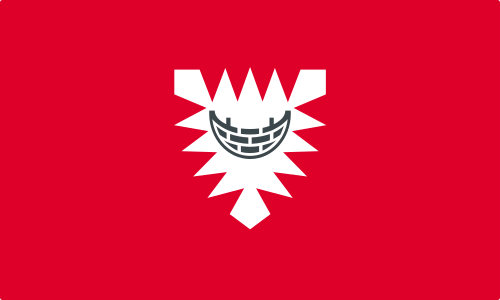
Kiel at a glance
- Name
- Kiel
- Country
- Germany
- Profile type
- City
- Sea access
- Kieler Förde on the Baltic Sea
- Historical settlement area
- Peninsula between Förde and Klein Kiel
- Traditional city foundation year
- 1242
- University opens
- 5 October 1665
- University name
- Christian-Albrechts-Universität
- Well-known former university teacher
- Max Planck
- First Regatta of the Kiel Week
- 23 July 1882
- Common sailing and construction week
- Since 1949
The Flag of Kiel
On the red flag cloth stands the Kiel coat of arms motif with silver white nettle blade and black boat. The boat lies within the bright figure and is therefore also in small representation a helpful distinguishing feature. A nettle leaf alone is not sufficient for the assignment to keel, because it also occurs in other Holstein coats of arms.
The Nesselblatt ties in with the Schauenburg Counts as historical lords of Holstein. The ship complements this dominion sign with the reference of the city to seafaring and commerce. There are different explanations about the original sense of the jagged bright figure. The urban representation mentions several views; a single botanical or technical history of origin is therefore not to be considered definitively established.
Kiel: Location and Territorial Role
Kiel is located in Schleswig-Holstein on the Kiel Förde. The fjord reaches into the city center and shapes traffic routes, banks and harbour areas. The city is provincial capital, but not to be equated with the entire federal state or the further support egion. The flag discussed here is the communal sign of Kiel and not a general state flag of Schleswig-Holstein.
The historic town centre was built on a peninsula between the Förde and the Kleiner Kiel. Only in the north was there originally a narrow land connection. The church, town hall and market were at the centre of the planned facility. This situation explains why the city could not expand arbitrarily in all directions with increasing space requirements.
Landscape, History and Culture
The water situation was both an advantage and a limitation. It provided access to shipping, but limited the building space of the old town. In the sixteenth century, the development was therefore expanded more to the south. The Klein Kiel and the Förde are important reference points if you want to understand the older urban structure within the later much larger urban area.
The Christian-Albrechts-Universität was opened on 5 October 1665. Its history is closely linked to the city, but extends far beyond a local training task. Teachers and researchers such as Max Planck and Otto Diels are part of their history of science. Kiel can therefore not only be understood as a port location, but also as a university location that has grown in the long term.
The Kieler Woche dates back to a joint race between Kieler and Hamburg sailors in 1882. The later combination of sport, culture and the urban festival programme developed gradually. Since 1949, Sailing and Construction Week have been jointly organized. The present character thus has several historical roots and has not emerged unchanged from a single regatta.
Old Town Peninsula
The floor plan of the old city makes the former peninsula location still comprehensible. From the market, roads led to the edge of the settlement, while water areas limited the extension. The comparison with the later suburb in the south shows particularly clearly how geographical conditions and the need for construction sites influenced urban development.
University history
The university began in 1665 and evolved over changing locations and political epochs. Its history of science complements the maritime keel with a second permanent function. The view of research and teaching prevents the city from being reduced to shipyards, ferries or sailing: university life is also part of its historical profile.
Kieler Woche and Förde
The first race of 1882 used the fjord as a sailing ground. Later, cultural and public events were added. This connection explains why the Kiel Week takes place both on the water and in the city. It combines a concrete landscape with sporting tradition and communal urban experience.
Explore this country and nearby profiles
 Germany
 Munich
 Cologne
 Frankfurt am Main
 Stuttgart
 Düsseldorf
 Dresden
What did you discover?
Take this flag into the quiz
Sources and image credits
This English article draws on the institutional sources listed below. Figures and memberships retain their stated reference dates.
Source record: 2 November 2026. A translation does not change the reference date of a figure or membership list.
- kiel.de/de/kultur_freizeit/stadtgeschichte/wappen.php
- efi2.schleswig-holstein.de/wr/wr.asp
- kiel.de/de/kultur_freizeit/stadtarchiv/erinnerungstage.php
- uni-kiel.de/de/universitaet/profil/geschichte-der-universitaet
- kiel.de/de/kultur_freizeit/stadtarchiv/erinnerungstage.php
- commons.wikimedia.org/wiki/File%3AFlagge_der_kreisfreien_Stadt_Kiel.svg