Essen: City Flag, History and Identity
Food has several historical faces. The cathedral and former place of abbey are reminiscent of spiritual rule, while Zollverein makes the history of mining visible. In the south, Baldeneysee and older villages complement the picture. The golden-blue flag with a city coat of arms fits a city whose development cannot be reduced to coal and steel alone.
Test your knowledge →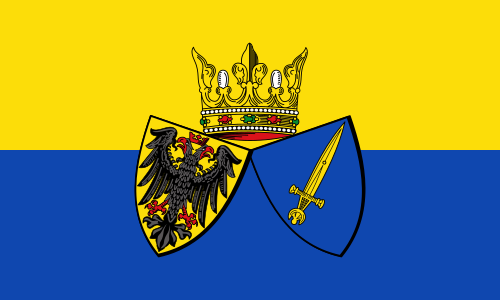
Essen at a glance
- Name
- Essen
- Country
- Germany
- Profile type
- City
- World Heritage Complex
- Zollverein coke mine and coke mill
- UNESCO recording
- 2001
- End of mine transport
- December 1986
- Museum location
- Ruhr Museum in the former coal laundering
- Capital of Culture Year
- RUHR.2010
- Environmental titles
- Green Capital of Europe 2017
- Southern Recreation Area
- Baldeneysee
- Historical site
- Become with Ludgerusgrab
The Flag of Essen
The Essen flag depicted uses gold or yellow at the top and blue at the bottom. Above it lie two coat-of-arms shields inclined towards each other under a golden crown. One contains a black double eagle on gold, the other a golden sword on blue. This combination is the most important additional distinguishing feature. Especially with similar yellow-blue city flags, it is therefore worth taking a close look at the applied sign.
The sword is an ancient city sign; the abbess granted it in 1399 to mark measures and weights. The imperial eagle commemorates the imperial protection of 1623, the crown of the abbess' rule. The flag thus combines colors and older dominion signs. These motifs were created long before the modern industrial era and are not an afterthought illustration of mining.
Essen: Location and Territorial Role
Essen is located in the North Rhine-Westphalian Ruhr area. The city name refers to a single municipality within the densely connected region, not the entire territory. Between the northern Zollverein site, the city centre and the southern areas on the Ruhr, the cityscape changes significantly. These spatial differences explain the unusual diversity of their historical and landscape reference points.
Essener Münster is located in the center, while Werden, Borbeck and Kettwig form further historical spaces of their own. The urban historical tours explicitly include these places. A path through Essen therefore not only leads along a single old town: several older cores and later industrial areas complement each other to form a multi-layered urban area with different structural standards.
Landscape, History and Culture
The Baldeneysee is one of the important open spaces of the city. Together with Grugapark and Zollverein Park, it was one of the main venues in the Year of the European Green Capital 2017. The selection makes it visible how different forms of green stand next to each other: shore landscape, designed park and nature on a former industrial site fulfill different tasks.
The Zollverein colliery closed in December 1986. Since 2001, the complex of coke mine and coke plant has been a UNESCO World Heritage site. Thus, a place of work became an internationally recognized industrial monument. The significance lies precisely in the context of the plants: production routes, buildings and technical infrastructure are better explained together than by a single striking building.
With the opening of the Ruhr Museum in the former coal laundry, the cultural use of Zollverein was further strengthened. The year RUHR.2010 marked an important phase of this development. Essen thus shows a structural change in which existing buildings can receive new tasks and at the same time remain legible as material evidence of their previous use.
Zollverein’
Coal mine, coke oven and transformed open spaces form a coherent cultural site. The terrain can be understood as an earlier working landscape whose technical processes determine the spatial order. Today, the use of museums and pathways enable new accesses. World Heritage status refers to this industrial context and not to a mere decorative use of former machinery.
Munster and older town centres
The cloister of the Essen Cathedral, the Ludgerus Tomb in Werden and the residence of the abbesses in Borbeck represent different chapters of spiritual history. They greatly expand the notion of food. If you compare these places with the industrial plants, you will realize how deep the local development goes back before the great mining epoch.
Grugapark and Baldeneysee
The Grugapark and the shores of Lake Baldeney show two different types of urban recreation. One is designed as a park, the other is tied to a water landscape. Together with the Zollverein Park, they form a good counter-image to the idea of a city completely determined by factories and make the different landscapes of Essen experienceable.
Explore this country and nearby profiles
 Germany
 Munich
 Cologne
 Frankfurt am Main
 Stuttgart
 Düsseldorf
 Dresden
What did you discover?
Take this flag into the quiz
Sources and image credits
This English article draws on the institutional sources listed below. Figures and memberships retain their stated reference dates.
Source record: 2 November 2026. A translation does not change the reference date of a figure or membership list.
- zollverein.de/ueber-zollverein/geschichte/
- zollverein.de/ueber-zollverein/aktuelle-entwicklung/
- geschichte.essen.de/historischesportal_orte/streifzuege/streifzuege_wege_durch_kultur_und_geschichte.de.html
- geschichte.essen.de/historischesportal_zeiten/1946_bis_heute/chronik_1946_bis_heute.de.html
- essen.de/dasistessen/stadtportraet/stadtwappen.de.html
- commons.wikimedia.org/wiki/File%3AFlagge_Essen.svg