Bonn: City Flag, History and Identity
Bonn connects Rhineland town history, Beethoven’s origins and the beginnings of the Federal Republic of Germany. The title Bundesstadt describes a special political role, although Berlin is now the capital. The city on the Rhine consists of four districts. Their red golden flag with cross and lion makes it clear that their local traditions date back far before recent government history.
Test your knowledge →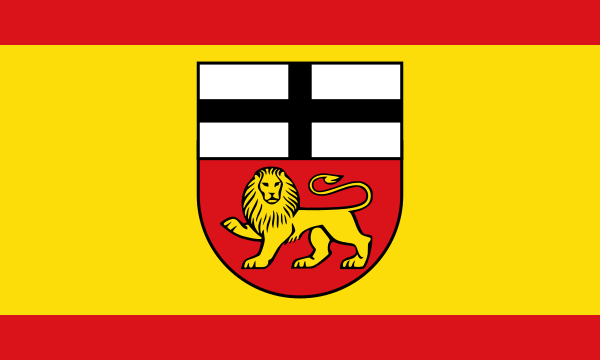
Bonn at a glance
- Name
- Bonn
- Country
- Germany
- Profile type
- City
- River
- Rhine
- Municipal reclassification
- 1969
- Municipalities
- Bonn, Bad Godesberg, Beuel and Hardtberg
- Beethoven's year of birth
- 1770
- Beethoven leaves Bonn
- 1792
- Revealing the Beethoven Monument
- 1845
- Berlin Bonn Act
- 1994
- Buildings in the UN campus
- Long Eugene
The Flag of Bonn
The flag has a wide golden-yellow midway between narrow red borderways. In the middle stands the Bonn coat of arms: on top a black cross on white, among them a golden striding lion on red. This combination of city colours and split coat of arms marks the representation selected here; a mere red-yellow cloth would be incompletely described.
The main urban statutes explicitly define colors and coat of arms. The cross and the lion stand for historical connections of today's urban area; in particular, the cross refers to Kurköln. The flag of the entire city should not be confused with the coat of arms of individual municipalities. After the communal reorganization, different local traditions were combined under a common city sign.
Bonn: Location and Territorial Role
Bonn is located on the Rhine in North Rhine-Westphalia and is a district-free city. Since the municipal reorganization of 1969, it consists of the four municipalities Bonn, Bad Godesberg, Beuel and Hardtberg. The district of Bonn is therefore only a part of today's entire city, even if it bears the same name.
Political geography requires a second distinction. Bonn was the central place of government of the young Federal Republic; the move of parliament and parts of the government to Berlin did not completely end this particular phase. As a federal city, Bonn still has federal political functions. At the same time, it is an independent municipality with local administration and much older history.
Landscape, History and Culture
The Rhine forms an essential spatial axis of the city. Today’s urban area connects former cities and municipalities to a larger whole. The division into four districts continues to make this diversity visible. For an overview, both the historical center and Bad Godesberg, Beuel and Hardtberg are important; the city center alone does not stand for all districts.
Ludwig van Beethoven was born in Bonn in 1770 and lived there until 1792. His family was connected with the electoral court music. The later international impact of his work thus began in a local musical environment. The Beethoven-Haus opens up this connection through museum, collection and research and anchors it in a concrete historical place.
Recent political history can be understood on the basis of several data. Bonn became the political centre of the Federal Republic in 1949. In 1991, the Bundestag decided to move to Berlin; in 1999, parliament and parts of the government took up work there. The Berlin Bonn Act of 1994 regulated the division of labor and formed a framework for Bonn's further development.
Beethoven House
The house in Bonngasse commemorates Beethoven’s birth and early years of life. Its significance goes beyond the function of a memorial: the collection and research there help to understand the composer in his Bonn environment. The place combines personal biography with the musical history of a former electoral residence.
Beethoven monument
On the Münsterplatz stands the well-known Beethoven monument. His unveiling in 1845 was accompanied by a first Beethovenfest, in the organization of which Franz Liszt was involved. The memorial shows that Bonn was publicly associated with music history long before its role as a seat of government and cultivated this memory in urban space.
UN campus
The former Langer Eugen high-rise and neighbouring buildings were redesigned to the UN campus. The location illustrates Bonn’s development as an international workplace after the government move. Historical federal buildings were given new tasks; the political history remained spatially visible, while international institutions brought an additional function to the city.
Explore this country and nearby profiles
 Germany
 Munich
 Cologne
 Frankfurt am Main
 Stuttgart
 Düsseldorf
 Dresden
What did you discover?
Take this flag into the quiz
Sources and image credits
This English article draws on the institutional sources listed below. Figures and memberships retain their stated reference dates.
Source record: 2 November 2026. A translation does not change the reference date of a figure or membership list.
- bonn.de/service-bieten/stadtpolitik-ortsrecht/ortsrecht/rat-ausschuesse-allgemeines/hauptsatzung.php
- bonn.de/bonn-erleben/besichtigen-entdecken/stadtbezirke.php
- bonn.de/themen-entdecken/bildung-lernen/chronik-stadt-bonn.php
- beethoven.de/de/beethoven
- beethoven-rundgang.bonn.de/standorte-in-bonn/chronoskop-1-beethoven-haus.php
- bonn.de/themen-entdecken/bildung-lernen/bonner-stadtgeschichte.php
- commons.wikimedia.org/wiki/File%3AFlagge_der_kreisfreien_Stadt_Bonn.svg