Singapore Flag, Capital and Country Facts
Singapore is a city and sovereign state on one of the most important sea links in Southeast Asia. The small area of land faces a global economic network. The red-and-white flag carries a crescent moon and five stars. Port, multilingual everyday life and carefully designed green spaces explain different sides of a state whose capital bears the same name.
Test your knowledge →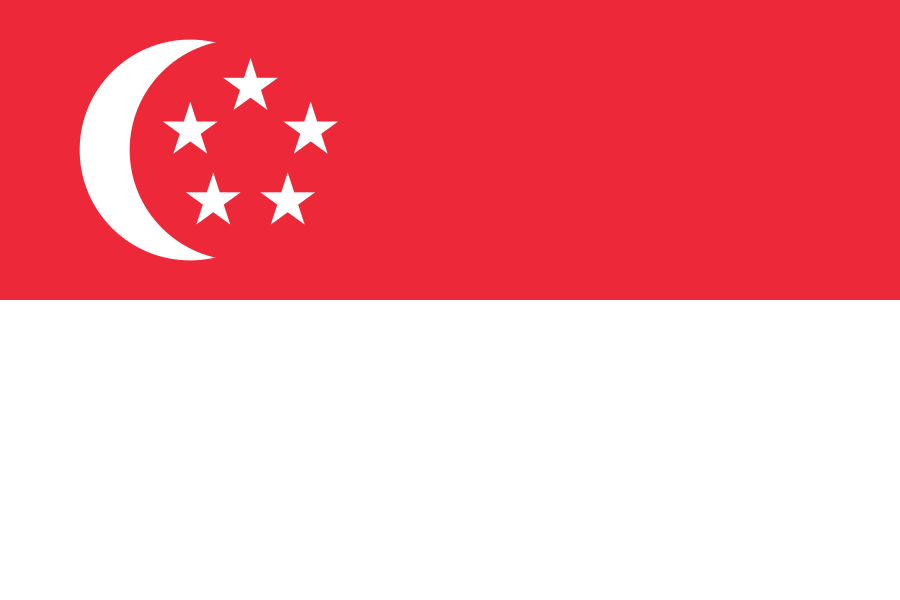
Singapore at a glance
- Capital
- Singapore
- Quiz continent
- Asia
- Languages in reference record
- English, Malay, Mandarin and Tamil; Malay is the national language
- Currency
- Singapore dollar (SGD)
- Population
- 6,111,175 (2025, World Bank)
- Area
- 710 km²
- Coastal setting
- Not landlocked
- ISO codes
- SG / SGP
- Internet country suffix
- .sg, .新加坡, .சிங்கப்பூர்
- Independence
- 9 August 1965
- Highest point
- Bukit Timah, 166 m
- Main Island
- Pulau Ujong
- National holiday
- 9 August
- UNESCO sites
- Singapore Botanic Gardens
- Important strait
- Strait of Singapore
Singapore Flag: Design, Meaning and History
The upper half of the flag is red, the lower half white. On the upper left are a white increasing crescent and five white stars in a circular arrangement. The stars lie within the red field next to the moon. The additional sign distinguishes the flag from the plain red-and-white two-color flags of Indonesia and Monaco.
Singaporean law on national symbols declares red as community and equality, white as purity and virtue. The increasing moon represents a young emerging nation. The five stars represent democracy, peace, progress, justice and equality. This legally described symbolism is more precise than a general assignment of the crescent to a single religion.
Capital: Singapore
As a city-state, Singapore does not have a geographically separate capital in another part of the country. The name denotes both the sovereign state and its urban center. Administration, port economy and residential areas are spread over the main island and other islands. A single city centre view therefore only shows a small section of the entire national territory.
The location at the southern end of the Malay Peninsula connects the access to the Strait of Malacca with the South China Sea. This position favoured the development into a commercial and port square. Modern transport networks reinforce an older location function: Singapore is located on sea routes where goods are transported between the Indian and Pacific Oceans.
Practise this capital →Singapore: Geography, History and Culture
The natural relief is predominantly low and hilly. The current land area was changed by extensive landfills. The reference year is therefore important for area indications. The city-state also includes various coastal and island spaces; dense urban development is a dominant use, but not the only existing form of landscape. The highest natural point Bukit Timah reaches only 166 meters. Its low altitude illustrates how strongly Singapore’s spatial development is characterised by coastal and bounded land area instead of mountain barriers.
English, Malay, Mandarin and Tamil are official languages. Malay is at the same time a national language, while English is important as a common working and educational language. This distinction shows that national symbolic function and everyday communication function do not have to be identical. In addition, there are other Chinese language forms and the languages of international immigration.
Singapore became independent in 1965, having previously been part of Malaysia. The factbook archive stand from 2025 describes an economy strongly focused on international trade, industry and services. The dependence on global connections explains why port, airport and supply policy are particularly important. The state is geographically small, but its economic sphere of action extends far beyond.
Botanical garden
The Singapore Botanic Gardens are UNESCO World Heritage Sites. The historical garden combines scientific plant work with a designed urban landscape.
Five Ideals
The five stars are individually explained in the National Symbol Law. They stand for democracy, peace, progress, justice and equality.
City and State
Singapore shows very clearly that a capital is not always a city within a large state. Both political and geographical levels bear the same name here.
Explore neighbouring and related places
 Afghanistan
 Armenia
 Azerbaijan
 Bahrain
 Bangladesh
 Bhutan
What did you discover?
Sources and image credits
This English article draws on the institutional sources listed below. Figures and memberships retain their stated reference dates.
Source record: 2 November 2026. A translation does not change the reference date of a figure or membership list.
- github.com/factbook/factbook.json/blob/144d6977b2b01ac1cbd220de754c0a005616760b/east-n-southeast-asia/sn.json
- data.worldbank.org/indicator/SP.POP.TOTL
- whc.unesco.org/en/statesparties/sg
- sso.agc.gov.sg/Act/NSA2022
- github.com/mledoze/countries