Bolivia Flag, Capital and Country Facts
Bolivia ranges from glaciated Andean peaks over the Altiplano to tropical lowlands. Its capital question has two levels: Sucre is the constitutional capital, La Paz the seat of government. Accuracy is also worthwhile for the symbols, because in addition to the red-yellow-green tricolor, the multi-colored Wiphala plays an independent role.
Test your knowledge →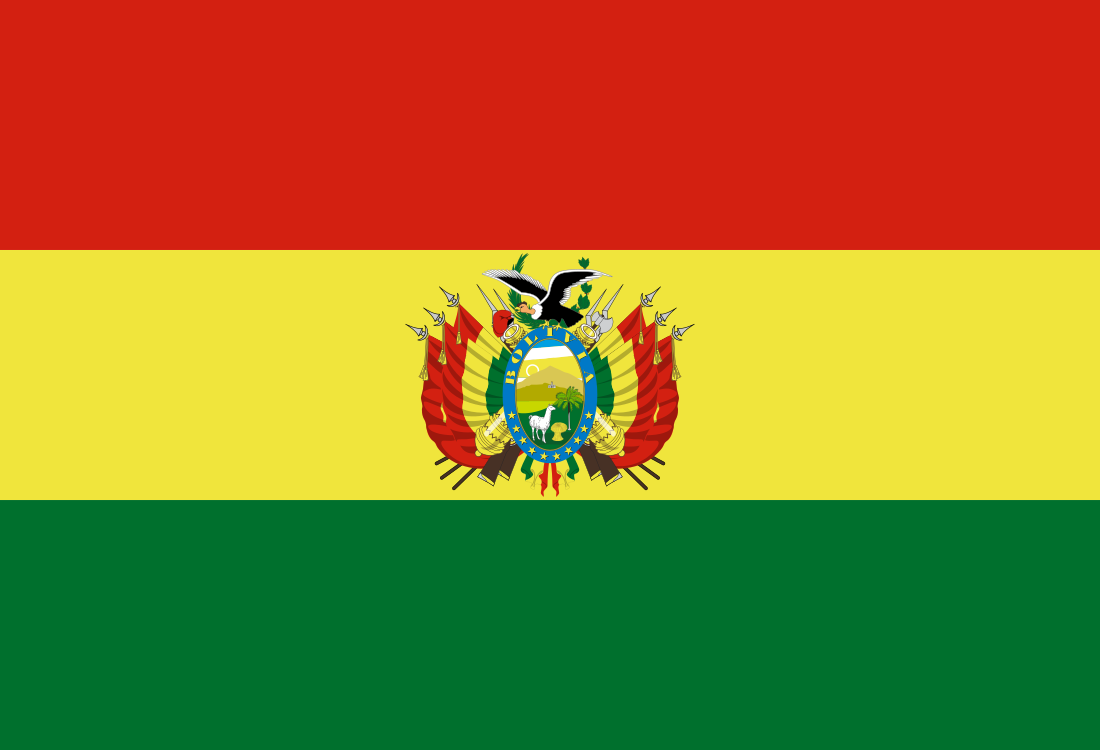
Bolivia at a glance
- Capital
- Sucre
- Quiz continent
- South America
- Languages in reference record
- Spanish and recognized indigenous languages, including Quechua, Aymara and Guaraní
- Currency
- Boliviano (BOB)
- Population
- 12,581,843 (2025, World Bank)
- Area
- 1,098,581 km²
- Coastal setting
- Landlocked
- ISO codes
- BO / BOL
- Internet country suffix
- .bo
- Headquarters
- La Paz
- Highest point
- Nevado Sajama, 6.542 m
- Shared sea
- Lake Titicaca with Peru
- Salt area
- Salar de Uyuni
- Historic mining town
- Potosí
- Additional state symbol
- Wiphalae
Bolivia Flag: Design, Meaning and History
Sucre is the constitutional capital. La Paz is the seat of government.
Three equally high horizontal stripes form the Bolivian tricolor: red above, yellow in the middle and green below. In representations with a coat of arms, this is in the yellow field. The color order is crucial; the related pan-African colors alone are not sufficient to safely distinguish other flags.
The tricolor in this color sequence dates back to 1851. In addition, the Wiphala with its grid of multi-colored squares is a recognized state symbol. It is not a mere coat of arms variant of the patrol flag. For the quiz, therefore, the stripe motif actually depicted remains the anchor, while the Wiphala explains an additional historical and social connection.
Capital: Sucre
Sucre is the constitutional capital of Bolivia and the seat of important judicial bodies. UNESCO added the historic city to the World Heritage List in 1991. Its older name La Plata is reminiscent of the colonial period; its current name honors Antonio José de Sucre, a central figure in the history of South American independence.
La Paz, on the other hand, is the seat of government and houses the central political institutions of the executive and legislative branches. Anyone who mentions only the largest known administrative city in a capital question therefore misses the distinction. In the quiz, Sucre applies; La Paz explains the frequent second indication in atlases. Both cities are located in the Andean region, but not at the same altitude.
Practise this capital →Bolivia: Geography, History and Culture
The Andes determine the west with high mountain ranges and the intervening Altiplano. The Nevado Sajama reaches 6.542 meters according to the factbook archive. East of this, the terrain falls over mountain forests and valleys into extensive lowlands. Therefore, the picture of an exclusively cold high mountain country describes only a part of Bolivia.
Lake Titicaca is shared with Peru; the Salar de Uyuni is one of the most striking salt areas in the highlands. Large areas in the north and east, on the other hand, are connected to the Amazon basin. Bolivia today has no maritime access of its own, although the question of access to the Pacific plays an important role in its history and foreign policy.
The term plurinational refers to the recognition of several peoples and indigenous traditions in the state. In addition to Spanish, numerous indigenous languages are recognized; Quechua and Aymara are particularly important, Guaraní is spread among other things in the lowlands. Linguistic and geographical diversity are therefore intertwined, without each community being able to be assigned to a single type of landscape.
Potosí and silver mining
Potosí has been on the UNESCO World Heritage List since 1987. The city refers to the enormous economic importance of colonial silver mining and its social consequences.
Tiwanaku
The archaeological site became a World Heritage Site in 2000. It stands for an important Andean culture before European colonization and extends the view beyond the history of the Incas.
Lowlands as natural heritage
Noel Kempff Mercado National Park has been a World Heritage Site since 2000. Its recording makes it clear that Bolivian natural heritage includes tropical landscapes in addition to high mountains.
Explore neighbouring and related places
 Argentina
 Brazil
 Chile
 Paraguay
 Peru
What did you discover?
Sources and image credits
This English article draws on the institutional sources listed below. Figures and memberships retain their stated reference dates.
Source record: 2 November 2026. A translation does not change the reference date of a figure or membership list.
- github.com/factbook/factbook.json/blob/144d6977b2b01ac1cbd220de754c0a005616760b/south-america/bl.json
- data.worldbank.org/indicator/SP.POP.TOTL
- whc.unesco.org/en/statesparties/bo/
- github.com/mledoze/countries