Salzburg: State Flag, Capital and Regional Profile
The federal state of Salzburg extends from the pre-Alps in the north to high mountain areas in the south. It is larger and more diverse than the city of the same name, which forms its capital. The red-and-white national flag with the crowned coat of arms stands for this entire political space and must therefore be distinguished from its own Salzburg city flag.
Test your knowledge →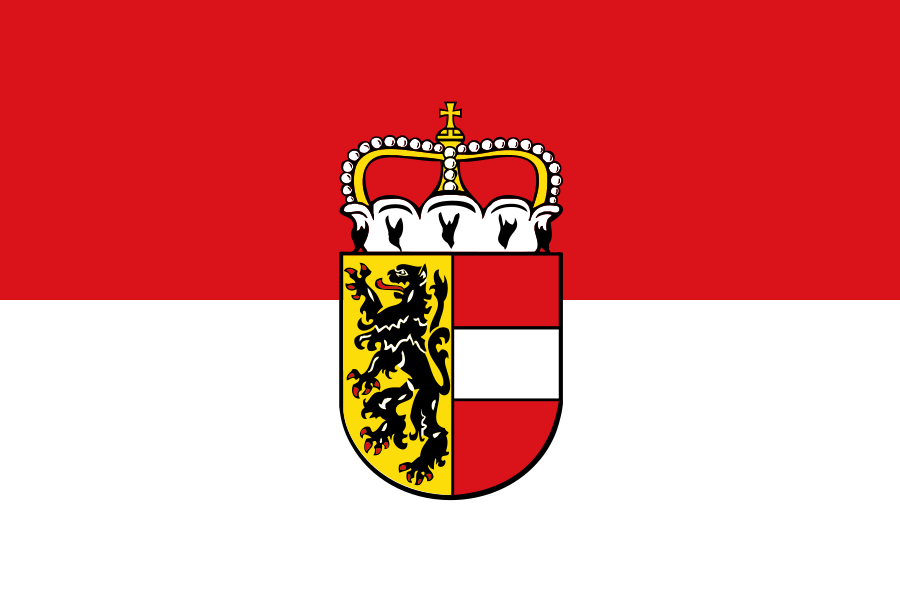
Salzburg at a glance
- Name
- Salzburg
- Country
- Austria
- Profile type
- Austrian federal state
- Administrative seat in source record
- Salzburg
- Northern landscape name
- Flagfish
- Hallein district
- Tennengau
- District of St Johann
- Pongau
- District of Zell am See
- Pinzgau
- District of Tamsweg
- Lungau
- Position of the capital
- Statutory city and its own political district
- Permanent affiliation with Austria
- Since 1816
- Urban World Heritage Site
- Historic centre of the city of Salzburg
- Famous son of the capital
- Wolfgang Amadeus Mozart
The Flag of Salzburg
The country flag shown has a red upper and a white lower stripe. In the middle is the crowned coat of arms. One half of the shield shows a black lion on gold, the other a white crossbar on red. The shield is thus divided into two differently designed fields.
This picture belongs to the federal state of Salzburg. A flag of the city of Salzburg can have other coat of arms details and is treated on its own city side. The same place names are not evidence of identical emblems. In the present selection, therefore, the land coat of arms and crown representation are expressly the relevant visible features.
Salzburg: Location and Territorial Role
The state of Salzburg is located in Austria and has the state capital of the same name in the north. This is at the same time a city with its own statute and its own political district. The city administration therefore performs tasks which fall elsewhere to a district head team; the rest of the federal province consists of other political districts.
The known landscape names are Flachgau, Tennengau, Pongau, Pinzgau and Lungau. They help to distinguish places and landscapes within the federal state. In the official administration there are also district names such as Salzburg environment, Hallein, St. Johann im Pongau, Zell am See and Tamsweg. The city of Salzburg is also to be considered separately.
Landscape, History and Culture
The northern Salzburg is connected with pre-alpine landscapes, while further south alpine valleys and high mountains determine the picture. The palates are therefore more than signposts to individual holiday resorts. They provide a spatial framework to understand the differences between the surroundings of the capital and intra-alpine regions.
Salzburg joined Austria permanently in 1816; the bicentenary was celebrated in 2016. Before that, his political history was about other dominion contexts. The former Prince-Bishopric explains the high rank of church and representative architecture in the capital. The history of the city and the history of the country are closely connected, but remain different levels of observation.
The historical centre of the city of Salzburg is located within the federal state, but does not cover its entire territory. The old town preserves developments from the Middle Ages to the nineteenth century. Italian architects influenced their Baroque appearance. This connection between northern and southern cultural currents is an important key to the historical position of Salzburg.
Five Landscape Names
Flachgau, Tennengau, Pongau, Pinzgau and Lungau provide a first orientation in the country. They should be learned together, instead of connecting the country name only with the city center. The capital forms a special administrative part, while for example Zell am See or Tamsweg are regional centers of other parts of the country.
Baroque capital
Vincenzo Scamozzi and Santino Solari are among the architects who shaped Salzburg’s baroque cityscape. The World Heritage honors a grown urban fabric. Its significance lies in the interplay of buildings and rooms, not only in a single cathedral, castle or particularly well-known photo motif.
Mozart and spatial accuracy
Wolfgang Amadeus Mozart is closely associated with the city of Salzburg. This cultural connection enriches the history of the federal state, but does not make every place in it a Mozart city. The distinction between city, district and country therefore also helps in accurately telling about famous personalities and cultural sites.
Explore this country and nearby profiles
 Austria
 Vienna
 Salzburg
 Graz
 Linz
 Innsbruck
 Burgenland
What did you discover?
Take this flag into the quiz
Sources and image credits
This English article draws on the institutional sources listed below. Figures and memberships retain their stated reference dates.
Source record: 2 November 2026. A translation does not change the reference date of a figure or membership list.
- salzburg.gv.at/sicherheit_/Documents/staatsbuergerschaftspruefung-geschichtesalzburg.pdf
- salzburgerland.com/de/das-salzburgerland/
- whc.unesco.org/en/list/784/