Quebec: Provincial Flag, Capital and Regional Profile
Québec designates both a Canadian province and its capital. The province is strongly influenced by the French language, the Saint-Lorenz area and widely spaced landscapes. Their Fleurdelisé flag shows white lilies and a white cross on blue. In addition to the fortified old town of the capital, the Miguasha fossil site tells a completely different geological history.
Test your knowledge →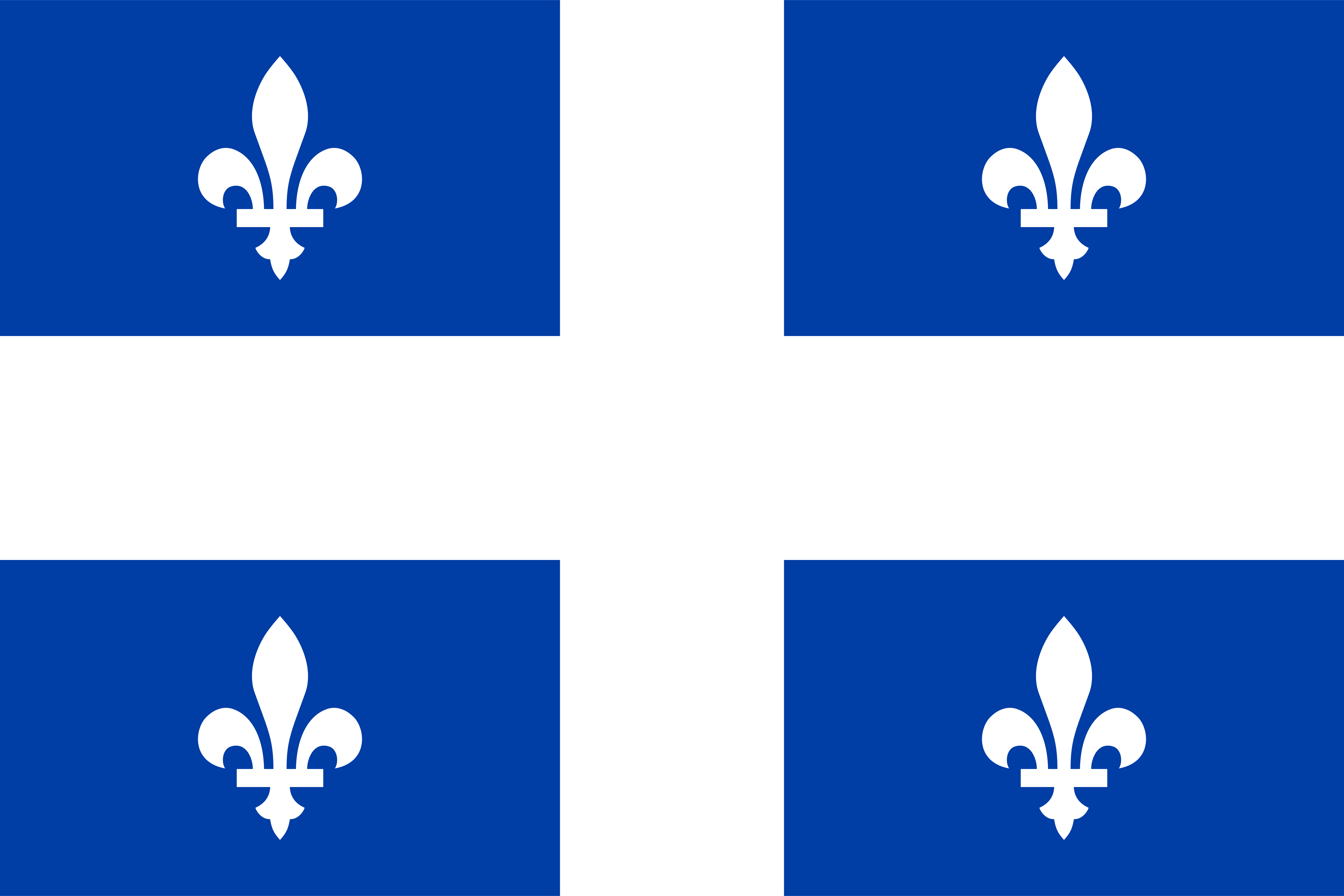
Quebec at a glance
- Name
- Quebec
- Country
- Canada
- Profile type
- Canadian province
- Administrative seat in source record
- Quebec City
- Provincial language
- French
- Origin of the name
- Constriction of the Saint-Lorenz River
- City of Québec founded
- 1608 by Samuel de Champlain
- Former name Montréals
- Ville-Marie, founded in 1642
- Old Town World Heritage Site
- Since 1985
- Fossil site
- Miguasha on the south coast of the Gaspé Peninsula
- Escuminac Formation
- About 370 million years old
- Flower emblem
- Iris versicolor, since 1999
The Flag of Quebec
A broad white cross divides the blue cloth into four fields. In each stands a white heraldic lily, each with its point upwards. This arrangement is called Fleurdelisé. It shows neither the Canadian maple nor the complete provincial heraldic shield and thus has a particularly clear visual language of its own.
On 21 January 1948, the Fleurdelisé was first hoisted as an official flag over the Parliament building. The elements pick up older French signs. Legends about the lily as a personal sign of early medieval kings are to be distinguished from this: they do not replace a secure explanation of the concrete flag decision of the 20th century.
Quebec: Location and Territorial Role
The provincial capital Québec and Montréal are different cities. Montréal emerged from the settlement of Ville-Marie, founded in 1642, while Samuel de Champlain founded the city of Québec as early as 1608. The St. Lawrence River is an important spatial reference point for this history of French colonization and the later development of the settlement space.
The provincial name is explained from an Algonkin expression for a narrowing or strait. Originally meant the constriction of the Sankt-Lorenz River near today's capital. Thus, the name refers to a specific geographical feature before it became the designation of a much larger political area.
Landscape, History and Culture
The historic old town of Québec includes Upper and Lower Town. Fortifications and city gates make their military and colonial past legible. UNESCO pays tribute to the interconnected urban fabric, not just an outstanding individual building. Since 1985, the historic quarter has been a World Heritage site and is jointly protected by several state levels.
The Gaspé Peninsula opens up a different perspective on the province. On its southern coast lies Miguasha, whose rocks preserve fossils from Devon. The Escuminac Formation is about 370 million years old. Especially the diversity and conservation of fish make the place important for the understanding of early vertebrates.
French is the sole official provincial language; however, this does not result in a linguistically uniform population. Indigenous communities are as much a part of history and present as English-speaking and other population groups. The legal system is also historically complex: French civil law exists alongside public law traditions of British origin.
Old town with fortifications
The World Heritage site in the capital preserves an exceptionally complete example of a fortified colonial city. Its value lies in the context of roads, buildings, upper city, lower city and defense installations. If you are only looking for individual sights, it is easy to overlook that these spatial relationships make up the protected ensemble.
Miguasha and the Devon
In Miguasha, the Escuminac Formation contains five of the six fossil fish groups important for Devon. The scientific significance therefore does not depend solely on individual conspicuous finds. Rather, the site allows to study the diversity and development of an entire earth-historical animal world in its geological context.
Plant and heraldic sign
The white lily of the flag is a stylized heraldic motif. The official flower emblem of the province, on the other hand, since 1999 is Iris versicolor, the different colored sword lily. This distinction between the coat of arms and actually certain plant species prevents a frequent confusion in questions about Québec's natural and state symbols.
Explore this country and nearby profiles
 Canada
 Toronto
 Vancouver
 Ontario
What did you discover?
Take this flag into the quiz
Sources and image credits
This English article draws on the institutional sources listed below. Figures and memberships retain their stated reference dates.
Source record: 2 November 2026. A translation does not change the reference date of a figure or membership list.
- quebec.ca/gouvernement/portrait-quebec/drapeau-symboles-nationaux/drapeau/histoire
- canada.ca/en/canadian-heritage/services/provincial-territorial-symbols-canada/quebec.html
- whc.unesco.org/en/list/300
- whc.unesco.org/en/list/686/
- patrimoine-culturel.gouv.qc.ca/rpcq/detail.do