Montenegro Flag, Capital and Country Facts
Montenegro connects a narrow Adriatic coast with high mountains and deep valleys inland. Podgorica is today's capital, while Cetinje has a special historical position as the ancient royal capital. The Bay of Kotor and the Durmitor Massif show two very different landscapes, which are close together within a comparatively small state.
Test your knowledge →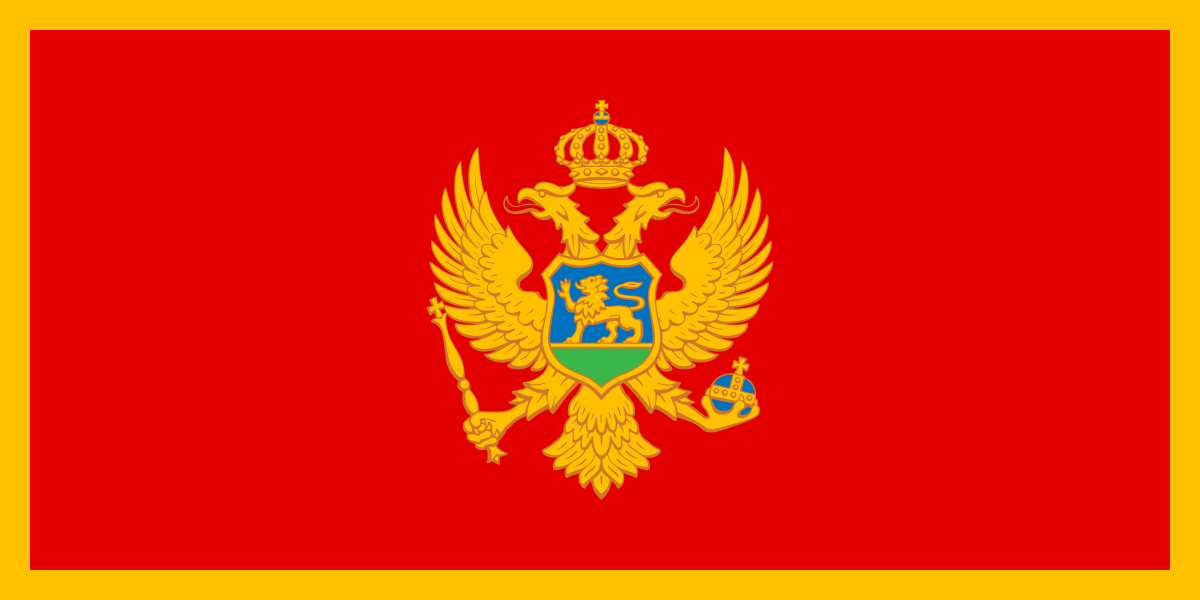
Montenegro at a glance
- Capital
- Podgorica
- Quiz continent
- Europe
- Languages in reference record
- Montenegrin; also Serbian, Bosnian, Albanian and Croatian in official use
- Currency
- Euro (EUR)
- Population
- 623,129 (2025, World Bank)
- Area
- 13,812 km²
- Coastal setting
- Not landlocked
- ISO codes
- ME / MNE
- Internet country suffix
- .me
- Independence
- 2006
- Ancient royal capital
- Cetinje
- Massif of mountains
- Durmitor
- Known gorge
- Tara canyon
- Border Sea
- Lake Skutari with Albania
- Coastal waters
- Adriatic Sea
Montenegro Flag: Design, Meaning and History
A golden bordered red cloth carries the coat of arms of the state in the middle. In it appears a golden double eagle with crown, sceptre and imperial apple. A lion is depicted on the breastplate. The golden border belongs to the flag motif and should not be confused with an additional horizontal stripe sequence.
Eagle and lion are based on the historical symbolism of Montenegro. The double eagle refers to a political and religious sign tradition; the crown reminds of monarchical history. The flag thus uses a coat of arms motif, although the present state is not a monarchy. The historical symbol and the present form of government must therefore be considered separately.
Capital: Podgorica
Podgorica is located in the southern inland near the confluence of Ribnica and Morača. The name means under the hill. The capital can be distinguished from coastal towns such as Kotor or Budva: the political center and most famous destinations are not in the same landscape, even if the distances within Montenegro are relatively small.
Cetinje retains the special status of the ancient royal capital. This historical role complements Podgorica’s current capital function. Whoever finds both names in sources, therefore, does not have to suspect any contradiction. These are different tasks within the same state history, similar to how former residences and present seats of government also retain importance elsewhere.
Practise this capital →Montenegro: Geography, History and Culture
The Adriatic coast is quickly transitioning into mountainous landscapes. The Durmitor area is characterized by high peaks, glacier tracks and deep river valleys. The Tara Canyon is one of its most famous forms. In the south-east, Lake Skutari lies on the border with Albania and complements the mountain landscape with a large cross-border inland water area.
UNESCO protects the Kotor Natural and Cultural Region as well as the Durmitor National Park. Kotor stands for a historic port city and its surrounding bay, Durmitor for an alpine landscape. Both together show why Montenegro should not be described only as a coastal country or only as a mountainous country: its special feature lies precisely in the close connection between the two spaces.
Montenegro became an independent state again in 2006 after a referendum. Montenegrin is an official language; other languages have legally recognized official uses. The means of payment is the euro. This does not lead to membership in the euro area: currency, European Union and state independence are different topics that should not be mixed on a learning side.
Kotor and its Bay
The UNESCO entry covers more than a single old town. The relationship between settlement, fortifications and surrounding landscape is essential; the bay provides the geographical framework for its historical role as a port and trading space.
Tara and Durmitor
The river has cut deep into the mountainous land. Together with the Durmitor Massif, it offers a counterpole to the Adriatic coast: water creates a gorge here, while at Kotor it shapes a historical port landscape.
Cetinje correctly classified
The old royal capital explains a frequent apparent contradiction of the capital. Podgorica is the answer in the quiz, Cetinje is nevertheless explicitly part of political history and has a special status; both data can therefore be true at the same time.
Explore neighbouring and related places
 Albania
 Bosnia & Herzegovina
 Croatia
 Serbia
What did you discover?
Sources and image credits
This English article draws on the institutional sources listed below. Figures and memberships retain their stated reference dates.
Source record: 2 November 2026. A translation does not change the reference date of a figure or membership list.
- github.com/factbook/factbook.json/blob/144d6977b2b01ac1cbd220de754c0a005616760b/europe/mj.json
- data.worldbank.org/indicator/SP.POP.TOTL
- whc.unesco.org/en/statesparties/me/
- github.com/mledoze/countries