Latvia Flag, Capital and Country Facts
Latvia lies on the Baltic Sea between Estonia and Lithuania. Flat landscapes, forests and rivers characterize the state; Riga is the most important center on the Daugava. The flag is carmine-white-carmine-red and at first glance resembles Austria's flag, but differs by the darker red and the narrower white middle stripe.
Test your knowledge →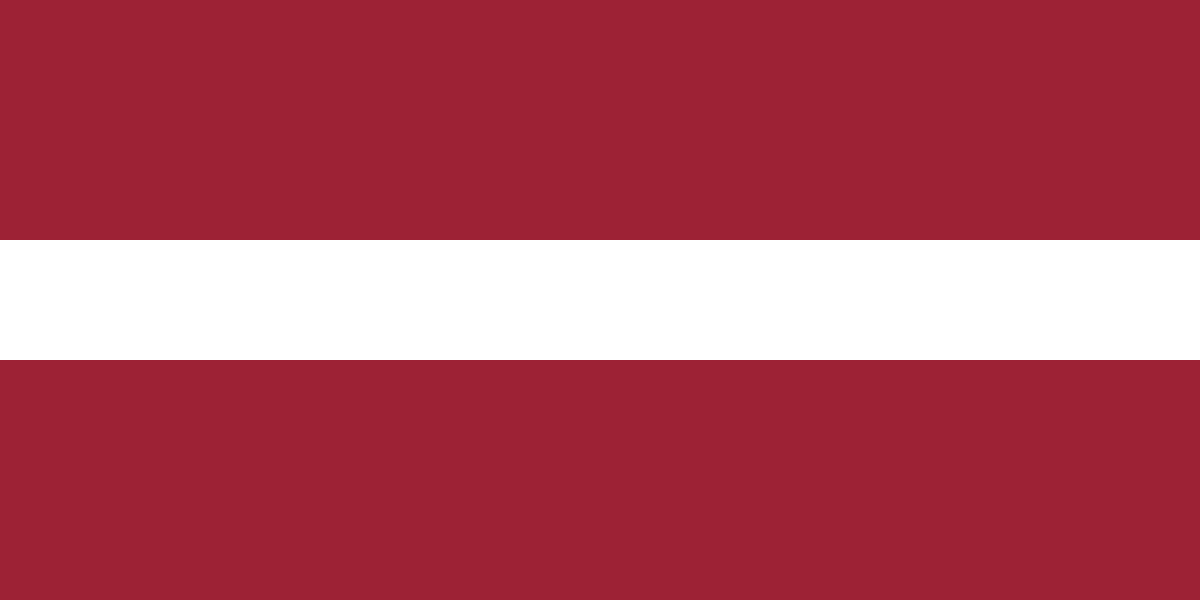
Latvia at a glance
- Capital
- Riga
- Quiz continent
- Europe
- Languages in reference record
- Latvian (official language); also, among others, Russian
- Currency
- Euro (EUR)
- Population
- 1,847,785 (2025, World Bank)
- Area
- 64,559 km²
- Coastal setting
- Not landlocked
- ISO codes
- LV / LVA
- Internet country suffix
- .lv
- Highest point
- Gaiziņkalns, approximately 312 m
- Capital river
- Daugava/Dune
- Sea bay
- Gulf of Riga
- Language group
- Baltic languages
- Flag stripes
- Height ratio 2:1:2
- Further city heritage
- Kuldīga, since 2023
Latvia Flag: Design, Meaning and History
The flag has two dark red outer stripes and a white middle stripe. The white is only half as high as any red stripe; the height ratio is 2:1:2. This narrow middle stripe and the crimson shade are the most important characteristics compared with Austria's equally wide red-white-red division.
The color sequence can be traced back historically: A medieval chronicle mentions a red banner with a white stripe around 1280. Today's flag is linked to this tradition. Stories that explain the red with a wounded leader belong to the realm of legend and should not be passed off as the sure origin of the concrete modern hue.
Capital: Riga
Riga is located on the Daugava near its mouth in the Gulf of Riga. The river is also called Düna in German. Its connection to the Baltic Sea region explains a large part of the historical trading function of the city. As the capital, Riga today concentrates central political and economic institutions and forms the most important urban area in Latvia.
The historic centre became a UNESCO World Heritage site in 1997. Medieval urban structures and later architecture make different phases of growth visible. The view of Riga should therefore not stop at a single old town view: port location, traffic routes and younger districts are also part of the development. The name of the capital is also a helpful reference point for the Gulf of the North.
Practise this capital →Latvia: Geography, History and Culture
Latvia consists mainly of lowland and gently moving mountain ranges. The Gaiziņkalns reaches about 312 meters according to the Factbook archive. The low maximum height clearly distinguishes the country from European Alpine states, but does not mean a uniform landscape. Forests, moors, lakes and river basins shape large parts of the country and change regionally in their distribution.
The Baltic Sea coast includes both the open sea in the west and the Gulf of Riga in the north. Latvia borders Estonia, Lithuania, Russia and Belarus. Its location thus connects the Baltic coastal area with an eastern inland country. The Daugava is a cross-border river and shows that watersheds do not end at political borders.
Latvian is one of the Baltic languages and is more closely related to Lithuanian than to Finnish-Ugric Estonian. This distinction is particularly instructive in the common term “Baltic states”: the regional summary does not mean a uniform language family. Russian is also common. Historical experiences and today's language conditions should be described in a differentiated way, without all people belonging to a single cultural group.
Kuldīga’
The old town of Kuldīga became a World Heritage Site in 2023. It complements the well-known Riga with another historical cityscape outside the capital.
Struve arc
Latvia participates in the cross-border World Heritage of the Struve arc. The measurement points stand for historical land surveying and scientific cooperation over long distances.
Baltic language
Latvian and Lithuanian belong to the Baltic language group. Estonian is linguistically different despite the geographical neighbourhood, which illustrates the difference between region and linguistic affinity.
Explore neighbouring and related places
 Belarus
 Estonia
 Lithuania
 Russia
What did you discover?
Sources and image credits
This English article draws on the institutional sources listed below. Figures and memberships retain their stated reference dates.
Source record: 2 November 2026. A translation does not change the reference date of a figure or membership list.
- github.com/factbook/factbook.json/blob/144d6977b2b01ac1cbd220de754c0a005616760b/europe/lg.json
- data.worldbank.org/indicator/SP.POP.TOTL
- whc.unesco.org/en/statesparties/lv/
- github.com/mledoze/countries