Israel Flag, Capital and Country Facts
Israel lies on the eastern Mediterranean between coastal plain, mountainous land and the dry landscapes of the Negev. The white-blue flag connects two stripes with the Star of David. Jerusalem is the seat of central Israeli institutions; its status is internationally controversial. A geographical introduction must therefore distinguish between actual administration, state claims and international legal recognition.
Test your knowledge →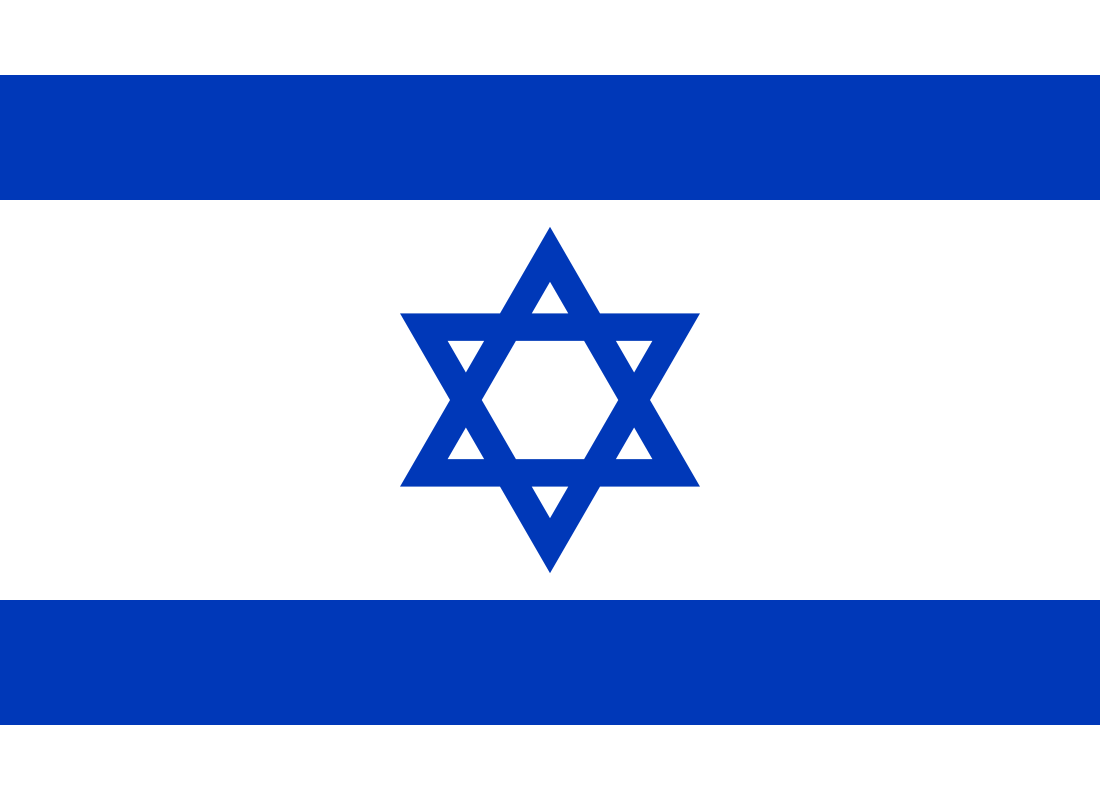
Israel at a glance
- Seat of government
- Jerusalem
- Quiz continent
- Asia
- Languages in reference record
- Hebrew; Arabic has a special legal status
- Currency
- New Israeli Shekel (ILS)
- Population
- 10,122,800 (2025, World Bank)
- Area
- 20,770 km²
- Coastal setting
- Not landlocked
- ISO codes
- IL / ISR
- Internet country suffix
- .il
- Southern landscape
- Negev
- Important lake
- Sea of Galilee
- Low-lying marine
- Dead Sea
- Establishment of the State
- 14 May 1948
- Parliament
- Knesset
- Flag symbol
- Six-pointed Star of David
Israel Flag: Design, Meaning and History
This question asks for the seat of the Israeli government in Jerusalem.
On a white background stand two horizontal blue stripes near the upper and lower edges. In between is a blue Star of David made of two interlaced triangles. The star is a hexagram with six tips. The white outer edges and the also white middle space belong to the design; they are not three equally wide stripes of color.
The motif is reminiscent of the Jewish prayer shawl Tallit. The Star of David was already a Jewish symbol before the founding of the state and became part of the state flag in 1948. The exact blue shading can vary in representations. For recognition, the two blue stripes and the six-pointed line sign are therefore more important than a certain screen color.
Seat of government: Jerusalem
The quiz asks for Jerusalem as the seat of government. Israel designates the city as its capital, and parliament and central government institutions are located there. This practical function must be distinguished from its international status: Israel’s claim to all of Jerusalem is not generally recognised internationally. The United Nations regards East Jerusalem as occupied Palestinian territory.
Jerusalem contains holy sites of Judaism, Christianity and Islam. Religious significance does not in itself determine state sovereignty. The United Nations treats the city’s final status as a matter for a political settlement. Tel Aviv is an important economic and cultural centre, but that does not make it the answer to this quiz’s government-seat question. Historical and present-day descriptions require particularly careful context here.
Practise this capital →Israel: Geography, History and Culture
Between the Mediterranean coast and the Jordan Trench, the relief changes over a short distance. To the south lies the dry Negev, while the north and the coastal region have different precipitation conditions. The room on the Dead Sea is below sea level. Especially water availability and altitude explain many differences between settlement and agricultural areas.
Hebrew is the main state language; Arabic has a special legal status. In addition, other languages are spoken through immigration and international connections. Religious affiliation, language and nationality are different categories. A representation of the country should therefore not condense them into a single description of the population or treat entire groups as politically uniform.
The founding of the state in 1948, wars, flight and expulsion as well as the unresolved Israeli-Palestinian conflict characterize the present. Basic geographical indications mentioned here are additionally based on the factbook archive status of 2025; controversial areas are not taken over unnoticed. UNESCO sites such as Masada, Akko and Tel Aviv’s White City also provide concrete insights into different historical epochs.
White City
Tel Aviv's White City is a UNESCO World Heritage Site. The entry documents modern architecture and complements the perception often focused on ancient sites.
Acre
The old town of Akko is on the World Heritage List. It reminds of the long history of fortified port cities on the eastern Mediterranean.
Masada
UNESCO runs Masada as its own cultural site. The place shows how closely ancient architectural history and the dry landscape on the Dead Sea are connected.
Explore neighbouring and related places
 Egypt
 Jordan
 Lebanon
 Palestine
 Syria
What did you discover?
Sources and image credits
This English article draws on the institutional sources listed below. Figures and memberships retain their stated reference dates.
Source record: 2 November 2026. A translation does not change the reference date of a figure or membership list.
- github.com/factbook/factbook.json/blob/144d6977b2b01ac1cbd220de754c0a005616760b/middle-east/is.json
- data.worldbank.org/indicator/SP.POP.TOTL
- whc.unesco.org/en/statesparties/il
- un.org/unispal/permanent-status-issues/
- unrwa.org/resources/fact-sheet/unrwa-installations-and-services-occupied-east-jerusalem
- github.com/mledoze/countries