Florence: City Flag, History and Identity
Florence is located on the Arno and is the capital of Tuscany. The city combines dense historical street spaces with an extraordinary concentration of art and architecture. Ponte Vecchio, Cathedral and Palazzo Vecchio are not isolated exhibits, but parts of a grown city. Her red lily on white is one of the most striking simple city flags in Europe.
Test your knowledge →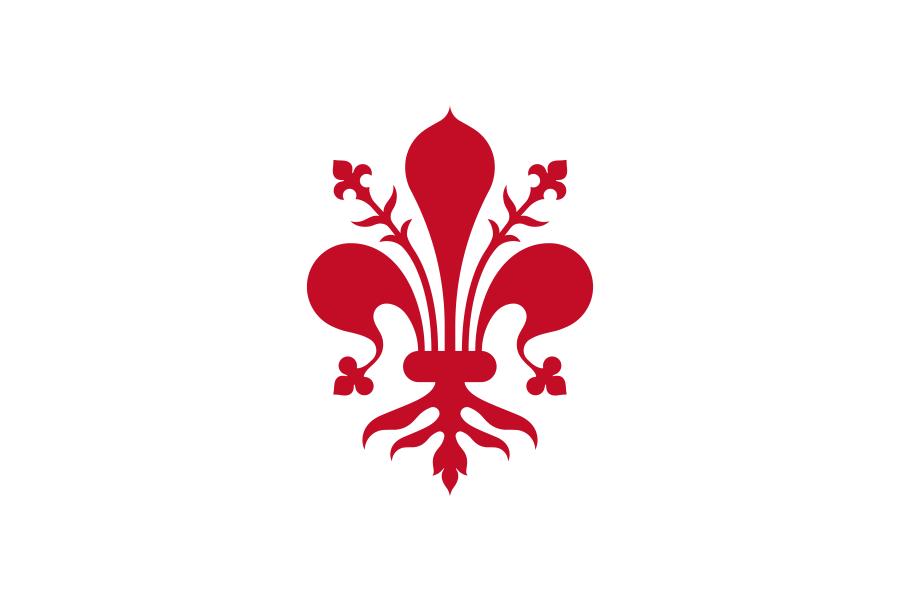
Florence at a glance
- Name
- Florence
- Country
- Italy
- Profile type
- City
- Urban river
- Arno
- Southern urban area
- Oltrarno’
- World Heritage Inspection
- Historical centre since 1982
- Main cathedral
- Santa Maria del Fiore
- Political place
- Piazza della Signoria
- Today's Ponte Vecchio
- 1345 completed
- Vasari Corridor
- 1565 built in.
- Goldsmiths on the Bridge
- Since 1593
The Flag of Florence
The flag shows the red Florentine lily on a white background. The sign is elaborately stylized and has lateral flower elements; it is not a natural plant drawing. Apart from the lily, the displayed file contains neither an additional heraldic shield nor writing. The clear relationship between white area and red motif is crucial for recognition.
The urban representation of symbolic history suggests that the origin of the lily is controversial. Frequently, a connection to white sword lilies of the environment is called. More certain is the historical reversal of the colors: the older white sign on red was replaced in the political context of the Guelphs and Ghibellines by the red lily on white.
Florence: Location and Territorial Role
Florence is located in central Italy on both sides of the Arno. The river separates and connects important urban areas. The southern shore is known as Oltrarno; it is home to Palazzo Pitti and the Boboli Garden. Bridges are therefore more than viewpoints: they are among the paths between political, economic and stately places of the historic city.
The center can be accessed via places and assemblies. Santa Maria del Fiore Cathedral represents a different part of the city’s history than Palazzo Vecchio in Piazza della Signoria. The Uffizi lies between this political center and the Arno. The spatial proximity explains why a short path can already make very different functions of the city visible.
Landscape, History and Culture
The Arno has repeatedly shaped the city by floods. The current Ponte Vecchio was built after the flood of 1333 and was completed in 1345. Her three arches and the side shops give her a special shape. As a result, the bridge is at the same time a traffic route, built-up business space and a place where the river landscape is experienced directly.
The historical center of Florence became a UNESCO World Heritage site in 1982. The justification highlights the extraordinary artistic development and importance of the Medici in the 15th and 16th centuries. This story is not limited to collections of paintings. It also stands out in churches, palaces, gardens and the relationships between the large buildings in urban space.
Above the Ponte Vecchio runs the Vasari Corridor. It was created in 1565 on behalf of Cosimo I as a link between Palazzo Vecchio and Palazzo Pitti. The building shows how the ruling family used existing urban structures for their own ways. Below the corridor, there was also a publicly used passage over the Arno.
Ponte Vecchio
The built-up sides distinguish this bridge from many other river crossings. Since 1593, the former meat and fish shops have been replaced by goldsmith shops. The combination of sales premises, public roads and the corridor above makes the building a particularly vivid example of how several urban functions can come together in a confined space.
Dome and Piazza della Signoria
The two areas open up different centers of power of historical Florence. At the cathedral religious representation and architecture are in the foreground, at Piazza della Signoria the political history of the city. Those who compare the two places recognize the importance of public spaces as stages of urban life and as connecting spaces between outstanding buildings.
Oltrarno and Palazzo Pitti
The path across the Arno leads to an area as important for the history of the residence as the northern center. Palazzo Pitti and Boboli Garden extend the idea of Florence to stately living and open spaces. With Ponte Vecchio and Vasari Corridor, they remain closely connected to the rest of the historic city.
Explore this country and nearby profiles
 Italy
 Rome
 Venice
 Milan
 Lombardy
 Sicily
What did you discover?
Take this flag into the quiz
Sources and image credits
This English article draws on the institutional sources listed below. Figures and memberships retain their stated reference dates.
Source record: 2 November 2026. A translation does not change the reference date of a figure or membership list.
- comune.firenze.it/system/files/2017-11/SIV%20Firenze_2014.pdf
- feelflorence.it/it/punti-di-interesse/ponte-vecchio-0
- whc.unesco.org/en/list/0174
- italia.it/it/toscana/firenze/cosa-fare/firenze-centro-storico
- commons.wikimedia.org/wiki/File%3AFlag_of_Florence.svg