Golf, Hotel and India: Signal Flags and Meanings
Golf and hotel form an easily noticeable pair on the pilot question, India supplements a change of course to port. But golf has an additional, precisely limited importance on fishing grounds. These three flags therefore show particularly well why letter, signal image and situation belong together: the same flag can carry a different message under specified conditions.
Test your knowledge →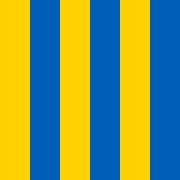
Key facts and distinctions
- Article focus
- International Code of Signals
- Learning distinction
- Sign, message and context are separate
- Gulf
- G; a pilot is required
- Gulf pattern
- Six vertical yellow and blue stripes
- Gulf for close fishing vessels on fishing grounds
- Nets are caught up
- Hotel
- H; a pilot is on board
- Hotel model
- Vertical white and red
- India
- I. Change of course to port
- Model India
- Black circle on yellow
- Port board
- Left side facing the bow
Gulf: pilotage requirements and the fisheries exemption
Golf consists of six vertical yellow and blue stripes. In the general single flag code, G indicates the need for a pilot. The signal thus says something about a desired service, not about the nationality of the ship or the training of its crew. A schematic translation such as help would be too unspecific, because the signal book provides other signs for general help.
An explicit exception concerns fishing vessels working close together on fishing grounds. In this context, golf means that nets are caught up. All parts of the restriction are important: vehicle type, spatial proximity and fishing area. This does not become a second meaning that any transmitter could freely choose. The exception also explains why shortened flag posters without context are unsuitable for more demanding quiz questions.
Hotel: The pilot is already on board
Hotel is vertically divided into a white and a red field. H reports that there is a pilot on board. So golf and hotel answer two different questions: Is a pilot needed, or is he already on the ship? This comparison can be remembered particularly reliably if the meanings as a need and an existing state are learned.
Hotel does not contain a request to all other ships and does not state that the ship operates a hotel. The spelling name is merely a unique name for H. This applies accordingly to Gulf and India: everyday meanings of the words and geographical associations do not explain their nautical individual signals. The linguistically conspicuous names are used for recognizing and spelling, while the message is fixed in the signal book.
India: Change of course to port
India shows a black circle on a yellow background. The single flag signal I indicates a change of course to port. Portboard is the left side of the ship when you look forward to the bow. So the reference point is the sending ship. For an observer on the shore or on an oncoming vehicle, his own left side must not take its place unnoticed.
The counterpart Echo denotes a course change to starboard. Together, the two directional flags can be practiced independently of the pilot signals. In a race, the same cloths can also have sporting rule meanings; this does not lead to a change in the international single flag code. Before the translation, there is therefore the question of whether an ICS signal, a race indication or merely a decoratively set flag alphabet is being considered.
Details Worth Remembering
Derogation with three conditions
The fishing significance of Gulf is linked to a described context. Anyone who memorizes only pilot requests or only nets knows only a part of the rule. A good question therefore explicitly states the context.
Request is not on board
Golf and hotel distinguish desire and existing condition. Precisely because both involve a pilot, they can be learned as a couple. The two different flags make the alternation between these statements visible.
A circle without directional image
The black circle of India does not contain an arrow. His connection with port is agreed and must be learned. The memory aid is the comparison with Echo, whose message denotes the opposite course change.
The illustrated signs and variants


Continue exploring
What did you discover?
Take this flag into the quiz
Sources and image credits
This English article draws on the institutional sources listed below. Figures and memberships retain their stated reference dates.
Source record: 2 November 2026. A translation does not change the reference date of a figure or membership list.
- govinfo.gov/content/pkg/GOVPUB-D5_300-PURL-LPS73101/pdf/GOVPUB-D5_300-PURL-LPS73101.pdf
- imo-epublications.org/content/books/9789280117387
- oceanservice.noaa.gov/education/dyw-blue-peter.html
- media.sailing.org/sailing/wp-content/uploads/2025/07/29083752/2025-2028-RRS-with-Changes-and-Corrections.pdf