Alfa, Bravo and Charlie: Signal Flags and Meanings
Alfa, Bravo and Charlie open the flag alphabet with three very different tasks: a reference to divers, a report of dangerous goods and an affirmative answer. In the International Signal Book, a single flag can represent a complete sentence. Color and shape help in recognition; the exact meaning is derived from the agreed signal system.
Test your knowledge →
Key facts and distinctions
- Article focus
- International Code of Signals
- Learning distinction
- Sign, message and context are separate
- Alfa
- Point A; water divers
- Alfa colours
- White and blue
- Alfa form
- Cut in at the fly edge
- Bravo
- Point B. Loading, unloading or transporting dangerous goods
- Bravo design
- Single colour red with dovetail
- Charlie
- Point C; affirmative answer
- Charlie stripe
- Blue–White–Red–White–Blue
- Group NCB
- Independent international emergency signal
Alfa: Diver as an invisible part of the location
Alfa is the white-blue letter flag A cut at the fly edge. Their single flag signifies a diver in the water and demands clearance at slow speed. The essential idea lies beneath the surface: the danger may not be visible at all from the observing ship. The signal therefore makes known an activity that does not explain the mere observation of the hull.
The well-known red diver flag with white diagonal stripe is another sign. It is not one of the 26 letter flags of this alphabet. Anyone who learns both pictures together under the keyword diving, should still be able to name them separately. Alfa combines the activity with a concrete internationally agreed message; the red-and-white motif must not simply be treated as a graphical variant of A.
Bravo: Report charge without claiming a fire
Bravo is a single-colored red dovetail flag. In the signal book, B indicates the picking up, extinguishing or transport of dangerous goods. The three activities are important. A short form such as loading explosives would be too narrow, because the code does not only mean this class of goods and not only the loading process. The flag informs about a property of the operation or cargo.
Bravo is different from Juliett. J concerns a fire in the case of a dangerous charge or its leakage; B does not claim such an event. For learning, this separation is particularly useful: two red or dangerous associations do not yet produce interchangeable signals. Cargo information and notification of a specific harmful event answer different questions about the same ship.
Charlie: a yes in the right context
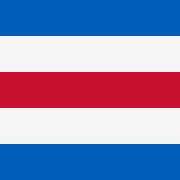
Charlie shows five horizontal stripes in blue, white, red, white and blue. The individual signal C signifies an affirmation. In the procedural context, it can also characterize the meaning of a preceding group in an affirmative manner. However, this does not result in a free grammar with which any individual flag signal could be changed by appending a C. The signal book expressly limits such additions.
The combination November via Charlie is a good counterexample to the spontaneous stringing of individual translations: NC is set as its own emergency group. You don't read it as a contradictory no-yes. Flags can be recognized as letters, but a coded bandage has its own meaning. Therefore, for a learning quiz, image recognition, individual meaning and reading of a group should each be treated as separate tasks.
Details Worth Remembering
Invisible activity
At Alfa, the decisive event is not the flag itself, but the diver under water. The picture is an indication of this hidden activity. This connection makes the signal more memorable than a mere list of letter and color.
Dangerous goods are a broader concept
Bravo describes several stages of handling dangerous goods. As a result, the meaning fits both to a transhipment process and to a journey with corresponding load. A fire is not a prerequisite for this message.
A code is not a picture puzzle
Charlie means yes as a single signal, but the letters of a signal group are not always translated individually. Exactly this difference explains why NC can carry a fixed emergency message and is not a linguistic contradiction.
The illustrated signs and variants

Continue exploring
What did you discover?
Take this flag into the quiz
Sources and image credits
This English article draws on the institutional sources listed below. Figures and memberships retain their stated reference dates.
Source record: 2 November 2026. A translation does not change the reference date of a figure or membership list.
- govinfo.gov/content/pkg/GOVPUB-D5_300-PURL-LPS73101/pdf/GOVPUB-D5_300-PURL-LPS73101.pdf
- imo-epublications.org/content/books/9789280117387
- oceanservice.noaa.gov/education/dyw-blue-peter.html
- nhc.noaa.gov/marine/outreach/Marine_Fact_Sheet.pdf