Azores: Regional Flag, Capital and Regional Profile
The Azores is an autonomous region of Portugal in the Atlantic Ocean with nine islands. Their blue-and-white flag connects a golden raptor with a star arc. The political institutions are also spread over several islands. Ponta Delgada is the seat of government, Horta the seat of parliament and Angra do Heroísmo is another important institutional place with its own historical significance.
Test your knowledge →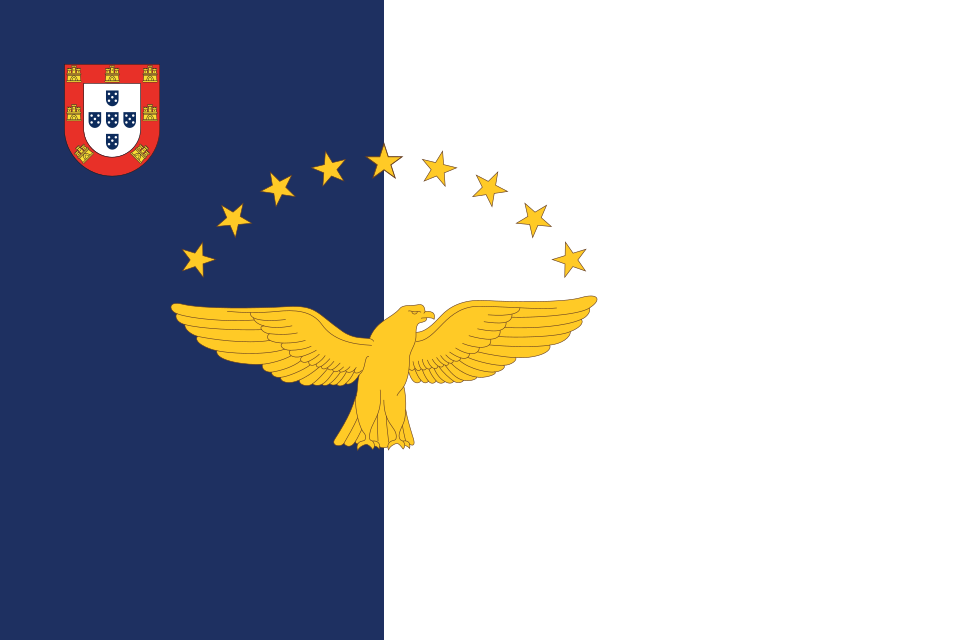
Azores at a glance
- Name
- Azores
- Country
- Portugal
- Profile type
- Autonomous region
- Administrative seat in source record
- Ponta Delgada
- Number of islands
- Nine
- Government Headquarters Island
- São Miguel with Ponta Delgada
- Parliament seat
- Horta on Faial
- Another institutional location
- Angra do Heroísmo in Terceira
- Angra World Heritage Site
- Historic Centre, since 1983
- Pico World Heritage Site
- Winegrowing landscape, since 2004
- Vineyard walls
- Predominantly of local black basalt
- Historic earthquake
- 1 January 1980 in Angra do Heroísmo
The Flag of Azores
On the mast is a dark blue field, on the right a wider white field. Above the dividing line appears a golden bird with spread wings. Nine golden stars form a semicircle above it. On the upper left is the Portuguese coat of arms. The flag is thus a regional sign with an explicitly visible connection to Portugal.
The bird is heraldically referred to as açor, i.e. hawk. The nine stars refer to the nine islands. The official flag dates back to the autonomy flag of the late 19th century and was adopted by law in 1979. An explanation of the island name about the bird regulations at that time should be separated from this, because popular name stories do not have the same evidential value.
Azores: Location and Territorial Role
The Government has its seat in the Palácio da Conceição in Ponta Delgada on São Miguel. The regional parliament sits in Horta on Faial. Angra do Heroísmo on Terceira also houses regional institutions and an official presidential seat. The simplified indication of a single capital would not adequately reflect this distribution of political tasks.
The group of islands includes Santa Maria, São Miguel, Terceira, Graciosa, São Jorge, Pico, Faial, Flores and Corvo. Names of cities and islands can be distinguished: Horta is a city on Faial, Angra do Heroísmo a city on Terceira. A journey or a geographical assignment can therefore designate the same places at different spatial levels.
Landscape, History and Culture
Angra do Heroísmo developed into an important intermediate stop for Atlantic shipping. The protected harbour, fortifications and a planned urban fabric explain its historical role. Despite the severe earthquake of 1 January 1980, the centre preserves significant parts of its architecture and the older road network, which were subsequently carefully repaired.
On Pico, small plots of wine with dark stone walls form an unusual cultural landscape. The walls consist mainly of local basalt and protect vines against wind and salty sea water. Their small-scale order makes visible how agriculture has been adapted to a volcanic and Atlantic-influenced environment, rather than completely reshaping it.
The World Heritage of the Azores thus comprises two very different testimonies of human work. Angras center tells of sea connections and urban development, the wine landscape of Picos of farming and local materials. In both cases, the spatial context is more important than a single monument: port and city or walls, plots and associated buildings form the actual ensemble.
Angra as a World Heritage City
Angras Centre has been on the UNESCO World Heritage List since 1983. Its fortifications flank a city whose importance was closely linked to the routes between continents. The historical role can be traced in the port location and floor plan, even after Angra had lost its former function as an international maritime transport hub.
Picos walled vineyards
The wine-growing landscape on Pico has been a World Heritage Site since 2004. Some walled parcels continue to be cultivated, others retain traces of abandoned use. This connection between living and historical cultural landscape is crucial. The protection is therefore also aimed at preserving traditional materials and economic methods that created the image in the first place.
Institutional seat in Angra
The Palácio dos Capitães Generais in Angra was originally intended as a Jesuit college. Today it belongs to the autonomous region and is one of its official presidential seats. Its history shows how buildings can take on new tasks over centuries, while its architecture continues to reveal the earlier stages of education, domination and regional self-government.
Explore this country and nearby profiles
 Portugal
 Lisbon
 Madeira
What did you discover?
Take this flag into the quiz
Sources and image credits
This English article draws on the institutional sources listed below. Figures and memberships retain their stated reference dates.
Source record: 2 November 2026. A translation does not change the reference date of a figure or membership list.
- portal.azores.gov.pt/en/web/comunicacao/bandeira_oficial2
- portal.azores.gov.pt/en/web/palacios-da-presidencia/palacio-dos-capitaes-generais
- alra.pt/index.php/c-moradas
- trails.visitazores.com/pt-pt/ilhas-acores
- whc.unesco.org/en/list/206/
- whc.unesco.org/en/list/1117