Botswana Flag, Capital and Country Facts
Botswana is located in southern Africa and has no marine access. Large dry rooms of the Kalahari stand opposite the water-rich Okavango Delta. This contrast explains much of the wildlife, settlement patterns and tourism. The light blue flag even places water at the center of its traditional symbolism.
Test your knowledge →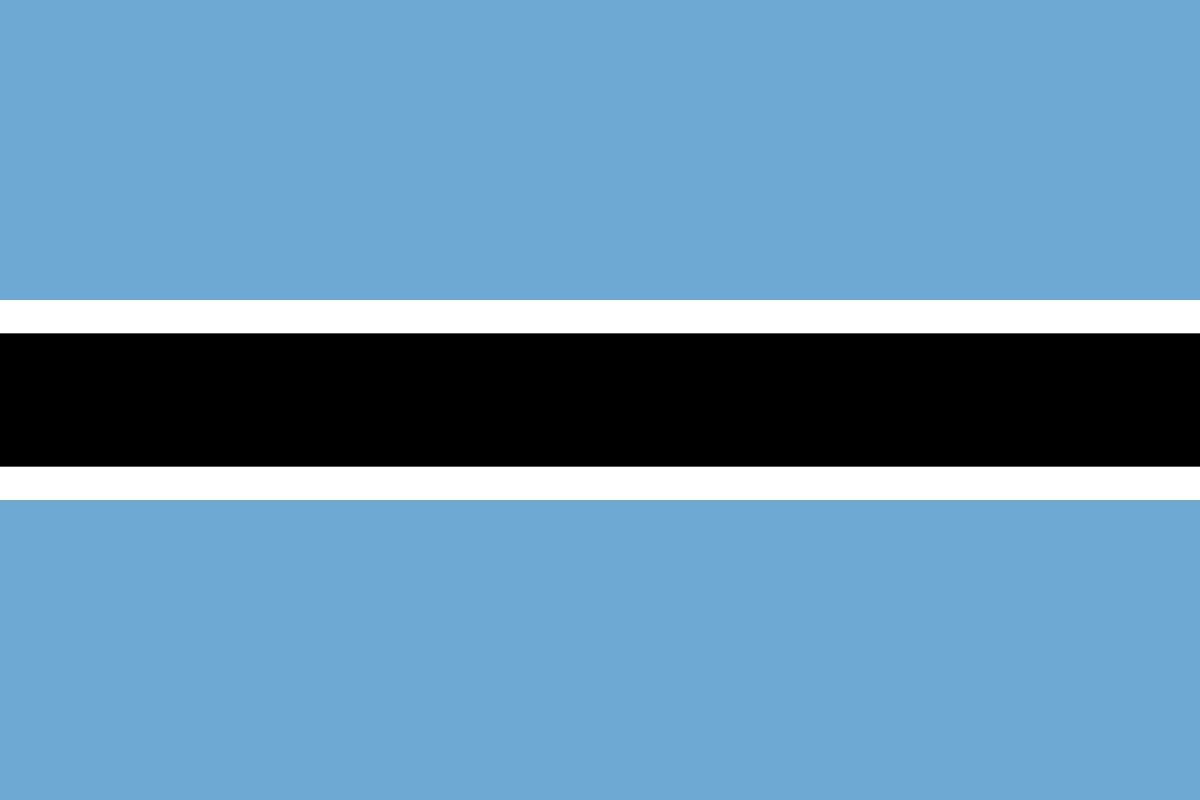
Botswana at a glance
- Capital
- Gaborone
- Quiz continent
- Africa
- Languages in reference record
- English (official language); Setswana and other languages
- Currency
- Pula (BWP)
- Population
- 2,562,122 (2025, World Bank)
- Area
- 582,000 km²
- Coastal setting
- Landlocked
- ISO codes
- BW / BWA
- Internet country suffix
- .bw
- Independence
- 30 September 1966
- Former name
- Bechuanaland
- Embossing drying chamber
- Kalahari
- Inland delta
- Okavango delta
- National symbol
- Zebra
- Cultural World Heritage Site
- Tsodilo, since 2001
Botswana Flag: Design, Meaning and History
A light blue field is crossed in the middle by a black horizontal stripe. Narrow white lines surround the black band at the top and bottom. The flag has neither coat of arms nor star. Especially the bright blue shade and the white-black middle band make them unmistakable within Africa.
According to the Factbook archive, blue stands for rainwater, the black and white stripes for the coexistence of different population groups. The water motif fits particularly well to a predominantly dry country. The flag thus uses a different color language than numerous African states with green-yellow-red pan-African combinations.
Capital: Gaborone
Gaborone is located in southeast Botswana near the border with South Africa. The capital bears the name of a Tlokwa leader. Its location belongs to the more densely populated eastern part of the country and differs significantly from the wide, sparsely populated areas of the Kalahari in the west.
As the capital of the independent state since 1966, Gaborone concentrates administration and economic services. The proximity to South Africa is more important for regional classification than the mere situation in southern Africa. The Okavango Delta is located far away in the northwest and is not the landscape that directly determines the capital area.
Practise this capital →Botswana: Geography, History and Culture
Botswana's terrain is mostly flat to gently corrugated. The Kalahari characterizes a large part of the national territory; dry does not mean that pure sand desert occurs everywhere. Semi-arid grassland and bushland are also part of the landscape. Precipitation and available water greatly affect where permanent settlements, livestock farming and other uses are possible.
In the northwest, the Okavango branches into an extensive inland delta. Its water does not reach an ocean, but is distributed in a dry inland space. This juxtaposition explains the extraordinary ecological importance of the delta. It is at the same time a clear counter-term to marine deltas such as that of Ganges and Brahmaputra in Bangladesh.
The former British Protectorate of Bechuanaland became independent on 30 September 1966 as Botswana. Setswana is widely used in everyday life, English serves as an official language. Diamond mining and nature tourism are among the economic fundamentals described in the Factbook archive. The country should therefore not be considered as a safari destination alone or exclusively as a raw material location; both areas use very different spaces.
Okavango delta
The Okavango Delta has been a UNESCO Natural Heritage Site since 2014. The entry represents an important wet habitat in an otherwise dry environment. For the understanding of the country, this contrast is more helpful than the blanket designation of Botswana as a desert state.
Tsodilo
Tsodilo has been a World Heritage Site since 2001. The hills are known for their rock art. In addition to natural areas, Botswana’s World Heritage Site also has a site that makes visible the human use and cultural significance of the landscape.
Zebra as a symbol
The zebra is one of the national symbols of Botswana. Its black-and-white pattern can be associated with the distinctive color combination of the flag. However, the animal itself does not appear on the national flag; in the quiz only the stripes can be recognized.
Explore neighbouring and related places
 Namibia
 South Africa
 Zambia
 Zimbabwe
What did you discover?
Sources and image credits
This English article draws on the institutional sources listed below. Figures and memberships retain their stated reference dates.
Source record: 2 November 2026. A translation does not change the reference date of a figure or membership list.
- github.com/factbook/factbook.json/blob/144d6977b2b01ac1cbd220de754c0a005616760b/africa/bc.json
- data.worldbank.org/indicator/SP.POP.TOTL
- whc.unesco.org/en/statesparties/bw
- github.com/mledoze/countries