Sydney: City Flag, History and Identity
Sydney is shaped by Port Jackson and its long history as a maritime place. The city history includes the Gadigal as well as the British colonial foundation and the later municipal administration. The richly illustrated city flag tells mainly about colonial officials and shipping; the history of the place goes back considerably further.
Test your knowledge →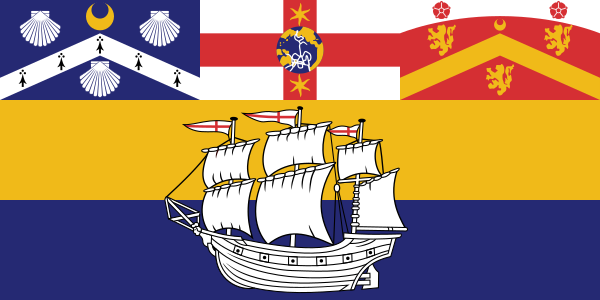
Sydney at a glance
- Name
- Sydney
- Country
- Australia
- Profile type
- City
- Port of Port
- Port Jackson, also Sydney Harbour
- Indigenous community in the local area
- Gadigal
- Gadigal Territory
- On the south side of the port
- Beginning of the British Penal Colony
- 1788
- Establishment of the municipality
- 1842
- Opera house architect
- Jørn Utzon
- Opera House Competition
- 1957
- Opera House as a World Heritage Site
- Since 2007
The Flag of Sydney
The flag is divided horizontally into white, golden yellow and blue. The upper zone bears three historical coats of arms; above the golden yellow and blue area lies a sailing ship with white sails. The ship extends over the golden yellow and blue surfaces. The combination of upper coat of arms and maritime scene makes the selected city flag unmistakable.
The city explains the upper zone with Thomas Townshend, after whom Sydney was named, the contribution of Arthur Phillips and the coat of arms elements of James Cook, as well as the first Lord Mayor Thomas Hughes. The ship points to the port. The flag takes up the older coat of arms; it is not a complete portrait of all population groups and historical layers.
Sydney: Location and Territorial Role
Sydney is located in the state of New South Wales on Australia's east coast. The name denotes in ordinary usage a large metropolis. The City of Sydney, on the other hand, is a certain municipal body at the core of this metropolitan area. Its flag belongs to this commune; it is not a flag of the entire state of New South Wales.
Port Jackson port forms the spatial key to the historic center. The bays and shores were settlement and meeting places long before European roads and administrative borders emerged. Subsequent changes to the boundaries of the City of Sydney also show why the extensive urban landscape cannot simply be equated with the jurisdiction of a single municipal council.
Landscape, History and Culture
The Gadigal are the original Aboriginal inhabitants of the area of today's City of Sydney. Their land stretched along the south side of the port from South Head to about today’s Petersham. The city assigns them to the Eora. This anchorage in the harbour space belongs to the geographical history of Sydney and not only to a distant prehistory.
The British penal colony was founded in 1788; Sydney was established as a commune in 1842. In between and afterwards, forms of administration and political responsibilities changed. The history of the municipal council is therefore its own chapter alongside the history of the entire settlement. The city explicitly points out that its borders have been altered by state governments.
The Opera House also makes the port a place of modern world architecture. Jørn Utzon’s design won the competition in 1957; the building was added to the UNESCO World Heritage List in 2007. Its sculptural roof shapes show how a cultural building can interact with its location on the water. It belongs to city perception, although the city flag uses a different visual language.
Opera House at the Port
The opera house combines architecture, engineering work and the public space on the waterfront. UNESCO recognizes it as an outstanding work of the twentieth century. Its roofs and its location can be viewed together: the building acts not only as a concert and theater venue, but also as a widely visible landmark.
Gadigal and Port Jackson
The official city history names the Gadigal and its territory on the south side of the port. This perspective complements the colonial names on the flag with a much older relationship between people and landscape. Port bays thus appear as part of an inhabited country whose history does not begin with European ships.
Municipal City History
The establishment of the Commune in 1842 is a different event than the arrival of the First Fleet in 1788. This distinction helps in reading historical city plans. It also explains why today’s City of Sydney has its own institutional history, while Sydney as a metropolis has outgrown many communal boundaries.
Explore this country and nearby profiles
 Australia
 New South Wales
 Victoria
What did you discover?
Take this flag into the quiz
Sources and image credits
This English article draws on the institutional sources listed below. Figures and memberships retain their stated reference dates.
Source record: 2 November 2026. A translation does not change the reference date of a figure or membership list.
- cityofsydney.nsw.gov.au/history/symbols-city
- cityofsydney.nsw.gov.au/history/history-city-sydney-council
- cityofsydney.nsw.gov.au/history/aboriginal-histories
- whc.unesco.org/en/list/166/
- commons.wikimedia.org/wiki/File%3ACity_of_Sydney_Flag.svg